


How Smart Ring Data Proves Wellness Fundamentals Work
How smart ring data proves the effectiveness of basic wellness practices.
How smart ring data proves the effectiveness of basic wellness practices.
%402x.svg)
For decades, wellness advice has floated in the realm of the abstract. "Get better sleep." "Manage your stress." "Listen to your body." It's well-intentioned, sound guidance, but it’s often met with a frustrated sigh. How? What does "better" sleep actually look like in my unique body? Is my stress "high" because of a tough day, or a chronic, silent issue? "Listening to your body" can feel like trying to decipher a foreign language without a translator.
This has created a gap—a credibility gap, even—between knowing what’s good for you and knowing it's working for you. We’ve been told to trust the process, to have faith in the fundamentals, without the tangible, personal evidence to fuel that trust. It’s why resolutions falter and why the latest health fad often overpowers the timeless, boring, but effective basics.
Enter the smart ring: a silent, continuous, and deeply personal translator for the language of your physiology. Worn on the finger, this unassuming device captures a torrent of biometric data—heart rate, heart rate variability (HRV), skin temperature, blood oxygen, and movement—through the night and day. It’s not just counting steps; it’s quantifying the very pillars of well-being: sleep quality, recovery, and stress resilience.
This article isn't about the technology for its own sake. It's about the revelation that comes from wearing it. It's about the moment the abstract becomes concrete. When you see a direct, quantifiable line on a graph connecting your 8 p.m. digital detox to a 12% increase in your deep sleep. When you observe your resting heart rate steadily declining over weeks of consistent morning walks. When you finally have proof that the glass of water and 10-minute meditation before bed did something measurable.
We are standing at a unique point in human history where personal, clinical-grade data is democratized. For the first time, we can move beyond generic advice and into the realm of personalized, data-validated proof. We can test the age-old wellness fundamentals not on a population level, but on a me level.
Over the next ~8,000 words, we will delve into the concrete evidence. We will explore exactly how the continuous data from a smart ring validates, illuminates, and reinforces the non-negotiable foundations of health. We will move from theory to proof, from hope to certainty. This is where wellness meets its verdict, delivered not by a guru, but by the undeniable signals of your own body.

The journey to optimal well-being has long been a path walked by feel, guided by vague sensations and retroactive assessments. "I slept pretty well last night." "I think I'm less stressed than I was last month." "I feel run down." This subjective landscape is where good intentions go to die, lost in a fog of imprecision. The rise of the "Quantified Self" movement promised clarity, but early tools often delivered more noise than signal—step counts that ignored quality, sleep trackers that confused stillness with rest.
The modern smart ring represents the maturation of this movement. It shifts the paradigm from quantifying activity to quantifying state. It’s less about what you do and more about how your body responds to what you do. This is a seismic change. By moving the sensor to the finger—a vascular-rich area with minimal motion artifact during sleep—these devices gain a 24/7 window into your autonomic nervous system (ANS), the unconscious control center for recovery, stress, and restoration.
The Data Triad: HRV, RHR, and Body Temperature
At the core of this insight are three interlinked metrics:
This continuous data stream transforms wellness from a philosophy into a science—a personal, *n-of-1* science. You are no longer comparing yourself to population averages. You are building a detailed map of your own normal. With this map, you can run experiments. Does a 4 p.m. coffee truly disrupt my sleep architecture? Does a 20-minute yoga session calm my nervous system in a measurable way? The ring provides the objective feedback, turning guesswork into gravitas.
The true power lies not in a single night's data, but in the trends. It’s the longitudinal view—the story told over weeks and months—that validates the fundamentals. It shows you the cumulative reward of consistency, making the invisible, visible. As we proceed, we'll see how this foundational data layer applies directly to each pillar of wellness, providing the proof that has been missing for so long.
If wellness were a hierarchy of needs, sleep would be the unshakeable base. We know it's critical for cognitive function, emotional regulation, immune defense, and metabolic health. Yet, it remains the most commonly sacrificed element of modern life. Why? Because its degradation is often slow, and its profound impact feels intangible… until you start tracking it with a device that measures what matters.
A smart ring doesn't just tell you you slept for 7.5 hours. It deconstructs that time into a rich narrative of your night, validating or refuting your morning gut feeling.
Architectural Proof: Seeing Your Sleep Blueprint
Advanced sleep staging—tracking light, deep, and REM sleep—is where data gets compelling. The fundamentals tell us we need ample deep sleep (for physical restoration) and REM sleep (for memory consolidation and emotional processing). Your smart ring shows you exactly how much you're getting.
Beyond Staging: The Silent Signals
The ring’s true advantage is capturing what happens between the stages:
This objective feedback loop is transformative. It turns "I should get to bed earlier" into "When I am in bed by 10:30 p.m., my deep sleep increases by an average of 25%, and my next-day readiness score is consistently above 85%." It replaces guilt with insight, and hope with strategy. For a deeper dive into constructing this impeccable sleep architecture, our guide on the natural sleep foundation building blocks of great rest explores the essential habits that your ring data will soon validate.
Stress is not an emotion; it is a physiological state. For centuries, we've relied on subjective feelings of being "overwhelmed" or "anxious" to identify it, often missing the low-grade, chronic variety that wears us down silently. Recovery, its essential counterpart, has been even more elusive. How do you know if you're truly recovered from yesterday's workout, work crisis, or poor night's sleep?
The smart ring, through its continuous ANS monitoring, illuminates this invisible battlefield. It provides a real-time, objective stress score and a concrete recovery metric, creating a dialogue between your lifestyle and your body's capacity to handle it.
HRV: The North Star of Recovery
Your Heart Rate Variability is your body's most honest readout of recovery status. When your body is well-recovered and resilient, your parasympathetic nervous system is dominant, leading to higher HRV. When you are stressed, fatigued, fighting illness, or overreaching, the sympathetic ("fight-or-flight") system takes precedence, lowering HRV.
The Daytime Stress Graph: A Mirror to Your Life
Many smart rings generate a continuous stress graph throughout the day. This is where cause and effect become stunningly clear.
This visibility is the first step toward agency. You can't manage what you can't measure. By making the invisible waves of stress and recovery visible, the smart ring transforms them from abstract concepts into manageable metrics. It proves that the fundamental act of taking a break, breathing deeply, or prioritizing downtime isn't a luxury; it's a non-negotiable physiological reset, and now you have the data to back it up. To understand how your recovery needs can shift over time, consider reading about better sleep naturally through seasons of life, which explores adapting these fundamentals as your body and circumstances change.
The fitness world has long been dominated by a "more is better" and "no days off" mentality. This approach brutally ignores a fundamental truth: your body's readiness to perform varies daily. Pushing through fatigue is not virtuous; it's a fast track to injury, burnout, and diminished returns. The smart ring, by prioritizing readiness over arbitrary activity goals, ushers in a new era of intelligent, responsive movement.
The Readiness Score: Your Daily Prescription
A composite score derived from your sleep, HRV, RHR, and temperature data, your "Readiness" or "Recovery" score is your body's frank assessment of its capacity for stress—physical or mental. It answers the critical question: "How hard should I push today?"
Activity Autoregulation: Data-Driven Movement
This creates a dynamic, autoregulated approach to fitness:
This cycle proves that sometimes the most productive thing you can do for your fitness is to rest. It validates the fundamental importance of deload weeks, active recovery, and the profound fitness benefits of quality sleep. You will see direct correlations: a week of prioritizing sleep often leads to a new personal best, not because you trained harder that week, but because you recovered better.
The Cardio Fitness (Vo2 Max) Trend
Many rings estimate your cardio fitness level (VO2 Max) over time. This number is a powerful long-term validator. Seeing this score gradually improve is not just a result of your workouts; it's the result of the entire ecosystem of wellness fundamentals—consistent sleep, balanced nutrition, managed stress, and smart training—all working in concert. The ring proves that fitness isn't built just in the gym; it's built in the kitchen, the bedroom, and the moments of calm you create throughout your day.
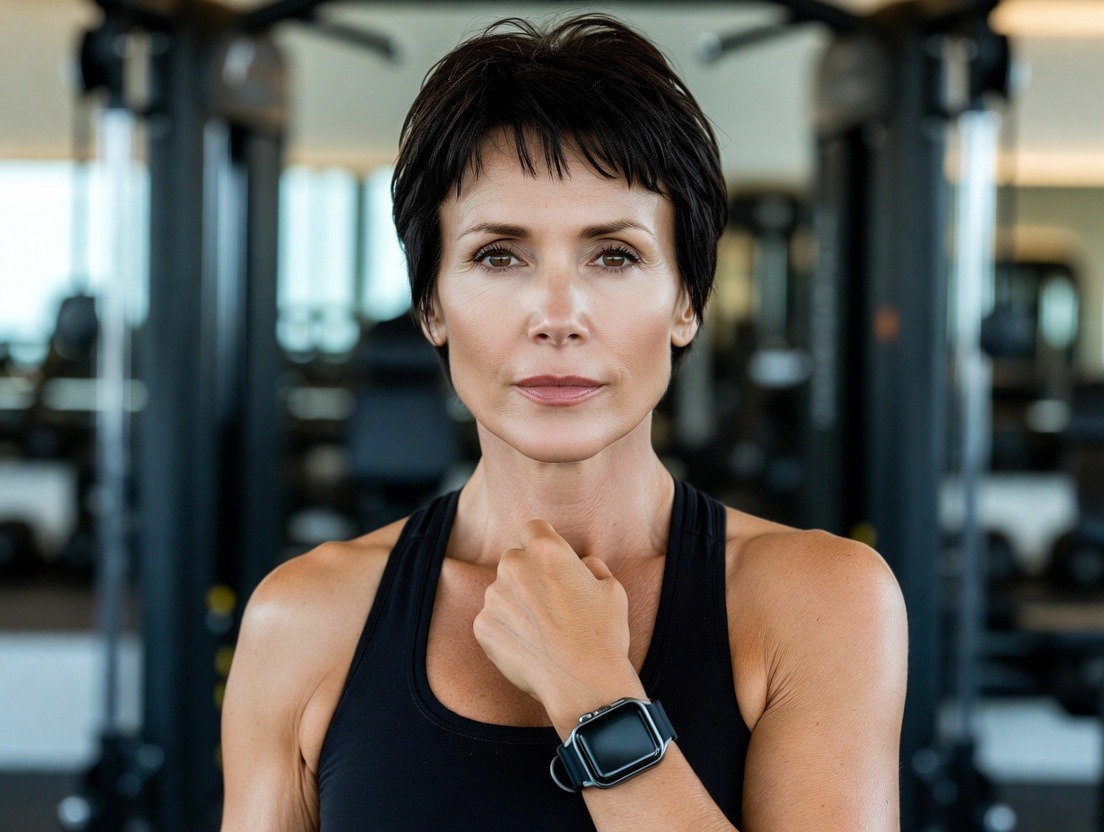
For half the population, a critical layer of wellness fundamentals has been navigating the monthly hormonal cycle with little more than a calendar and intuition. The smart ring’s continuous core temperature tracking (via the finger) has catalyzed a quiet revolution, providing women with unprecedented, objective insights into their cyclical biology and proving that syncing life with your cycle isn't a trend—it's science.
Basal Body Temperature (BBT), Perfected
Traditional BBT tracking requires taking your temperature at the exact same moment upon waking, with extreme precision, before any movement. It's prone to error. A smart ring automates this perfectly, taking thousands of temperature readings throughout the night and establishing a hyper-accurate baseline. This allows for the clear identification of:
Validating Cycle-Syncing Fundamentals
With this precise map, women can now see the physiological impact of cycle-syncing principles:
Beyond Fertility: A Holistic Health Dashboard
This tracking is invaluable far beyond family planning. It provides a long-term health log that can:
The ring transforms the menstrual cycle from a mysterious, often frustrating monthly event into a legible, predictable rhythm. It proves that the female body doesn't have one static "normal," but a dynamic, intelligent pattern. Honoring that pattern with tailored fundamentals isn't optional; it's the key to unlocking consistent energy, performance, and well-being all month long.
The age-old question, "What should I eat?" is met with a cacophony of conflicting answers. Nutrition fundamentals can feel infuriatingly generic: "Eat whole foods," "Avoid late meals," "Stay hydrated." The problem is bio-individuality—what fuels one person may disrupt another. Smart ring data cuts through the noise by showing you not what you should do, but what your body is actually doing with the choices you make.
The Nightly Report Card on Your Dinner
Your most powerful nutritional experiments are conducted at dinner, and the results are published in your overnight biometrics.
Hydration & Biomarkers
Dehydration is a silent performance killer and stressor. A fundamental like "drink more water" finds proof in the data:
Caffeine & Alcohol: The Quantified Impact
No two substances are more perfectly measured by a smart ring than caffeine and alcohol.
This transforms nutrition from a dogmatic set of rules to a personal exploration. You become a scientist, with your body as the laboratory and your ring as the measurement tool. The fundamentals provide the hypothesis ("eating earlier should improve my sleep"), and the data delivers the verdict. This evidence-based approach fosters a healthier, more curious relationship with food, rooted in self-awareness rather than restriction.
The most fundamental rhythm of all is not your menstrual cycle or your workout schedule—it's your circadian rhythm. This ~24-hour internal clock, governed by light exposure, regulates everything from hormone release and metabolism to sleep-wake cycles and cognitive performance. "Get morning sunlight" and "avoid blue light at night" are not just wellness tips; they are instructions for keeping this master clock in sync. A smart ring provides the first-ever personal dashboard to see if you're in tune or out of sync.
Body Temperature Rhythm: The Gold-Standard Proxy
Your core body temperature has a distinct circadian wave—lower at night to facilitate sleep, rising in the morning to promote wakefulness. The smart ring's continuous temperature tracking plots this wave for you.
HRV & RHR Diurnal Patterns
Your autonomic nervous system follows a circadian pattern too. Typically, parasympathetic (rest-and-digest) activity dominates at night, with a sympathetic (fight-or-flight) shift in the morning to prepare for the day.
Validating Light Exposure Fundamentals
This is where data meets the most powerful circadian lever: light.
By mapping your circadian rhythms, the smart ring elevates wellness from a checklist of habits to an exercise in biological timing. It proves that when you do things—sleep, eat, exercise, see light—is often as important as what you do. Aligning with your clock isn't poetic; it's performative, and now you can track the performance in real-time.
One of the most profound validations of wellness fundamentals is their role in preventing sickness. But what about when an illness begins despite your best efforts? Here, the smart ring transforms from a wellness coach into a sophisticated early warning system, proving that your body sends signals long before you feel symptoms—signals that fundamentals like rest are not just preventative, but critically responsive.
The Deviations from Baseline
Your ring's power lies in its deep knowledge of your personal, established baselines for metrics like resting heart rate, HRV, and skin temperature. Illness, even a mild one, is a massive physiological stressor that disrupts this baseline.
The "Sickness Detection" Feature
Many advanced rings now synthesize these signals into a direct "Sickness Alert" or "Incident Detection" notification. This isn't a guess; it's an algorithm recognizing a statistically significant deviation across multiple biomarkers. Getting this alert is a powerful moment—it's your body, via data, telling you to slow down.
Validating the Ultimate Fundamental: Rest
This is where the data provides incontrovertible proof for the most basic wellness commandment: rest when you're sick.
This capability profoundly changes your relationship with your health. It fosters a proactive, rather than reactive, approach. You learn to trust the data's whisper before the symptom's shout. It proves that the fundamentals of listening to your body and honoring rest are not weak or indulgent; they are the most intelligent strategies for resilience, backed by the clearest biological evidence imaginable. Understanding this data starts with knowing what you're looking at; a resource like sleep tracking metrics decoded: what each number means can help build that foundational literacy.
The mind-body connection is the cornerstone of holistic wellness, yet for centuries it existed in the realm of philosophy and anecdote. Meditation, breathwork, and mindfulness were "good for you," but how good? What does "calming the nervous system" actually look like in hard data? The smart ring brings this esoteric concept into the realm of empirical evidence, providing stunning, real-time validation of the power of mental practices.
Direct ANS Feedback: Seeing the Shift
Every thought and emotion has a physiological correlate. Anxiety increases heart rate and muscle tension. Calm slows the breath and promotes parasympathetic activity. The smart ring's PPG sensor acts as a window into this process, measuring the downstream cardiovascular effects of your upstream mental state.
Stress Resilience: Building Capacity Over Time
The true power of these practices isn't just in the acute session, but in the long-term training effect—a fundamental known as building "stress resilience."
This quantification demystifies mindfulness. It removes the "woo-woo" barrier for the data-driven individual. When you can see the line on the graph move in direct response to your intention, the mind-body connection stops being a theory and starts being a tangible, usable tool. It proves that training your mind is as concrete, measurable, and impactful as training your body. To explore a structured approach to integrating these validated habits, a better sleep naturally: your 12-week transformation plan can provide a foundational framework.

At the heart of every wellness fundamental is a single, unglamorous requirement: consistency. We know this intellectually. But knowing and feeling are different. The "why" behind consistency often gets lost in the daily grind, leading to the "what's the point?" feeling that breaks streaks and dissolves habits. Smart ring data is the ultimate antidote to this. It provides the visceral, visual, and rewarding "why" by showing you the compound interest of your daily deposits into your health.
The Compound Interest Graph of Your Health
Financial compound interest is powerful because you can watch the number grow. Health compound interest has been invisible—until now.
Positive Reinforcement Loop
This visible progress creates a powerful positive feedback loop, which is the engine of sustained habit formation:
This is far more effective than relying on willpower or distant goals like "lose 10 pounds." The reward is immediate (the data insight) and intrinsically linked to the action. The ring turns the vague promise of "feeling better someday" into the concrete reality of "see how much better you recovered last night."
Breaking the "All-or-Nothing" Cycle
Perfection is the enemy of consistency. Data is compassionate. It shows you that 80% consistency yields 80% of the results. If you have a late night, the data might show a poor recovery score. But by the next night, implementing your fundamentals again, you can see your body bounce back. This proves that wellness is not a streak to be broken, but a dynamic balance to be managed. It encourages you to get back on track immediately, because you can see the track and know exactly what getting back on it does for you.
In essence, the smart ring makes consistency its own reward. It proves that the boring, daily fundamentals are not boring at all—they are the individual brushstrokes that, over time, paint the masterpiece of your own vibrant health.
A sophisticated critic of wearables might raise a valid point: “Correlation is not causation.” Just because your deep sleep increased the night after you started using blue-light blocking glasses doesn’t prove the glasses were the cause. Perhaps you were simply more tired, or you also went to bed earlier, or it’s a random fluctuation. This is where the smart ring transitions from a passive observer to an active tool for personal discovery, enabling you to run your own single-subject experiments to move beyond correlation and establish personal causation.
The N-of-1 Experiment Framework
The ring empowers you to become a scientist of your own life. The classic, “Try it for yourself and see how you feel” is replaced with a structured, data-driven methodology:
Case Study: The Late-Night Meal Test
Controlling for Placebo
The objectivity of biometrics cuts through the placebo effect. You might believe a new supplement will boost your energy, but if your HRV trends downward and your resting heart rate increases—classic signs of physiological stress—the data tells a different story. Conversely, you might be skeptical of a 10-minute meditation app, but if it consistently elevates your HRV score post-session, you have objective proof of its tangible effect, independent of your beliefs.
This ability to test fundamentals transforms them from received wisdom to personal truth. It builds a wellness protocol that is uniquely and irrefutably yours. You are no longer following a guru; you are following the evidence generated by your own physiology. This is the ultimate proof—not from a study of 10,000 people, but from the most important study of all: the study of you.
Wellness fundamentals are often framed as a way to look and feel better now. But their most profound impact is longitudinal—they are the tools that shape the trajectory of your healthspan. A critical flaw in our healthcare model is the definition of "normal" based on population averages for your age. If the average 50-year-old has a resting heart rate of 72, that becomes the clinical benchmark. But what if your personal data shows you can maintain a resting heart rate of 58? The smart ring allows you to escape the tyranny of the average and build a personal, optimal baseline that defies age-related decline.
Biomarkers of Aging, Tracked in Real-Time
Several metrics tracked by smart rings are direct biomarkers of biological, not just chronological, aging:
The "Healthspan Dashboard"
This long-term view transforms the app from a daily coach into a healthspan dashboard. You're no longer just asking, "How did I sleep last night?" You're asking, "How is my sleep quality trending over the last five years?" The answers provide profound proof:
This capability validates the most fundamental wellness principle of all: that daily choices compound over a lifetime. The ring makes the compounding visible. It redefines "aging well" not as the absence of disease, but as the active preservation of function, as measured by your own, personal, optimal data. It proves that you are not a passenger on the train of time; you are the engineer, with direct levers to control its speed and destination. To understand the starting point for building this lifelong data asset, our sleep tracking 101: everything beginners need to know offers the perfect foundation.
We began by acknowledging the credibility gap in wellness—the chasm between knowing the fundamentals and knowing they work for us. We've journeyed through how the continuous, nuanced biometric data from a smart ring bridges that gap, turning abstract principles into personal, visual, and indisputable proof.
From the architectural blueprint of our sleep to the silent waves of our stress, from the rhythmic dance of our circadian biology to the early whispers of illness, the data provides a translation. It decodes the ancient, instinctual language of the body into a modern dialect of graphs, scores, and trends. We have seen how it:
This is not about becoming obsessed with numbers or outsourcing intuition to a device. It is about informing intuition with evidence. It’s about creating a collaborative partnership between you and your body’s own data. The fundamentals—sleep, nutrition, movement, stress management—haven't changed. Their truth is timeless. What has changed is our ability to see that truth manifest in our own biology, in real-time.
The smart ring does not invent wellness; it illuminates it. It proves that the path to better health isn't a mystery shrouded in guesswork, but a journey that can be mapped, measured, and mastered with the light of personal data. We are no longer walking the path in the dark. We have a lantern, and its beam is cast by the very rhythms of our own beating hearts.
The proof is in the data. You’ve seen your HRV climb with consistency, watched your deep sleep solidify with an earlier dinner, and felt the validation of a readiness score guiding a rest day. But a critical juncture now arrives: the transition from observation to integration. Data is meaningless without interpretation, and interpretation is useless without action. The true power of smart ring insights isn’t in creating a new obsession with nightly scores, but in weaving data-driven wisdom seamlessly into the fabric of your daily life, creating a sustainable, responsive, and empowered approach to well-being.
From Reactive Tracking to Proactive Ritual
The initial phase of wearing a smart ring is often reactive—checking the app each morning to see “how you did.” The goal is to evolve beyond this. The data should inform the creation of proactive, non-negotiable daily rituals that make the “good scores” inevitable, not surprising.
This shift turns data from a report card into an architect’s blueprint. You are no longer graded by the ring; you use its intelligence to construct your day.
Developing Your "Bio-Intuition"
The ultimate aim is for the external data to refine your internal sense—your bio-intuition. Over months of correlation, you begin to internalize the signals.
The ring trains your perception. It calibrates your internal gauges. The data becomes less about constant checking and more about having educated your own senses. You graduate from needing the dashboard for every turn to having a deeply informed sense of the road.
The Balanced Mindset: Avoiding Data Anxiety
This integration requires guarding against its shadow: data anxiety. The pursuit of perfect scores can become a new source of stress, ironically tanking the very metrics you're trying to improve.
Integrating data wisdom means letting the ring be a guide, not a god. It provides the evidence, but you remain the author of your story, using that evidence to write a better one. For those looking to systematically build these life-integrated habits, a structured approach like a better sleep naturally: your 12-week transformation plan can provide the scaffold to turn data insights into automatic rituals.

Armed with personal proof and a mindset geared toward integration, the next step is to synthesize your learnings into a dynamic, living document: your Personal Wellness Protocol (PWP). This is not a rigid set of rules, but a flexible playbook based on your unique data. It answers the question: “What does my body need, and when?” Here’s how to build it.
Phase 1: The Discovery Month (Weeks 1-4)
Phase 2: The Foundational Experiment (Weeks 5-8)
Phase 3: The Nutritional Layer (Weeks 9-12)
Phase 4: The Activity & Recovery Audit (Weeks 13-16)
Phase 5: Synthesis & Refinement (Ongoing)
This protocol is alive. It evolves with new data, life changes (new job, travel, training for an event), and seasonal shifts. It is the ultimate expression of data-verified wellness: a set of principles, personalized and proven, that you can trust because you built the evidence yourself.
Wellness fundamentals are often personal battles fought in private. The smart ring introduces a powerful, yet nuanced, social and psychological layer: the potential for shared accountability and data-informed community. This external dimension can profoundly reinforce internal commitment, turning private proof into shared progress.
The Accountability Partner 2.0
Sharing your wellness journey moves from vague promises (“Let’s try to sleep better this month”) to objective, data-backed commitments.
The Pitfall of Comparison
This social layer has a critical danger: biometric comparison. Your friend’s HRV baseline of 80 ms and your baseline of 50 ms is not a judgment. Genetics, age, fitness history, and countless other factors make individual baselines incomparable.
Data-Verified Community Wisdom
On a broader scale, anonymized, aggregate data from user communities is already revealing powerful insights about human health. Learning that “70% of our users see a 15% or greater improvement in sleep score when implementing a digital sunset” is a powerful reinforcement of that fundamental. It adds the weight of collective proof to your personal proof.
This social dimension validates a core psychological fundamental: we are more likely to succeed with support. The smart ring provides a new, objective language for that support, making it more specific, actionable, and effective. It transforms wellness from a solitary pursuit into a potentially connected, evidence-based journey.
As we embrace this new era of data-verified wellness, it is imperative to view it with clear eyes. The smart ring is a revolutionary tool, but it is not a medical device, and its insights exist within a complex ethical and technological landscape. Acknowledging its limitations is not a critique, but a mark of sophistication, ensuring we use this power wisely.
Understanding the Technical Limits
The Ethical Considerations: Data Ownership and Privacy
The Future: Predictive Analytics and Integrated Ecosystems
Looking forward, the convergence of continuous biometrics, artificial intelligence, and personalized medicine will deepen the proof.
Navigating this future requires a balanced perspective: profound optimism for the tools, tempered with rigorous ethics and self-awareness. The goal is not to create a generation of people enslaved to their data, but a generation empowered by it, using it to live with more agency, vitality, and proof than ever before.
We stand at the end of one exploration and the beginning of a new practice. The journey through the data has revealed a fundamental shift in the contract we hold with our own well-being. For millennia, this contract was based on faith, folklore, and the delayed, often ambiguous, feedback of how we felt. Today, it can be rewritten in the clear, objective language of our own physiology.
The Old Contract: Trust these generic rules. Hope they work for you. Use vague feelings as your only metric. Defer to external authorities for your health narrative.
The New Contract, Verified by Data:
The smart ring, and the data it provides, does not replace wisdom, intuition, or the profound importance of professional medical care. It informs them. It grounds them in evidence. It turns the art of living well into a science—a personal science—where you are both the subject and the scientist.
The ultimate proof that wellness fundamentals work is no longer found solely in population studies or ancient texts. It is found in the quiet, consistent pulse of your heart rate variability as you sleep. It is in the steady decline of your resting heart rate over months of consistent movement. It is in the deep, restorative sleep graph earned by a mindful evening. This proof is personal, it is powerful, and it is now accessible.
Your Trusted Sleep Advocate: Sleep Foundation — https://www.sleepfoundation.org
Discover a digital archive of scholarly articles: NIH — https://www.ncbi.nlm.nih.gov/
39 million citations for biomedical literature :PubMed — https://pubmed.ncbi.nlm.nih.gov/
Experts at Harvard Health Publishing covering a variety of health topics — https://www.health.harvard.edu/blog/
Every life deserves world class care :Cleveland Clinic - https://my.clevelandclinic.org/health
Wearable technology and the future of predictive health monitoring :MIT Technology Review — https://www.technologyreview.com/
Dedicated to the well-being of all people and guided by science :World Health Organization — https://www.who.int/news-room/
Psychological science and knowledge to benefit society and improve lives. :APA — https://www.apa.org/monitor/
Cutting-edge insights on human longevity and peak performance:
Lifespan Research — https://www.lifespan.io/
Global authority on exercise physiology, sports performance, and human recovery:
American College of Sports Medicine — https://www.acsm.org/
Neuroscience-driven guidance for better focus, sleep, and mental clarity:
Stanford Human Performance Lab — https://humanperformance.stanford.edu/
Evidence-based psychology and mind–body wellness resources:
Mayo Clinic — https://www.mayoclinic.org/healthy-lifestyle/
Data-backed research on emotional wellbeing, stress biology, and resilience:
American Institute of Stress — https://www.stress.org/


