


The Wearable Wellness 101 Guide to Avoiding Data Overwhelm
Advice on how to avoid becoming overwhelmed or anxious by the constant stream of health data.
Advice on how to avoid becoming overwhelmed or anxious by the constant stream of health data.
%402x.svg)
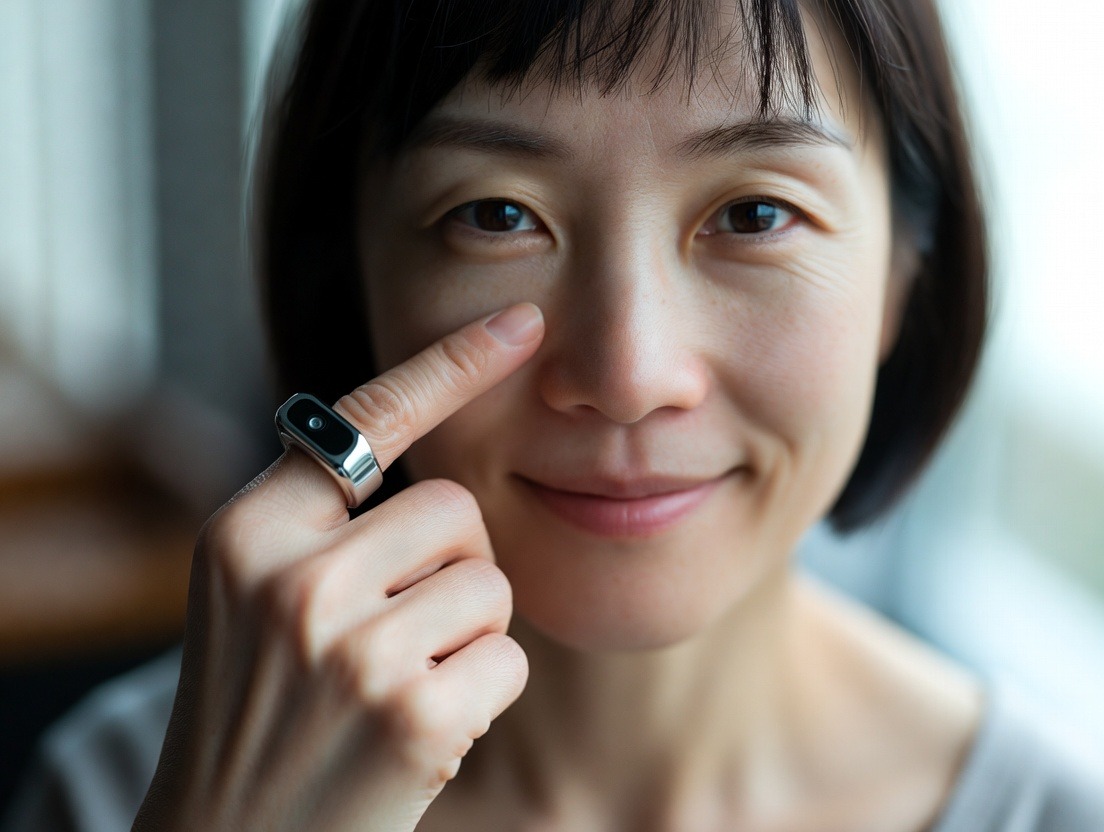
Your smart ring glows softly on your finger. Your fitness tracker buzzes silently on your wrist. Your phone pings with a notification: “Your heart rate variability is 12% lower than yesterday. Consider a recovery day.” You glance at the sleep score on your bedside table: 72. “Fair.” You feel a pang of anxiety. Last night was 89. “Excellent.” What did you do wrong? As you brew your coffee, you open three different apps, each telling a slightly different story about your readiness, stress, and activity goals for the day. By the time you sit down to work, you’re already exhausted, not from living, but from measuring your life.
Welcome to the paradox of modern wellness technology. We invested in these sleek, powerful devices—smart rings, watches, and sensors—with a beautiful promise: self-knowledge. They would be our guides, our impartial coaches, our windows into the hidden rhythms of our bodies. Instead, for many, they’ve become a source of a new, insidious stress: data overwhelm.
This is the constant, low-grade noise of too many metrics, conflicting interpretations, and the compulsive need to “close the rings” or “hit the target” at the expense of listening to our own flesh and blood. It’s the obsession with a sleep score that ruins a perfectly good morning. It’s the guilt from a missed step goal that overshadows a day of meaningful mental work. It’s the confusion when one device says “strained” and another says “productive.” We’ve traded intuitive living for analytical paralysis.
But what if it didn’t have to be this way? What if your wearable could truly serve as a tool for empowerment, not anxiety? What if the data could flow around you like a gentle stream, rather than at you like a firehose?
This guide is your roadmap out of data overwhelm and into a state of informed calm. This isn’t about ditching your technology. It’s about mastering it. We’re going to deconstruct the flood of information from devices like the Oura Ring, Whoop, Apple Watch, and Garmin, and rebuild a personalized, sustainable relationship with your data. We’ll move from being a passive consumer of numbers to becoming an active, wise interpreter of your own story.
The goal is not a perfect score. The goal is a profound understanding. It’s using technology to support a lifestyle of restful living, where data informs decisions but never dictates your peace. Imagine ending your day not with a judgment, but with a compassionate insight. Imagine your wearable whispering useful cues, not blaring alarmist alerts. This is the art of wearable wellness, and it begins by turning down the volume so you can finally hear the signal.

We live in the age of quantification. For the first time in human history, we can track our heartbeats per minute, the milliseconds between them (HRV), our core body temperature deviations, our blood oxygen levels during sleep, and the precise duration of every sleep stage. This is miraculous. It’s also, for our ancient, analog brains, utterly overwhelming.
Data overwhelm is the psychological and emotional state that occurs when the volume, velocity, and complexity of information from our devices exceed our capacity to process it meaningfully. It’s not just having a lot of data; it’s the stress that arises from feeling obligated to do something with it all, coupled with the confusion of not knowing what to do.
Why Does This Happen?
The consequence of this overwhelm isn’t just frustration; it’s a phenomenon called “wearable burnout.” People either become compulsively addicted to checking and optimizing, leading to orthosomnia (an unhealthy obsession with perfect sleep data), or they completely disengage, tossing the expensive device in a drawer, declaring the whole endeavor useless. Both outcomes represent a failure of the technology to serve human needs.
Escaping this paradox requires a fundamental mindset shift. Your wearable is not a report card. It is not a boss. It is not a doctor. It is a data-gathering tool. Its job is to collect. Your job is to interpret, contextualize, and act—with compassion and intelligence. The first step to ending the overwhelm is to recognize its source, not in the device itself, but in our unexamined relationship with it. As you begin to design a more restful living philosophy, you'll find that the data can start to serve that calm, rather than shatter it. In fact, taking a restful living assessment can be a powerful first step to understanding your baseline before the data even comes into play.
To understand our fraught relationship with wearables, we must look inward, to the very wiring of our human psychology. The compulsion to check our sleep score, the dopamine hit from a “100%” readiness, the sinking feeling from a “red recovery”—these aren’t accidental. Wearable tech taps into deep, primal psychological drivers, and when left unchecked, they can easily steer us toward anxiety.
The Dopamine Loop of Gamification
At its core, most wellness tech is a brilliantly designed game. It uses the core principles of gamification: goals (close your rings, hit your sleep score), rewards (badges, streaks, “optimal” labels), and instant feedback. Every time you check your app and see a green “Good” or a completed circle, your brain releases a small hit of dopamine, the neurotransmitter associated with pleasure and reinforcement. This is the same mechanism behind social media likes and video game achievements. We get hooked on the pursuit of the next “win,” turning our health into a daily performance metric. The problem arises when life inevitably interferes—a sick child, a stressful work project, a social event—and we “break the streak.” The dopamine disappears, replaced by a sense of failure. We’ve been conditioned to feel bad about natural life variability.
The Illusion of Control and Predictive Anxiety
In an uncertain world, our wearables offer a tantalizing promise: control. If we can measure it, we can manage it. This appeals to our deep-seated desire for predictability and safety. We start to believe that by perfectly adhering to our device’s recommendations, we can stave off illness, guarantee energy, and optimize our performance. This creates what psychologists call “predictive anxiety.” We begin to worry about tomorrow’s scores today. “If I don’t fall asleep by 10:15 PM, my deep sleep will be ruined, and my readiness will be low, which means I’ll have a bad day.” The device transitions from a reflective tool to a predictive oracle, and our peace becomes contingent on its algorithmic forecasts.
The Quantified Self vs. The Felt Self
This is perhaps the most profound psychological rift. The “Quantified Self” is the digital avatar built from your data: a collection of graphs, numbers, and trends. The “Felt Self” is your lived, embodied experience: your energy, your mood, your intuition, your subtle aches and comforts. Data overwhelm occurs when the Quantified Self hijacks the narrative from the Felt Self.
You might feel energetic, joyful, and rested, but if your device shows a low HRV and a poor sleep score, you start to doubt your own perception. “Maybe I’m not as good as I feel?” Conversely, you might feel groggy and off, but see a score of 85, and think, “I must be lazy or imagining it.” This erodes self-trust, our most fundamental wellness tool. The goal of intelligent wearable use is not to let the Quantified Self override the Felt Self, but to create a dialogue between the two. When they align, it’s powerful confirmation. When they conflict, it’s a critical invitation to ask “Why?”—not to automatically assume the data is the ultimate truth.
By recognizing these psychological traps—the dopamine chase, the control illusion, and the Felt Self betrayal—we can begin to interact with our devices consciously. We can appreciate the gamification without being enslaved by it. We can use predictions as gentle guides, not absolute fate. And we can always, always, privilege the wisdom of the body in the present moment. This conscious approach is a cornerstone of a sustainable practice, much like the intentional design of a restful living workspace supports productivity without burnout.
Faced with a dashboard of 20+ metrics, from heart rate and HRV to skin temperature, sleep stages, SpO2, and “activity load,” the natural question is: “Which of these should I actually care about?” The answer is both simple and complex: It depends entirely on your personal goals and current life context. Trying to optimize everything at once is the fast track to overwhelm. The key is to practice selective attention.
Let’s demystify the most common wearable metrics, categorizing them not by their technical brilliance, but by their actionable insight for different wellness goals.
Tier 1: The Foundational Biometrics (The Big 3)
These are your non-negotiables, the core vitals that provide a high-level overview of your system’s state. Think of them as your body’s daily weather report.
Tier 2: The Contextual Insight Metrics
These metrics explain why your Tier 1 numbers might be where they are. They add the “story” to the foundational data.
Tier 3: The Behavioral Input Metrics
These are the metrics you directly control through your choices. They are the “levers” you pull.
The Liberation of Focusing on Just 1-2 Metrics
Here is the anti-overwhelm prescription: For the next 30 days, ignore everything except your Tier 1 metrics and one contextual metric relevant to a single goal. Are you trying to improve recovery? Watch HRV and sleep consistency. Worried about burnout? Watch RHR and daytime stress scores. Investigating energy slumps? Watch sleep duration and deep sleep trends.
This focused lens transforms the dashboard from a chaotic stock ticker into a simple, clear story about one chapter of your health journey. It allows you to build intuition and see cause and effect without the distraction of a dozen other graphs. This principle of focused attention is also vital for preventing the mental drain of decision fatigue, which can be exacerbated by constant data monitoring.

Before you look at another chart or set another goal in your app, you must answer the most important question: Why are you wearing this device?
If your answer is vague—“to be healthier,” “to optimize,” “to get better sleep”—you are adrift in a sea of data without a compass. A generic “why” leads to generic tracking, which inevitably leads to overwhelm because you have no filter for what’s important. Every metric screams for equal attention. A powerful, personal “why” acts as that filter. It dictates what you look at, what you ignore, and how you interpret the information.
Moving Beyond Vanity Metrics
Steps and calories burned are classic “vanity metrics.” They are easy to measure and gamify but offer shallow insight into true health. 10,000 steps in a stressed, sleep-deprived state is not equivalent to 7,000 steps from a place of vitality. Your “why” should push you toward quality metrics over quantity metrics.
Crafting Your Personalized Wellness “North Star”
Take a moment to reflect. What is the primary area of your life or well-being you want this technology to support? Be specific. Here are some examples of powerful, personalized “whys”:
The Quarterly “Why” Check-In
Your “why” is not set in stone. Life changes. Priorities shift. A best practice is to conduct a quarterly “Why Check-In.” Sit down, review your original intention, and ask:
This ritual ensures your wearable serves you, not the other way around. It turns the device into a tailored instrument for your evolving life. This intentional approach mirrors the philosophy behind creating a restful living weekend—a deliberate pause to reset and refocus on what truly matters, rather than being swept along by constant activity (or data streams).
In the world of wearable data, there is no “good” or “bad” in absolute terms. There is only “you” and “not you.” The single most powerful concept to defeat overwhelm and gain true insight is establishing your personal baseline. Your baseline is your unique fingerprint of health—the range within which your body naturally operates when it’s in a relatively stable, healthy state.
Why is this so critical? Because without it, you are interpreting your data against a fictional, often inappropriate, standard. The device’s green/yellow/red zones are based on population averages. Your 8 hours of sleep might be a “10” for you but register as “fair” on a generic scale. Your HRV of 40 might be your robust, healthy normal, while trying to force it to 70 could drive you to madness.
How to Establish Your True Baseline (The 30-Day Observation)
The Power of Deviations, Not Absolute Numbers
Once your baseline is set, the magic happens. You stop caring about the absolute number and start observing deviations from your norm. This is where the data becomes a powerful diagnostic tool.
This shift in perspective is liberating. You are no longer a student failing a test graded on a curve. You are a detective, observing the clues of your own biology. A deviation is not a judgment; it’s a conversation starter. It prompts the gentle question: “What’s different?” The answer might be an extra glass of wine, a tough conversation, an intense workout, or the early sniffles of a cold. This level of self-knowledge is profound and is a key component of restful living measurement, where you track progress in peace, not in panic.
For smart ring users (like Oura, Ultrahuman, RingConn), the night is where the most rich and nuanced data is harvested. While watches track your day, rings excel at capturing the restoration of your night. But a sleep dashboard can be a minefield of overwhelm if you don’t know how to read the story. Let’s translate your nocturnal data into actionable wisdom.
Sleep Scores: The Composite, Not the King
Your total sleep score (e.g., 82/100) is a useful headline, but never let it be the only thing you read. It’s a composite algorithm weighing duration, efficiency, timing, and stages. A “low” score could be due to one bad factor or several moderate ones. Always drill down. Did you get 7.5 hours but have low efficiency? That points to restlessness. Did you have great efficiency but only 6 hours? That’s a story of insufficient opportunity.
The Sacred Timeline: Bedtime and Wake Time Consistency
This is arguably the most powerful lever you have for sleep health, and it’s beautifully tracked by your ring. Your circadian rhythm thrives on predictability. A consistent bedtime and wake time (even on weekends, within 60 minutes) does more for sleep quality and daytime energy than any supplement or hack. Your ring will show you your “sleep midpoint.” Aim to keep this as stable as possible. A wildly shifting midpoint is a surefire way to feel jet-lagged even if you never leave your home.
Sleep Stages: Trends Over Truth
Consumer devices use accelerometers and heart rate patterns (photoplethysmography or PPG) to estimate sleep stages. They are good at distinguishing Wake, Light, and Sleep (combining Deep and REM), but the distinction between Deep and REM has margins of error. Therefore:
The Vital Signs of the Night: HRV, RHR, and Temperature
Putting It All Together: A Nocturnal Story
Instead of scanning individual numbers, learn to read the night as a narrative. For example:
This narrative approach turns a list of numbers into a understandable report on your recovery bank account. It directly informs how you can structure your next day to support, rather than drain, your system—a principle that is vital for high-performing individuals like entrepreneurs building sustainable businesses.
While you sleep, your ring assesses recovery. While you’re awake, it measures engagement. The daytime data—often called “Activity,” “Strain,” “Stress,” or “Readiness to Perform”—tells the story of how you spend your energy. The art of avoiding overwhelm here lies in understanding the dynamic balance between exertion and restoration. This is the core rhythm of sustainable wellness.
Activity Scores and Exercise Load: Not All Movement is Equal
Your device likely gives you an overall “Activity” score or quantifies your training with an “Exercise Load.” This is usually a combination of volume (duration) and intensity (heart rate elevation). The key insight is to see this number not as a standalone goal to maximize, but as an input that must be matched with an output (recovery).
Daytime Stress/Strain Metrics: Listening to Your Nervous System
Many advanced devices now offer a continuous “stress” or “strain” score throughout the day. This is an algorithmic interpretation of your heart rate and HRV patterns while awake. A high score doesn’t mean you’re having a bad day emotionally (though that can contribute); it means your nervous system is in a state of high arousal or “sympathetic drive.”
The “Productive” vs. “Destructive” Stress Distinction
Not all stress is bad. A high strain score during a fulfilling workout, an engaging creative session, or a joyful social event is “productive” stress—a challenge that leads to growth and adaptation. A similarly high score from sitting in traffic, doomscrolling news, or a toxic work meeting is “destructive” stress—a drain with no adaptive benefit.
Your wearable can’t tell the difference. You must. This is where the “Felt Self” dialog is critical. Label your high-strain periods. Was it productive or destructive? Over time, you can aim to minimize the destructive drains and engage more in the productive challenges, even if their physiological signature looks similar on a graph.
The Power of the Resting Break
One of the most practical applications of daytime data is using it to schedule true mental breaks. If you see your stress score creeping into the “high” zone for prolonged periods, use it as a trigger. Set a rule: “When my stress score is elevated for 90 consecutive minutes, I will take a 10-minute non-screen break.” Go for a walk, step outside, do some gentle stretches, or simply stare out the window. Watch the score come down. This turns your device from a passive monitor into an active partner in managing your nervous system throughout the day, creating a rhythm that prevents burnout and fosters sustained focus—a benefit keenly understood by remote workers who must design their home as a sanctuary.
How and when you check your data is just as important as how you interpret it. A compulsive, all-day checking habit fuels anxiety and fragments your attention. A mindful, structured ritual, on the other hand, turns data review into a brief, insightful daily practice. The difference is profound: one steals your presence, the other enhances your self-awareness.
The “When”: Designing Your Check-In Schedule
Break free from the reflex to check your phone first thing in the morning. That single habit sets the tone for your day based on a algorithmic judgment. Instead, design a ritual that serves you.
The “How”: The Compassionate Question Protocol
When you do check your data, engage with it through a series of compassionate, curious questions. Replace “Why is this so bad?” with:
The “Data Sabbath” Practice
To prevent dependency and reset your intuitive connection to your body, institute a regular Data Sabbath. This could be one day per week (e.g., Sunday) or one weekend per month where you do not check your wellness app at all. You can still wear the device to keep your streak if you wish, but you commit to not looking at the scores. Spend the day listening to your body’s hunger, energy, and rest signals without digital validation or contradiction. This practice rebuilds self-trust and reminds you that you are more than your metrics. It’s a powerful reset for your relationship with technology, aligning with the concept of using music and sound to support calm without any data input at all.
The pinnacle of mastering wearable wellness is achieving a state of seamless integration. This is where the data from your Quantified Self and the wisdom of your Felt Self don’t just have a dialogue—they begin to sing in harmony. You no longer feel torn between the ring on your finger and the gut feeling in your chest. You use one to illuminate the other.
Building Your “Correlation Journal”
The most powerful tool for integration isn’t another app; it’s a simple journal (digital or analog). For a period of 2-4 weeks, practice this daily exercise:
When to Trust the Gauge, When to Trust the Gut
Establish personal rules of engagement. For example:
The “So What?” Test
For every piece of data that grabs your attention, apply the “So What?” test. This is your final filter against overwhelm.
If you can’t pass the “So What?” test—if the data point doesn’t lead to a compassionate, reasonable, and non-anxious action—then it is informational noise. Acknowledge it and let it go. This disciplined focus is what allows for a restful living community to thrive on shared principles, not shared anxiety over disparate data points.
Once you’ve mastered the basics of baseline and daily ritual, you can elevate your practice to a strategic level. Your body is not a static machine; it’s a dynamic, cyclical organism influenced by longer waves of time—training cycles, hormonal cycles, and the seasons themselves. Applying the concept of periodization to your data tracking prevents the plateau of constant, directionless optimization and aligns your expectations with your body’s natural rhythms.
Training Periodization: Phasing Your Data Expectations
If you engage in structured fitness, your data should ebb and flow with your training plan.
Hormonal Cycle Awareness (For Menstruating Individuals)
For anyone with a menstrual cycle, ignoring its hormonal waves is like trying to interpret a weather report without knowing if it’s summer or winter. Your baseline changes throughout the month.
Seasonal Shifts: Your Body in Winter vs. Summer
Even our ancient biology responds to light and temperature.
By adopting this macro view, you graduate from daily score-chasing to long-term trend management. You understand that “optimal” is a moving target, and true wellness is about navigating these cycles with intelligence and grace, not forcing your body to conform to a flat line on a graph 365 days a year.
Even with a clear “why” and strong personal baselines, you will encounter moments of confusion. Your smart ring says you’re exhausted, but you feel great. Your watch says you had a fantastic workout, but your ring flags high stress. Two different devices provide two wildly different sleep stage breakdowns. This dissonance is a major source of overwhelm and skepticism. Navigating it requires understanding the “why” behind the conflict and embracing a fundamental truth: All consumer wearables are estimators, not medical devices.
Why Data Conflicts Happen: The Sensor & Algorithm Story
Your Action Plan for Conflict Resolution
When faced with conflicting data, don’t panic. Follow this decision tree:
Embracing the “Trend is Your Friend” Mantra
In the face of conflicting absolute numbers, trends are almost always more reliable than single data points. If one device shows HRV going down for a week and the other shows it flat, investigate the trend on each. But if both show a clear downward trend over a week, even from different absolute values, that’s a powerful, convergent signal worth paying attention to. Focus on the direction of the arrow, not just the number on the dial.
By understanding the “why” behind the noise, you demystify it. You become a savvy consumer of technology, appreciating its insights while knowingly discounting its inconsistencies. This nuanced understanding frees you to use the tools effectively without being mentally imprisoned by them, a skill that enhances your overall relationship with time and focus.
The constant buzz, ping, and vibration of a wearable is the frontline assault of data overwhelm. An unprompted alert that says “High Stress” can instantly create the very state it’s detecting. Notifications, in their default state, are designed for engagement—to pull you back into the app. To transform your device from a stressor to a supportive tool, you must become the master of its alerts. This is an exercise in digital boundary-setting.
The Default Deluge: What Most Devices Push
By default, you’re likely set up to receive:
Each one is a context switch, pulling your mind away from the flow of your life and onto a dashboard of your biology. This fragments attention and can create a neurotic, hyper-vigilant relationship with your own body.
The Philosophy of “Proactive” vs. “Reactive” Alerts
Reconfigure your mindset and your settings to favor proactive alerts over reactive ones.
Your Personalized Notification Audit & Overhaul
Go into your device’s companion app right now and audit every notification channel. For each one, ask: “Does this alert empower me to make a positive choice in the moment, or does it merely report news (often bad news)?”
Recommended Settings for a Calmer Experience:
The “Do Not Disturb” Synergy. Sync your wearable’s focus modes with your phone’s. During your “Work” focus, allow only critical alerts. During “Wind Down” or “Sleep” mode, silence everything except your alarm. This creates a unified tech environment that supports deep work and true rest, rather than undermining it at every turn. By mastering this digital environment, you create the conditions for restful living without guilt, where technology supports your boundaries instead of breaching them.
Data is powerless without action. But for the data-overwhelmed, the question “What should I do?” can be paralyzing. The answer is not a chaotic list of 20 biohacks. It’s a simple, tiered framework that connects specific data signals to clear, manageable responses. This framework turns anxiety into agency.
The “Signal & Response” Matrix: Your Personal Decision Tree
Create a simple mental (or physical) guide that links common data deviations to a short menu of supportive actions. This removes the “What now?” panic.
The “One Thing” Principle
When multiple signals are off, you will feel tempted to overhaul your entire life. Resist this. It’s overwhelming and unsustainable. Instead, apply the “One Thing” Principle: Based on your Signal & Response matrix, choose the single most impactful, easiest to implement action for the next 24 hours. If HRV is low and sleep is poor, your “One Thing” might be “Lights out by 10:30 PM tonight,” not “Fix my sleep, diet, exercise, and stress all at once.” Mastery is built through consistent, small adjustments, not chaotic revolutions.
The 72-Hour Rule for New Interventions
When you implement a change based on your data—be it an earlier bedtime, a new morning routine, or a dietary shift—give it a minimum of 72 hours before you expect to see a corresponding shift in your core biometrics (RHR, HRV). The body’s systems have inertia. This rule prevents the frantic hopping from one intervention to another when you don’t see instant results, which is a sure path back to overwhelm. Patience, informed by your framework, becomes part of the practice.
In the connected world of wearables, data can become a social currency. We share our sleep scores on social media, compare readiness with friends on leaderboards, and hear podcasts where biohackers boast of an HRV of 120. This environment is a potent breeding ground for a specific type of overwhelm: comparative anxiety. It distorts your personal journey and makes your perfectly healthy baseline feel inadequate.
The Fallacy of the Leaderboard
Many apps have social or community features that rank users. This directly ties into the gamification dopamine loop, but with a toxic twist: it externalizes validation. Your worth becomes tied to out-scoring your friend in “sleep consistency” or having a higher “recovery” score. This completely ignores context. Your friend might be 22, single, and without children. You might be 45, managing a team, and helping with toddler sleep regressions. The comparison is not just meaningless; it’s destructive. It encourages behaviors that might boost a score in the short term (like going to bed at 8 PM to win a sleep competition) but are unsustainable or even detrimental to your holistic life.
Curating Your Digital Environment
The Power of “For Me”
The most important phrase in your wearable wellness vocabulary is “for me.”
Finding Your “Data Tribe” (The Right Way)
If you crave community, seek out or create small, private groups focused on shared learning and problem-solving, not competition. The conversation should center on: “My HRV dropped this week, and I think it’s because of X. Has anyone experienced something similar?” not “Who has the highest score this week?” This supportive inquiry is how communities truly foster growth and understanding.
The daily noise of scores can blind us to the profound story unfolding over months and years. To access the deepest value of your wearable, you must zoom out. Long-term trend analysis is where data transforms from a daily weather report into a climate map of your health. It reveals the slow, powerful currents beneath the surface waves of daily life.
The Quarterly & Annual Review Ritual
Schedule a recurring calendar event every 3 and 12 months for a Data Review Ritual. This is not a daily check-in; it’s a strategic reflection.
For Your Quarterly Review:
For Your Annual Review:
The “Lifetime Baseline” Shift
Over years, your absolute baseline will change—and it should. In your 20s, your average RHR might be 58. In your 40s, with consistent training, it might be 52. Or, as a natural part of aging, it might gently rise. Your HRV has a general, age-related decline trend. This is not failure; it is biology. The long-term view normalizes this. The goal is not to have the metrics of a 25-year-old at age 50. The goal is to have the best possible metrics for you at 50, and to see that your lifestyle choices are supporting a graceful, healthy aging process. This longitudinal self-study is the ultimate gift of wearable technology, showing you how practices that enhance physical health markers play out over the long arc of your life.
When to Seek Deeper Insight: The Data as a Conversation Starter with Professionals
Your long-term trends are powerful tools for healthcare conversations. Walking into a doctor’s office with a 6-month graph showing a sustained, unexplained elevation in RHR or a gradual decline in nocturnal SpO2 is infinitely more actionable than saying “I’ve been tired.” It provides objective, longitudinal data that can guide further testing. Your wearable data is not a diagnosis, but it can be the most compelling reason to seek one. Use it to start informed conversations with your physician, physical therapist, or therapist, framing it as, “I’ve noticed this persistent trend in my personal data; what do you think we should explore?”

Paradoxically, the path to mastering your wearable data requires knowing when to stop using it. Just as muscles grow during rest, not during the workout, your intuitive connection to self solidifies not during measurement, but during integration. Periodically stepping away from the data is not a failure of your wellness practice; it is its highest expression. It is the ultimate trust fall with your own body.
Recognizing the Signs of Wearable Burnout
Listen to these internal signals that indicate it’s time for a break:
Structured Breaks: The “Data Detox”
Instituting planned, time-bound breaks resets your relationship and rebuilds intuition.
The Re-Entry Protocol
After a break, returning to your data requires a specific mindset to avoid falling back into old patterns.
This cyclical practice of engagement and disengagement ensures the technology remains a tool you use, not a reality you inhabit. It preserves the space for the unstructured, unmeasured moments that often contain the most joy and insight—the very essence of a restful living weekend dedicated to true recovery.
Your wearable provides a crucial piece of the wellness puzzle, but it is not the whole picture. True well-being exists at the intersection of the quantified, the qualified, and the felt. To avoid the myopia of data obsession, you must deliberately integrate its insights with other pillars of a healthy life. This creates a robust, holistic practice where data informs, but does not dominate.
The Synergy of Wearable Data and Mindfulness/Meditation
This is perhaps the most powerful integration. Your wearable measures the physiological outputs of stress and calm (HRV, RHR). Mindfulness practices work on the psychological and neurological inputs.
Nutrition: Beyond Calories to Inflammation and Recovery
While most wearables don’t track nutrition directly, they brilliantly track its effects.
Journaling: The Qualitative Correlate
As mentioned earlier, a simple journal is your data’s best friend. Beyond a correlation log, use journaling to track qualitative metrics that wearables cannot capture:
Traditional Fitness Logs + Biometric Feedback
Combine your old-school training log (sets, reps, weight, perceived exertion) with your recovery metrics. This is periodization in action. You’ll see directly how a week of heavy squats impacts your HRV, guiding your deload timing more precisely than any pre-written program could.
By weaving your data into this broader tapestry of practices, you prevent it from becoming an idol. It becomes one instrument in a larger orchestra of well-being, each element informing and strengthening the other. This holistic view is critical for complex, high-stress roles, such as restful living for entrepreneurs, where success depends on sustainable energy across all domains of life.
The landscape of wearable wellness is accelerating at a breathtaking pace. New sensors, new algorithms, and new interpretations emerge constantly. What feels cutting-edge today may be obsolete in 18 months. To maintain a calm, centered practice amidst this change, you must adopt a flexible, principle-based approach rather than becoming dogmatically attached to any one device, metric, or score.
Principles Over Products: The Eternal Guidelines
These core principles will serve you regardless of what gadget is on your wrist or finger:
If a new device or metric doesn’t serve these principles, you can safely ignore it.
Evaluating New Metrics & Features with Skepticism
When a new flashy metric appears (“Sleep Animal,” “Recovery DNA,” “Nervous System Age”), apply a rigorous filter:
The Coming Wave: Continuous Glucose, Blood Pressure, and More
Non-invasive continuous glucose monitors (CGMs) and blood pressure wearables are on the horizon for the mass market. These will add another massive layer of data.
The Role of AI and Personalized Coaching
Artificial intelligence promises hyper-personalized insights. The key here is transparency. A good AI coach should:
Your mindset should be one of collaborative partnership with the AI, not subservience to it. You are training it to understand your unique biology.
By grounding yourself in timeless principles and approaching new tech with curious skepticism, you become an adaptable, informed user. You can harness genuine innovation without falling prey to every new trend that promises optimization but delivers only more complexity. This wisdom ensures your journey toward restful living and creativity is fueled by technology, not hindered by its incessant churn.
We began this guide in the clutches of data overwhelm—the anxiety of conflicting scores, the compulsive checking, the guilt of a missed target. We’ve journeyed through the psychology of metrics, the establishment of personal baselines, the design of mindful rituals, and the integration of data into a holistic life. The destination of this first portion of our exploration is not a state of perfect scores, but a state of informed calm.
Informed calm is the quiet confidence that comes from self-knowledge. It’s glancing at your data with the detached interest of a gardener checking a soil moisture meter—a useful data point to inform watering, not a judgment on the worth of the garden. It’s the ability to see a low readiness score and think, “Interesting. I’ll take it easy today,” rather than, “My day is ruined.” It’s the empowerment of understanding the narrative behind the numbers, and the freedom to sometimes close the app and simply live.
You now have the foundational toolkit:
This is the art of wearable wellness. It transforms a device from a source of external validation into an instrument of internal discovery. The data becomes a gentle mirror, reflecting back not what you should be, but what you are in all your complex, cyclical, beautiful humanity.
The path forward is one of practice, not perfection. There will be days you slip into old patterns of obsession. There will be new metrics that tempt you into confusion. Return to your principles. Re-center on your “Why.” Take a data Sabbath. This is a lifelong practice of partnership with technology, one that honors both the power of information and the profound wisdom of the unmeasured heart.
In the next portion of this guide, we will dive deeper into advanced applications: using your data for specific life phases, navigating health conditions, building family wellness rituals, and exploring the ethical future of biometrics. We’ll move from building a calm personal practice to extending that wisdom into every corner of a modern, measured life. The journey from overwhelm to empowerment continues, built on the stable foundation of informed calm you have just constructed.
Your Trusted Sleep Advocate: Sleep Foundation — https://www.sleepfoundation.org
Discover a digital archive of scholarly articles: NIH — https://www.ncbi.nlm.nih.gov/
39 million citations for biomedical literature :PubMed — https://pubmed.ncbi.nlm.nih.gov/
Experts at Harvard Health Publishing covering a variety of health topics — https://www.health.harvard.edu/blog/
Every life deserves world class care :Cleveland Clinic - https://my.clevelandclinic.org/health
Wearable technology and the future of predictive health monitoring :MIT Technology Review — https://www.technologyreview.com/
Dedicated to the well-being of all people and guided by science :World Health Organization — https://www.who.int/news-room/
Psychological science and knowledge to benefit society and improve lives. :APA — https://www.apa.org/monitor/
Cutting-edge insights on human longevity and peak performance:
Lifespan Research — https://www.lifespan.io/
Global authority on exercise physiology, sports performance, and human recovery:
American College of Sports Medicine — https://www.acsm.org/
Neuroscience-driven guidance for better focus, sleep, and mental clarity:
Stanford Human Performance Lab — https://humanperformance.stanford.edu/
Evidence-based psychology and mind–body wellness resources:
Mayo Clinic — https://www.mayoclinic.org/healthy-lifestyle/
Data-backed research on emotional wellbeing, stress biology, and resilience:
American Institute of Stress — https://www.stress.org/


