


The Beginner-Friendly Guide to Morning Screen Time: What Your Ring Suggests
A beginner's guide to managing morning screen time based on what your ring suggests about your sleep and stress.
A beginner's guide to managing morning screen time based on what your ring suggests about your sleep and stress.
%402x.svg)
The first conscious moments of your day are sacred territory. In the quiet space between sleep and full wakefulness, your brain is uniquely impressionable, its theta waves slowly giving way to the alert rhythms of beta. This neurological handover is a critical pivot point that can set the tone for your entire day. For millions, however, this fragile transition is now instantly hijacked by a glaring rectangle of information: the smartphone. The compulsive, bleary-eyed scroll through email, news, and social media has become a modern ritual, a digital hit of cortisol and dopamine before our feet even touch the floor.
But what is this habit truly costing you? Beyond the anecdotal feeling of being "rushed" or "scattered," the data from advanced wearable technology is now painting a stark, physiological picture of the impact. Your smart ring—that unassuming band of titanium or ceramic on your finger—has been quietly collecting the biometric evidence. It’s not just tracking your sleep; it’s recording the downstream consequences of your morning choices. It sees the elevated resting heart rate that persists for hours after a stressful news headline. It detects the fragmented sleep architecture from the previous night, influenced by evening blue light. It quantifies the heart rate variability (HRV) that plummets after a morning anxiety spike, signaling a nervous system tipped into "fight or flight."
This article isn't another guilt-tripping lecture. It's a data-driven, beginner-friendly manual for reclaiming your mornings. We'll translate the subtle biometric whispers of your smart ring into actionable insights. You'll learn not just to avoid screens, but to consciously craft a morning routine that your physiology will thank you for. We'll explore why that first hour is so potent, decode what your ring's metrics are trying to tell you, and build a personalized, sustainable protocol that aligns your technology with your biology, not against it. Your journey toward more mindful days begins not with willpower, but with understanding.
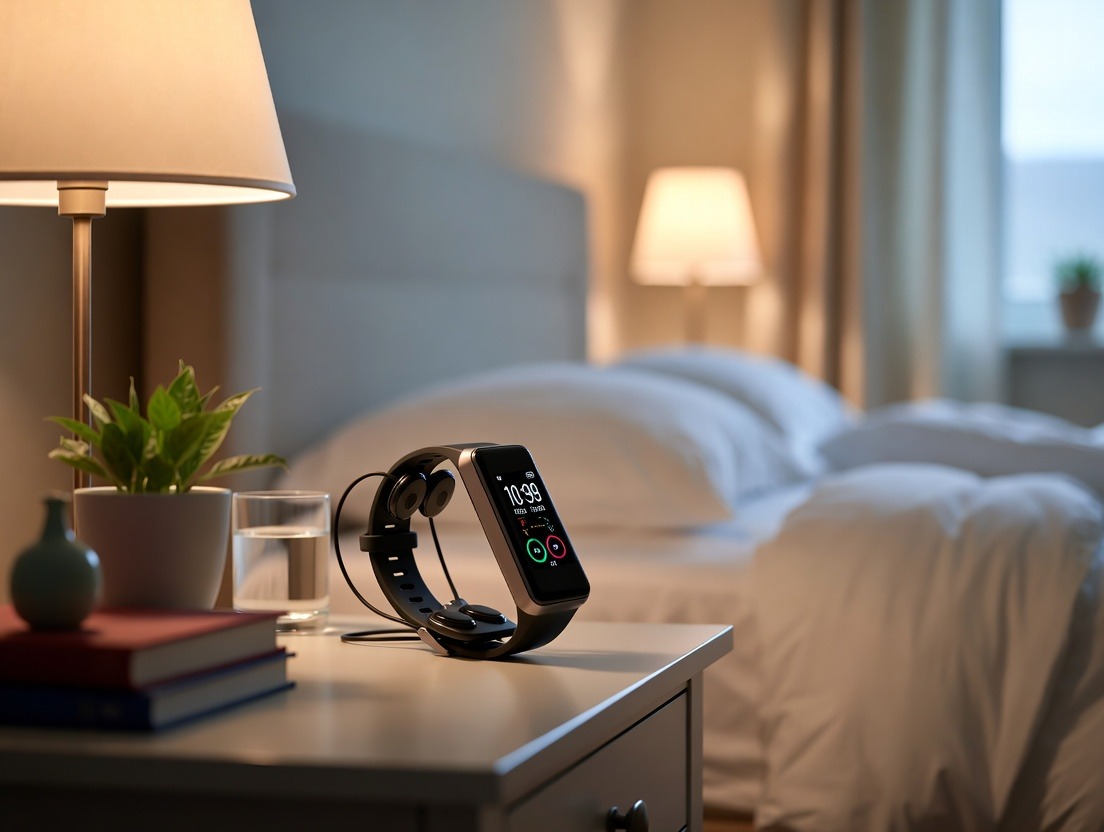
The concept of a "morning routine" is ancient, but our understanding of its neurobiological underpinnings is now crystal clear, thanks to modern neuroscience. When you wake, your brain is emerging from a state dominated by delta (deep sleep) and theta (dreaming) waves. Theta state, in particular, is a gateway—it’s the brainwave associated with hypnagogia, deep meditation, and heightened suggestibility. This is why affirmations or visualization practiced upon waking can be so powerful; the mental barriers are down. By immediately introducing a smartphone, you are essentially conducting a hostile takeover of this open, impressionable state.
The assault is threefold: cognitive, emotional, and physiological.
Cognitive Hijacking: Your brain has a limited reservoir of executive function and decision-making power for the day. This resource, often called "willpower" or cognitive bandwidth, is highest in the morning and depletes with every decision you make. By starting your day reacting to a dozen emails, three news alerts, and twenty social updates, you are spending this precious cognitive capital on other people’s priorities before you’ve even defined your own. You begin the day in a reactive, defensive posture rather than a proactive, intentional one.
Emotional Priming: The content you consume primes your emotional palette. A stressful work email sets an anxiety tone. A polarizing news article ignites latent frustration. Even "positive" social media comparisons can seed subtle inadequacy. This emotional priming creates a filter through which you interpret all subsequent events. Your smart ring often captures this as a sustained elevation in your resting heart rate or a depressed HRV score—tangible signs your body is holding onto that initial stress.
Physiological Cascade: The blue light from screens, even in small doses in the morning, signals to your suprachiasmatic nucleus (your brain's master clock) that the sun is high. This suppresses melatonin production for later and can blunt the natural cortisol awakening response (CAR)—the healthy spike in cortisol that gives you energy to get up. Furthermore, the stress from absorbing information triggers a sympathetic nervous system response. Adrenaline and cortisol flood your system, raising your heart rate and blood pressure. As you'll learn when you explore the physiology of stress relief techniques, starting your day in this "fight or flight" mode makes it exponentially harder to access calm, focused states later.
Your smart ring is the unbiased witness to this cascade. A morning of frantic screen time might manifest in your daily readiness score, a lower-than-average HRV, or higher stress load metrics before noon. The data doesn't lie. It shows that the first digital hour isn't just a bad habit; it’s a physiological event with measurable consequences. By shifting this hour, you aren't just changing a behavior; you are reprogramming your day’s foundational biology. This aligns with the broader principle of learning to integrate mental wellness into your daily routine, starting with its most pivotal moment.
Your smart ring is a minimalist piece of jewelry with a maximalist mission: to translate the silent language of your autonomic nervous system into a story you can understand. To navigate away from problematic morning screen time, you first need to learn to read this story. The key characters in this narrative are Heart Rate Variability (HRV), Resting Heart Rate (RHR), Sleep Score, and the emerging metric of "Stress Load" or "Daytime Stress."
Let’s break down what they’re telling you about your mornings.
Heart Rate Variability (HRV): Your Nervous System’s Weather Vane
HRV is the gold-standard, non-invasive window into your autonomic nervous system balance. It measures the subtle variations in time between each heartbeat. A higher HRV generally indicates a resilient, adaptable system with strong parasympathetic ("rest and digest") tone. A lower HRV suggests a system under stress, overly dominated by the sympathetic ("fight or flight") branch.
Resting Heart Rate (RHR): The Engine’s Idle Speed
Your RHR is exactly what it sounds like—the number of times your heart beats per minute while you are truly at rest. It’s influenced by fitness, hydration, and crucially, stress.
Sleep Score & Deep/REM Sleep: The Night Before’s Legacy
Your morning doesn’t start when you open your eyes; it starts hours earlier, in the depths of your sleep cycles. Evening screen time, especially within an hour of bed, is a well-known sleep disruptor due to blue light and mental stimulation.
Daytime Stress/Stress Load: The Cumulative Cost
Many advanced rings now use a combination of HRV, RHR, and activity data to estimate your "stress load" throughout the day.
By learning to correlate your morning actions with these afternoon and evening biometrics, you move from guesswork to precise understanding. You’re no longer wondering why you feel anxious; your ring shows you the physiological origin story that began the moment you unlocked your phone.
To design a better morning, we must work with our biology, not against it. Two of the most powerful biological forces at play in the first 60-90 minutes after waking are the Cortisol Awakening Response (CAR) and the body's acute sensitivity to morning light. Screens disrupt both.
The Cortisol Awakening Response: Your Natural Energy Surge
Contrary to its bad reputation, cortisol is essential. The CAR is a healthy, robust increase in cortisol secretion that occurs in the first 30-45 minutes after waking. Think of it as your body’s natural espresso shot. It helps you transition from sleep to wakefulness, increasing blood sugar for energy, sharpening memory, and boosting alertness.
Morning Light: The Master Zeitgeber
Light is the primary "zeitgeber" (time-giver) for your circadian rhythm. Exposure to bright, full-spectrum light in the morning—ideally sunlight—is irreplaceable. It perfectly times your CAR, suppresses melatonin to promote alertness, and sets your internal clock for the next 24 hours, including when you’ll feel sleepy that night.
The goal of a screen-free morning, then, is to protect and optimize these natural processes. Allow your CAR to unfold naturally, supported by calm intention. Let morning sunlight, not smartphone glow, be your primary light source. This protects your endocrine system and circadian rhythm, creating a stable foundation for energy and mood. This biological stability is a cornerstone for building mental wellness resilience for future challenges.
Telling someone to "just don't look at your phone" with sheer willpower is a recipe for failure. Our environments are more powerful than our intentions. The modern smartphone and app ecosystem are meticulously engineered to be addictive, exploiting psychological vulnerabilities like the Fear Of Missing Out (FOMO) and variable rewards. To succeed, you must become an engineer of your own environment. This is about strategic friction management: adding friction to unwanted behaviors and removing it from desired ones.
Step 1: The Night Before Setup (The "Pre-Game")
Your morning routine starts at bedtime.
Step 2: The Morning Protocol (Creating Positive Friction)
By designing your physical and digital space to support your goals, you conserve willpower for the genuine challenges of the day. You move from fighting against your environment to having it work for you. This environmental design philosophy extends to all areas of life, as explored in our guide on environmental factors in mental wellness.

With the phone out of the way, you now have a blank canvas—60 minutes of potential. The goal is to fill it with activities that are deliberately different from screen consumption: they should be slow, sensory, and present-moment focused. Think of this as your "Morning Menu." You don't have to do everything; you simply choose one or two items that feel right for that day. The key is intentionality.
Here is a categorized menu of science-backed alternatives, each with a specific benefit your smart ring will likely reflect over time.
Category 1: Hydration & Gentle Nutrition
Category 2: Mindful Movement
Category 3: Mental Clarification & Intention
Category 4: Conscious Relaxation & Focus
Category 5: Sensory Engagement
Start small. Commit to one 10-minute item from this menu for a week. Use your smart ring’s "tag" or "journal" feature to note the mornings you succeed. Over time, watch for correlations: Do you see a higher HRV on days you journal? A lower stress load on days you walk? This data turns your morning experiment into a personalized science project, where you are both researcher and beneficiary.
Going from a decade of morning scrolling to a perfectly screen-free hour overnight is a shock to the system and often unsustainable. A gradual, structured transition respects your existing neural pathways while patiently building new ones. This 21-day protocol is designed to be beginner-friendly and data-validated with your ring.
Phase 1: Days 1-7 — The Observation & Reduction Phase
Phase 2: Days 8-14 — The 30-Minute Challenge
Phase 3: Days 15-21 — The 60-Minute Integration
This phased approach turns a daunting behavioral overhaul into a series of manageable experiments. Your smart ring provides the objective feedback loop, showing you the tangible physiological benefits of each step forward. This methodical, self-compassionate approach is key to creating mental wellness goals that are achievable and sustainable.
After 21 days of intentional experimentation, the true power of your smart ring is unlocked: it becomes a feedback device for behavioral change. This is where you move from following a protocol to understanding your unique physiology. The correlation between your actions and your metrics is your personal blueprint for wellness.
Here’s what to look for and how to interpret it:
The HRV Uptrend: This is the hallmark of improved autonomic resilience.
The RHR Downtrend: A sign of reduced cardiovascular strain.
The Stress Load Smoothening: Evidence of a quieter nervous system baseline.
The Sleep Score Improvement: The virtuous cycle in action.
The "Readiness" or "Recovery" Score Increase: The composite verdict.
Don't just look at single days. Look for trends over weeks. Your body adapts slowly. The data allows you to be a compassionate scientist of your own life. If you see a desired trend, you know you're on the right path. If not, you can adjust your "Morning Menu" without guesswork. This process of tracking and adjusting is fundamental to learning how to measure mental wellness progress over time.
Life is messy. The dog gets sick, you have a 6 AM flight, a child wakes you up at night. The goal is not perfection, but resilience and non-judgmental course correction. A "failed" morning is not a reason to abandon the practice; it's a critical data point. Here’s how to troubleshoot common obstacles with the help of your ring’s data.
Obstacle 1: "I woke up stressed and immediately grabbed my phone for distraction."
Obstacle 2: "My work demands I check email first thing."
Obstacle 3: "I just don't feel any benefits. I'm still tired/stressed."
Obstacle 4: "Weekends and travel completely derail me."
The path is never linear. Your ring’s data removes the emotional self-flagellation and replaces it with curious inquiry. A "bad" data day is not a failure; it's a question: "What happened yesterday that led to this?"
The benefits of a screen-free morning hour extend far beyond a slightly lower resting heart rate. They ripple out into every domain of your life, often in surprising and profound ways. This is the compound interest of mental wellness. By investing in the first hour, you earn dividends all day long.
Transformed Work Performance:
Starting the day proactively, not reactively, changes your relationship with work. With your cognitive capital intact, you can tackle your Most Important Task (MIT) in a state of deep focus. The constant context-switching induced by morning emails ceases, allowing for longer periods of "flow state." You bring the calm, intentional energy cultivated in your morning to your interactions and problem-solving. This intrinsic link between well-being and productivity is explored in depth in our article on the work-mental wellness connection.
Deeper Relationships:
When your first emotional impressions of the day aren't fueled by digital drama or comparison, you show up more present for the people in front of you—your partner, your children, your colleagues. You’re not mentally fragmented by the unresolved stress of a morning news cycle. This presence is the bedrock of meaningful connection and is a skill that helps in supporting someone else's mental wellness without overstepping, as you are coming from a place of centeredness rather than anxiety.
Unlocked Creativity:
The theta-state openness of early morning, when protected from digital intrusion, is a playground for creativity. This is when novel connections are made, ideas bubble up from the subconscious, and solutions to lingering problems appear. Journaling, walking in nature, or simply daydreaming during this time can unlock insights that frantic, screen-saturated brains never access.
Strengthened Resilience:
By consciously choosing how you start your day, you practice agency. You prove to yourself that you are not a passive victim of external stimuli. This builds a foundational sense of control and self-efficacy, which is critical for navigating larger life stresses, grief, or chronic challenges. This cultivated resilience is your best defense, whether you're navigating loss healthily or facing the pressures of daily life.
Your smart ring may not have a direct metric for "relationship depth" or "creative output," but the physiological stability it records (high HRV, low RHR, good sleep) is the substrate from which all these higher-order benefits grow. A regulated nervous system is the platform for a flourishing life.
This guide advocates for mindfulness, not Luddism. Screens are powerful tools. The goal is not to eliminate them but to eliminate their unconscious, compulsive, and anxiety-driving use, especially during the neurologically vulnerable morning window. There are times when short, intentional screen use in the morning can be beneficial, provided it is done with strict boundaries.
The "Tool, Not Toy" Principle: Define the purpose before unlocking.
The Container Method: How to structure intentional use.
Using Your Ring to Audit "Intentional" Use: Be honest with your data. If you introduce a "guided meditation" screen time and notice your morning stress metric spikes or your HRV drops on those days, investigate. Was it truly just meditation? Or did you get sidetracked? The data will hold you accountable to your stated intention.
The core question to ask is: "Is this screen serving me, or am I serving it?" If the use is active, purposeful, and leaves you feeling calm or informed, it may have a place. If it’s passive, endless, and leaves you feeling agitated or compare, it’s the exact habit we’re working to transform. This discernment is part of cultivating a healthy information diet for mental wellness.
A truly transformative morning routine is not an island; it is part of a circadian ecosystem. Your evening habits directly determine the quality of your sleep, which in turn dictates how you feel and what choices you make upon waking. To protect your sacred morning, you must build a supportive bridge from the night before.
The Digital Sunset: Your Evening Friction
Just as you create a screen-free morning, institute a "Digital Sunset" 60-90 minutes before your target bedtime.
The Evening Review: Closing the Loop
Spend 5 minutes reflecting on the day. This is not a stressful to-do list creation for tomorrow, but a gentle review.
Optimizing Sleep with Ring Data:
Use your ring’s sleep data not just as a report card, but as a diagnostic tool.
By crafting an evening that supports deep, restorative sleep, you wake up naturally more refreshed. This reduces the need for a digital stimulant to shock your system awake. The morning routine becomes a joyful choice, not a struggle against fatigue. This holistic 24-hour view—evening wind-down, quality sleep, mindful morning—is the ultimate system for sustained well-being, turning daily practices into a long-term investment in your cognitive and emotional health.

The first 21 days of a new morning ritual are about building a scaffold—creating a structure where none existed. The next 90 days, and beyond, are about the alchemy of turning that structure into a seamless part of your identity. This is where you transition from tracking your morning screen time to transcending it. Your smart ring shifts from being a daily coach to a periodic audit tool, and your own embodied sense of well-being becomes your primary guide.
From Conscious Effort to Unconscious Competence
In the beginning, every minute of your screen-free hour requires a decision. Over time, with consistency, these decisions become automatic. Neuroscience calls this "synaptic pruning" and "myelination"—the brain literally rewires itself to make the desired pathway more efficient and the old one fade. You’ll know you’re reaching this stage when:
The Quarterly Ring Audit: From Daily Check to Strategic Review
As the habit solidifies, you can change your relationship with the ring’s data.
This long-view approach to data is a key component of a sustainable 10-year mental wellness investment strategy. You’re not chasing daily wins; you’re cultivating a resilient system.
Developing Your "Ring-Informed" Intuition
The ultimate goal is to develop a keen interoceptive awareness—the ability to sense what’s happening inside your body—so that you don’t need the device to tell you. Your ring trains this intuition.
Adopting a screen-free morning can sometimes feel like a counter-cultural act, especially if your partner, family, or roommates are still glued to their devices. This doesn’t mean you must become a wellness hermit. With thoughtful communication and inclusive planning, you can honor your practice without creating friction in your relationships.
Lead by Example, Not by Lecture
The most powerful form of persuasion is non-verbal. When others notice you are consistently calmer, more present, and less reactive in the mornings, they will become curious. When asked, you can simply share your experience and the data from your ring, rather than preaching a doctrine. "I've noticed my ring shows my stress starts lower if I don't check my phone right away. I've been enjoying this quiet time with my coffee instead."
Create Shared "Analog-Only" Zones or Times
Propose small, collective agreements that benefit everyone.
Respect Differences Without Compromising Your Core Practice
Your partner may not want a full 60-minute screen-free routine, and that’s okay. Your practice is for you. You can:
Navigating these social dynamics with grace is a practical application of learning to support someone else's mental wellness without overstepping. You are modeling a behavior, not demanding compliance. Furthermore, finding others who value similar intentionality, even online in dedicated communities, can provide a powerful sense of belonging—a key community factor in mental wellness.
Once the foundational habit of a screen-free morning is locked in, you can begin to optimize it with more advanced biological principles. This isn't necessary for everyone, but for those fascinated by peak performance and personalization, it’s the next frontier. Your smart ring provides the perfect feedback mechanism for these experiments.
Working with Ultradian Rhythms: The 90-Minute Focus Sprints
Human brains don’t operate on an 8-hour workday clock; they operate in roughly 90-minute ultradian cycles, oscillating between high alertness and lower focus. Your morning routine can prime you to harness your first and most important cycle of the day.
Honoring Your Chronotype: Are You a Bear, Wolf, Lion, or Dolphin?
Not all morning routines are created equal because not all internal clocks are the same. Your chronotype—your genetic predisposition for when you sleep and wake—should inform the intensity and timing of your morning activities.
Your ring’s sleep consistency data and your own energy logs can help you deduce your chronotype. The key is to tailor the spirit of the practice—intentionality, protection from digital chaos—to your biology, not to force a one-size-fits-all schedule. This self-knowledge helps you create mental wellness goals that are achievable for you.
Even the most dedicated practitioner faces mornings that begin in crisis: a sick child, a work emergency, a bout of insomnia, or a wave of anxiety or grief. On these days, the 60-minute menu feels laughably out of reach. Abandoning your practice entirely, however, can make a hard start feel worse. This is when you need a scaled-down, emergency protocol—a "minimum viable morning" that honors the spirit of the practice in just 2-5 minutes.
The "Anchor Breath" Sequence
This is your non-negotiable, can-be-done-anywhere foundation.
The 5-Minute "Reset" Options
If you have just five minutes, choose ONE:
The Role of Your Ring on These Days
On emergency mornings, your ring’s role is one of compassion, not assessment.
The emergency protocol ensures that your practice is antifragile. It doesn't break under pressure; it adapts. It teaches you that even 120 seconds of conscious breathing can be the thread that connects you back to yourself on the most difficult days, much like having emergency stress relief techniques for panic and acute anxiety in your toolkit.
A habit sustained solely by biometric feedback can become dry and mechanical. To fuel long-term commitment, especially when motivation wanes, you must connect your morning practice to a deeper, personal "why." This transcends sleep scores and HRV numbers and taps into your values and vision for your life.
Questions to Uncover Your Deeper "Why":
Framing Your Practice as a Gift, Not a Chore:
Reframe your screen-free hour from being a "restriction" to being a "gift" you give yourself.
This reflective, values-driven approach touches on the spiritual dimension of mental wellness—not necessarily religious, but connected to meaning, purpose, and the conscious cultivation of your inner life. Your morning becomes a daily ritual that honors that dimension.
Using Your Ring to Validate Values, Not Just Vitals:
You can start tagging days not just with activities ("walk," "journal"), but with the quality you cultivated ("patience," "clarity," "gratitude"). Over time, you might find that the days you focused on the value of "clarity" had the most productive work output, or days focused on "gratitude" correlated with better social connections. This links your deepest intentions to tangible, data-validated outcomes.
Your screen-free morning creates a container. Within that container, you can place specific, potent practices that synergize to amplify the benefits. Based on the latest science, three of the most powerful levers are breathwork, light exposure, and temperature.
Breathwork: The Remote Control for Your Nervous System
Your breath is the only autonomic function you can easily consciously control. Using it intentionally in the morning is like manually tuning your nervous system to the right channel.
Light: The Master Zeitgeber, Revisited
We've discussed sunlight. Now, consider precision.
Temperature: The Metabolic Wake-Up Call
By strategically combining these elements within your screen-free hour, you create a compound effect. The whole becomes greater than the sum of its parts, and your ring’s data will show you which combinations work best for your unique physiology.
The practice of a mindful morning inevitably changes your relationship with technology and information for the rest of the day. You begin to develop a "digital diet" consciousness. Just as you wouldn’t eat junk food first thing in the morning, you become more selective about the informational "food" you consume at all hours.
The Ripple to an "Information Diet":
Starting your day with intention makes you more aware of how you use screens later. You might find yourself:
This conscious curation is the essence of maintaining an information diet for mental wellness. Your morning practice builds the "muscle" of intentional attention that you can flex all day long.
Becoming a More Conscious Digital Citizen:
When you are no longer reflexively consuming, you become more critical and deliberate in your interactions.
This shift has a subtle but profound impact on your overall digital well-being, reducing the sense of being overwhelmed and fragmented by the online world. It allows you to engage with technology from a place of strength and choice, which supports long-term mental wellness in our connected age.
After months of practice, experimentation, and data review, the screen-free morning ceases to be a "wellness hack" and becomes simply "how you start your day." It is as non-negotiable as brushing your teeth. This is the stage of full integration, where the practice provides a stable foundation that allows you to navigate life’s complexities with greater equanimity.
Your Morning as an Anchor:
No matter what travels, projects, or life changes come your way, this practice is your portable anchor. It’s the one thing you can control. In times of transition or stress, returning to this basic structure provides a profound sense of stability and self-care.
The Ring as a Periodic Check-In, Not a Crutch:
You may find you wear your ring less obsessively. You put it on because you appreciate the sleep and activity tracking, but you’re not anxiously awaiting your morning HRV. You know how you feel. You use the data quarterly or when something feels "off" to diagnose and adjust. The tool has served its purpose of educating your intuition.
Paying It Forward:
With this deep personal understanding, you are now equipped to guide others—not with rigid rules, but with empathetic insight. You can share your journey, the mistakes, the data, and the profound sense of reclaiming your own attention. You become a living example of how a small, consistent daily investment in mental space can yield extraordinary returns in every area of life, reinforcing the undeniable work-mental wellness connection and the importance of holistic self-care.
This journey from compulsive scrolling to intentional awakening is, in microcosm, the journey of modern self-mastery. It’s about using the most advanced personal technology not to distract us, but to help us reconnect with our most ancient and vital rhythms. Your smart ring was the guide, but the destination—a life lived with more presence, purpose, and peace—is entirely yours.
The final stage of this journey is moving beyond a singular "morning routine" and weaving its principles into the fabric of your entire lifestyle. This is where the 60-minute practice becomes the keystone habit that supports and reinforces other positive behaviors, creating a synergistic ecosystem for well-being. Your smart ring and the self-awareness you've cultivated are the tools you'll use to architect this system.
The Interconnected Wellness Dashboard: Beyond Sleep and HRV
By now, you’re fluent in the core biometrics. To build a holistic system, expand your view to correlate your morning practice with other ring-tracked and self-tracked metrics.
This integrated view allows you to see your morning not as an isolated event, but as the priming event for a high-functioning day. It’s the first and most important deposit in your daily wellness bank account.
Seasonal and Life-Stage Adjustments: The Fluid Protocol
A rigid routine breaks under the pressure of a changing life. A fluid system adapts. Your practice should evolve with the seasons of the year and the seasons of your life.
The key is to ask: “What does my body and mind need most right now?” and let that guide your Morning Menu. Your ring’s data provides the honest feedback to know if your adjustment is working.
Creating Your "Owner's Manual": A Living Document
Take what you’ve learned and compile it into a personal “Owner’s Manual.” This isn't for publication; it’s for you. Use a notes app or a physical journal.
This manual turns your experiential and biometric knowledge into an actionable, personalized system. You can revisit and revise it every 6-12 months as you learn more about yourself.
Even after a deep dive, practical questions and skepticism remain. Let’s address the most common ones with clarity and evidence.
Q1: "Isn't this just privileged, self-indulgent 'wellness culture'? Most people don't have an extra quiet hour."
Q2: "I've tried this and my HRV didn't budge. Does that mean it's not working?"
Q3: "My job is on my phone. I'm a social media manager/on-call professional. I literally can't do this."
Q4: "What about weekends? Should I be strict then too?"
Q5: "Does the type of screen matter? Is an e-ink reader (like a Kindle) okay?"
Your journey doesn’t end here. Below is a curated list of concepts, practices, and areas for deeper exploration, many of which are covered in detail on the Oxyzen blog. Use this to build out your Owner’s Manual and deepen your understanding.
Deep Dives into Complementary Practices:
Understanding Your Unique Psychology:
Broadening the Context of Wellness:
Books for Further Study:
We began this guide with a simple, almost universal problem: the reflexive, anxiety-inducing grab for the smartphone in the first moments of consciousness. We end it not with a complex solution, but with a profound shift in perspective.
The journey from digital compulsion to intentional awakening is not about adding more to your life. It is about a strategic, loving subtraction. It is the subtraction of noise to hear your own thoughts. The subtraction of other people’s agendas to remember your own. The subtraction of synthetic urgency to make space for what is genuinely important.
Your smart ring has served as a translator, turning the silent language of your heartbeat and sleep into a story you could understand—a story about how your choices, starting at dawn, ripple through your biology. It provided the objective feedback that made the intangible, tangible. But the true transformation happened not on your finger, but in your mind and nervous system. You have learned to feel the difference between a morning that scatters you and a morning that grounds you.
This practice is a radical act of self-respect in a world designed to hijack your attention. It is a daily declaration that your inner peace, your clarity, and your presence are more valuable than any notification, news cycle, or social update. By protecting your mornings, you are not hiding from the world; you are fortifying yourself to engage with it from a place of strength, compassion, and discernment.
Remember, perfection is not the goal. There will be mornings you fail, weeks you travel, and life events that disrupt everything. The practice is in the return. It’s in the gentle act of putting the phone down, stepping into the light, and taking that first conscious breath. Each time you do, you strengthen the neural pathway of choice over compulsion.
You now hold the beginner-friendly guide, but you are no longer a beginner. You are an architect of your own days, a student of your own body, and a guardian of your own attention. Let your morning be your sanctuary. Let your ring be your guide. And let your days unfold from a foundation of calm, intentional awareness.
Your Trusted Sleep Advocate: Sleep Foundation — https://www.sleepfoundation.org
Discover a digital archive of scholarly articles: NIH — https://www.ncbi.nlm.nih.gov/
39 million citations for biomedical literature :PubMed — https://pubmed.ncbi.nlm.nih.gov/
Experts at Harvard Health Publishing covering a variety of health topics — https://www.health.harvard.edu/blog/
Every life deserves world class care :Cleveland Clinic - https://my.clevelandclinic.org/health
Wearable technology and the future of predictive health monitoring :MIT Technology Review — https://www.technologyreview.com/
Dedicated to the well-being of all people and guided by science :World Health Organization — https://www.who.int/news-room/
Psychological science and knowledge to benefit society and improve lives. :APA — https://www.apa.org/monitor/
Cutting-edge insights on human longevity and peak performance:
Lifespan Research — https://www.lifespan.io/
Global authority on exercise physiology, sports performance, and human recovery:
American College of Sports Medicine — https://www.acsm.org/
Neuroscience-driven guidance for better focus, sleep, and mental clarity:
Stanford Human Performance Lab — https://humanperformance.stanford.edu/
Evidence-based psychology and mind–body wellness resources:
Mayo Clinic — https://www.mayoclinic.org/healthy-lifestyle/
Data-backed research on emotional wellbeing, stress biology, and resilience:
American Institute of Stress — https://www.stress.org/


