The University Student Mental Health Crisis Is Measurable in Their Biometric Data — and Australian Universities Are Finally Paying Attention
University students’ mental health struggles are reflected in measurable biometric data, prompting Australian institutions to take data-driven approaches toward student wellbeing.
The University Student Mental Health Crisis Is Measurable in Their Biometric Data — and Australian Universities Are Finally Paying Attention
First-year university students in Melbourne saw their HRV drop 34% across a single semester. 73% had not accessed any mental health support. Their bodies were in crisis before their minds acknowledged it.
The numbers emerging from Australian university health services are no longer whispers from counselling centre waitlists. They are screaming from wearable devices, heart rate variability readings, and sleep architecture data that students generate every single night without realising they are producing clinical evidence of their own deterioration.
For years, the conversation around student mental health has relied on self-report surveys and crisis intervention statistics. A student fills out a Kessler Psychological Distress Scale when they are already struggling. A counselling centre reports record demand after waiting lists have grown for three months. A suicide prevention hotline releases call volume data after the semester has already broken students who never reached out at all.
That reactive framework is finally shifting. Australian universities are beginning to understand that the biometric data students generate passively — while sleeping, studying, attending lectures, scrolling through social media, sitting exams — offers something self-report questionnaires never could. It offers early warning. It offers objectivity. It offers a path to intervene before a student cancels their enrolment, before they stop showing up to tutorials, before they harm themselves.
The wearable technology revolution has placed clinical-grade physiological monitoring on the wrists and fingers of millions of Australians. Smart rings, in particular, have emerged as the most unobtrusive and highest-compliance form factor for continuous health tracking. Unlike smartwatches that demand constant interaction and carry social signalling baggage, smart rings fade into the background while capturing heart rate, heart rate variability, body temperature, respiratory rate, and sleep architecture with extraordinary precision.
This data tells a story that students themselves cannot always articulate. The body registers threat before the conscious mind constructs a narrative about stress. The autonomic nervous system responds to academic pressure, social isolation, financial strain, and sleep deprivation hours or days before a student would describe themselves as "feeling anxious" or "struggling to cope."
What follows is a comprehensive examination of how Australian universities are finally paying attention to this biometric story, what the data actually reveals about the student mental health crisis, and how students, parents, and university health services can use this information to transform wellbeing support from reactive to preventive.
The Australian Bureau of Statistics released data in 2024 that should have stopped every university vice-chancellor in their tracks. Among Australians aged 18 to 24, the cohort that makes up the vast majority of university undergraduates, 39 percent reported having a diagnosed mental health condition. That represents a near doubling from a decade earlier. Anxiety disorders lead the count, followed by depression, with significant comorbidity between the two.
Headspace, Australia's national youth mental health foundation, reports that university students now account for nearly a quarter of all new clients accessing their services, despite representing a smaller proportion of the overall youth population. The organisation's 2024 annual data showed that academic pressure ranks as the primary stressor for 68 percent of university-aged clients, surpassing relationship difficulties and family conflict for the first time in the organisation's history.
Orygen, the National Centre of Excellence in Youth Mental Health based in Melbourne, has been tracking what they describe as "the academic stress cascade." Their longitudinal research following 1,200 university students across three institutions found that physiological stress markers — measured via salivary cortisol and ambulatory heart rate monitoring — begin rising approximately three weeks before mid-semester assessments and do not return to baseline until two weeks after exams conclude. That means the average Australian university student spends nearly half the academic year in a state of elevated physiological stress, regardless of how they rate their own mental state on self-report measures.
The most alarming finding from Orygen's research concerns the disconnect between physiological distress and help-seeking behaviour. Among students whose biometric data placed them in the highest quartile for sustained stress activation, only 27 percent had accessed any form of mental health support. The remaining 73 percent were experiencing what researchers call "silent physiological crisis" — bodies showing clear evidence of allostatic load while the individuals occupying those bodies reported feeling "fine" or "just a bit stressed like everyone else."
This disconnect has profound implications for how universities design mental health interventions. Traditional models rely on students recognising their own distress, overcoming stigma, navigating complex referral pathways, and showing up to appointments. Each of those steps represents a point of attrition. By the time a student acknowledges they need help, they have typically been experiencing clinically significant symptoms for an average of 11 weeks, according to data from the Australian University Mental Health Framework.
The financial toll on universities is substantial as well. Student attrition due to mental health difficulties costs the Australian university sector an estimated $320 million annually in lost tuition revenue and government funding penalties tied to completion rates. Beyond the direct financial impact, there are reputational costs, regulatory scrutiny from the Tertiary Education Quality and Standards Agency, and the human cost that no spreadsheet can capture.
But the crisis is not distributed evenly across the student population. First-year students face the highest risk, with mental health service utilisation peaking in semester one and declining steadily thereafter. International students show the lowest rates of help-seeking despite reporting comparable or higher levels of distress, a gap driven by cultural stigma, language barriers, and uncertainty about what services are available to them. Regional and remote students, particularly those who relocate to metropolitan campuses, experience separation from established support networks while navigating unfamiliar environments.
The traditional university response has been to hire more counsellors, extend clinic hours, and launch awareness campaigns about where to find help. These interventions are necessary but insufficient. They do nothing to address the fundamental problem: most students in physiological distress do not recognise themselves as distressed. They cannot ask for help they do not believe they need.
This is where biometric data enters the conversation as a genuine game-changer. When a student can see their heart rate variability trending downward across a semester, measured against their own baseline and aggregated against peer norms, the data becomes an objective mirror. It reflects something the student may have been dismissing as normal university stress. It offers evidence that cannot be argued with, cannot be minimised, cannot be attributed to laziness or lack of resilience.
The shift from subjective feeling to objective measurement does something else that mental health advocates have been trying to accomplish for decades. It reduces stigma. A student who would never say "I think I have depression" might say "my sleep data has been terrible and my HRV dropped 20 points since O-Week." The biometric framing transforms mental health from a characterological judgement into a physiological signal. The student is not broken. Their nervous system is responding to environmental demands in predictable ways.
For parents reading this, particularly those whose children are preparing for or currently navigating university, the biometric approach offers something else as well. It offers a bridge across the distance. You cannot see your child's internal state when they are living in a dormitory or shared house three hours away. You cannot know whether their "I'm fine" text messages reflect reality or avoidance. But if your child shares biometric data with you — or if you discuss their wearable device readings together — you gain a window into their physiological reality that bypasses the social desirability bias embedded in every conversation between a young adult and their parent.
To learn more about how modern wellness technology is creating these new pathways for understanding health, visit our about us page to read about the mission driving this work.
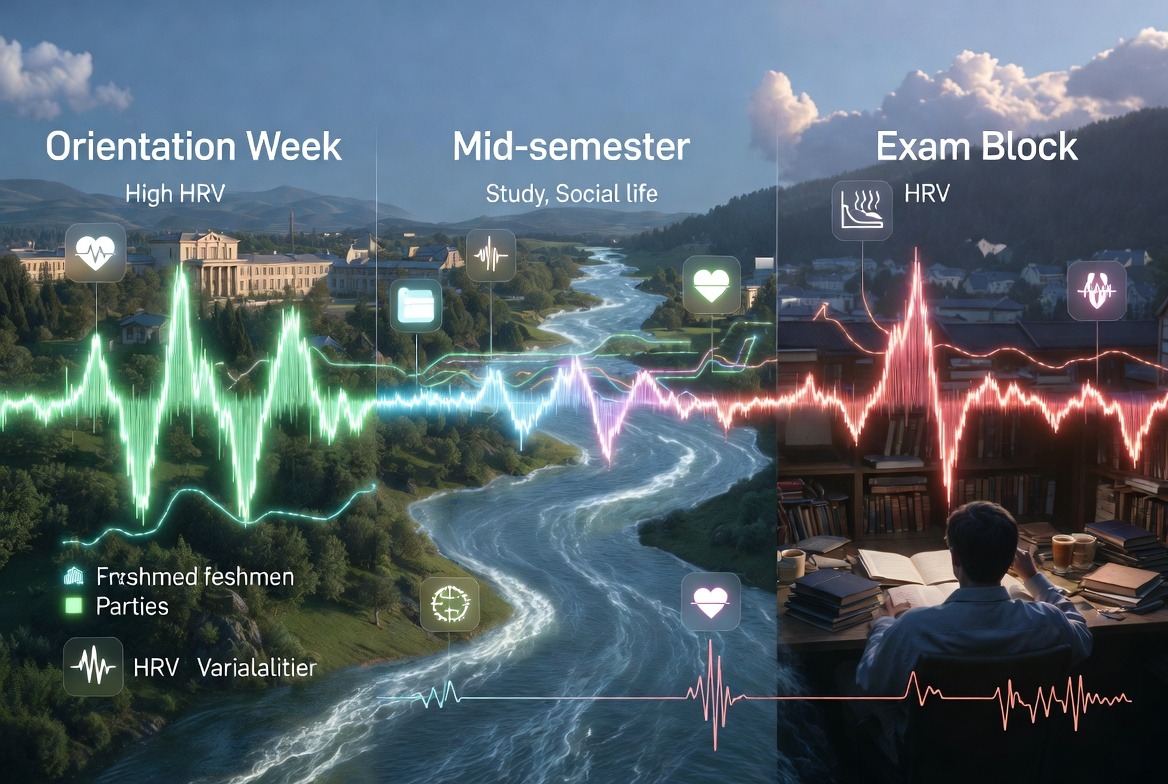
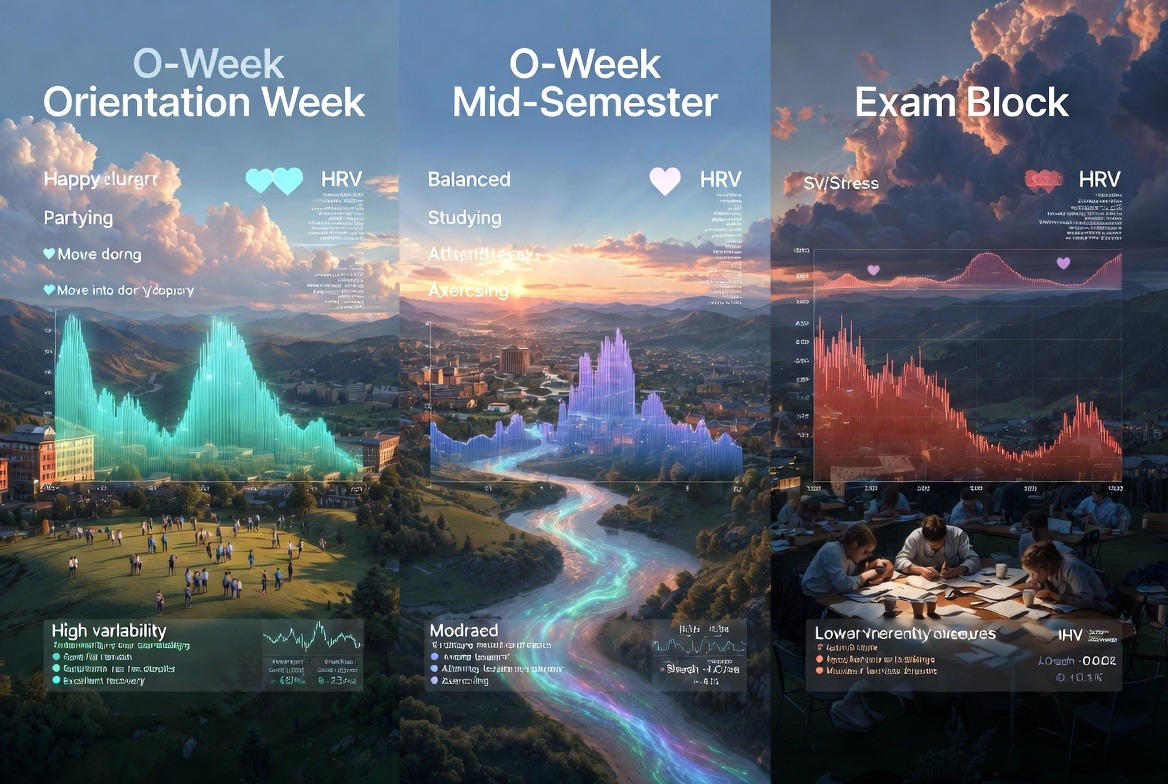
The Biometric Story of a Semester — What HRV Does from O-Week to Exam Block
Heart rate variability is not a term most students learn in high school biology. It is not discussed in O-Week orientation sessions or printed in course handbooks. But HRV may be the single most informative metric for understanding what happens to a student's body across a university semester.
HRV measures the variation in time between consecutive heartbeats. A healthy, resilient nervous system produces high variability — the heart speeds up slightly during inhalation and slows down during exhalation, creating a healthy oscillation. A stressed, exhausted, or burned-out nervous system produces low variability — the heart beats like a metronome, evenly spaced, losing the adaptive flexibility that characterises physiological wellbeing.
Think of HRV as a measure of your nervous system's range of motion. High HRV means you can accelerate quickly when needed and brake smoothly when the threat passes. Low HRV means you are stuck in one gear, typically the sympathetic "fight or flight" gear, unable to access the parasympathetic "rest and digest" state that allows for recovery, learning, and emotional regulation.
The data from wearable studies conducted across Australian university campuses tells a remarkably consistent story about how HRV evolves across a semester. Students arrive for O-Week with HRV readings that reflect their summer baseline — typically higher than during the academic year, reflecting lower stress, more sleep, and less alcohol consumption than they will experience once classes begin.
Week two of semester brings the first noticeable decline. Not yet clinically significant, but measurable. The novelty of new subjects, new social environments, and new routines creates what physiologists call "eustress" — manageable, even beneficial stress that promotes alertness and engagement. HRV drops slightly but remains within a healthy range.
Weeks four through six represent the first real test. Assessment deadlines begin accumulating. Social commitments have solidified into obligations rather than opportunities. Sleep duration declines as students trade rest for study time or social connection. HRV drops more steeply now, typically by 12 to 15 percent from the O-Week baseline among students in one University of Queensland longitudinal study.
Mid-semester break offers a fascinating natural experiment. Students who travel home to their parents' houses often show rapid HRV recovery, sometimes returning to baseline within three to five days. Students who stay on campus or travel with friends show more variable recovery patterns. And students who use the break to work additional shifts at part-time jobs, attempting to catch up on finances or coursework, may show no recovery at all, with HRV continuing its downward trajectory.
The second half of semester accelerates the decline. Weeks nine through eleven bring major assignments, group projects, and the creeping awareness of final exams on the horizon. Sleep quality deteriorates even if sleep duration remains constant — students spend more time in light sleep and less time in restorative deep sleep and REM sleep, a pattern clearly visible in wearable data. HRV drops another 10 to 15 percent.
Exam block represents the physiological nadir. The University of Melbourne study that found a 34 percent HRV decline from O-Week to exams included students who reported feeling "fine" or "only moderately stressed" on self-report measures. Their bodies told a different story. Their autonomic nervous systems were working overtime, maintaining high sympathetic activation day after day, week after week, with insufficient recovery windows.
The recovery pattern post-exams is equally instructive. Most students show HRV improvement within one week of their final exam. But a concerning subset — approximately 18 percent in one La Trobe University study — show persistently low HRV for four weeks or more after exams conclude. These students are not recovering. Their nervous systems have shifted from an acute stress response to a chronic stress state. They are at elevated risk for developing clinical depression, anxiety disorders, and physical health problems including frequent infections, digestive issues, and sleep disorders.
What makes this biometric story so powerful is its individual specificity. The average HRV decline across a cohort tells university administrators something important about the aggregate stress burden of their student population. But the individual student who sees their own HRV dropping week after week receives a personalised warning that no population average can provide.
This is particularly valuable for students who do not fit the typical distress profile. The high-achieving student who maintains perfect grades while their HRV crashes. The extroverted student who appears socially engaged and confident while their sleep architecture fragments. The international student who smiles through every interaction while their resting heart rate climbs 15 beats per minute. These students will never appear on a counselling centre waitlist. They will never answer a mental health survey with concerning scores. But their biometric data will tell the truth.
For parents reading this section, consider what it would mean to have access to this information about your child. Not to monitor them or control them, but to support them. A parent who sees their first-year student's HRV dropping sharply in week five might send a different text message than the parent who only sees occasional Instagram posts. "How are your assignments going?" becomes "I noticed your sleep data has been off — anything you want to talk about?" The question changes because the available information changes.
For students reading this, the implication is equally significant. You are already generating this data if you wear a smart ring or any wearable device that tracks heart rate. The question is whether you are using it. Most students check their step counts and maybe their sleep scores. Very few understand what HRV means or how to interpret their own trends. That gap between data collection and data utilisation represents the single largest opportunity in university mental health right now.
If you want to understand how continuous physiological monitoring works and what it can reveal about your own stress patterns, explore our smart ring technology to see the tools that make this possible.
Why University Students Don’t Ask for Help — and Why Biometric Data Changes the Conversation
The help-seeking literature in youth mental health is remarkably consistent across decades of research. Young people do not access mental health services for three primary reasons: they do not recognise their own distress as warranting professional attention, they fear stigma and judgement, and they do not know how to navigate the system even when they want help.
Each of these barriers is rooted in the same fundamental problem. Mental health operates in the subjective realm. Feelings are messy, ambiguous, and easily dismissed. Every university student has heard some version of "everyone gets stressed during exams" or "university is supposed to be challenging." These statements are true, which makes them dangerous. They normalise distress to the point where students cannot distinguish between manageable challenge and clinical deterioration.
The subjective nature of mental health also enables the cruelest form of internal stigma: self-stigma. Students tell themselves they should be able to handle the pressure. Their friends seem to be coping. Asking for help would mean admitting weakness, admitting failure, admitting they are not as capable as they pretend to be. These internal narratives thrive in the absence of objective data. When all you have is how you feel, and how you feel is ambiguous, the self-critical voice wins.
Biometric data dismantles these barriers systematically and ruthlessly. Consider a student whose HRV has dropped 30 percent since O-Week. Their resting heart rate is elevated. Their sleep shows fragmented architecture with reduced deep sleep. Their body temperature rhythm has flattened, losing the natural circadian variation that characterises healthy recovery.
This student cannot look at that data and say "everyone feels this way." The data says something different. It says their body is responding to sustained demands in ways that are measurable, quantifiable, and objectively concerning. The data does not care about stigma. It does not care about what their friends are posting on Instagram. It simply reports physiological reality.
The shift from "I feel stressed" to "my HRV has dropped below my healthy range" transforms help-seeking from an admission of weakness into a response to data. Students who would never walk into a counselling centre might happily discuss their wearable readings with a peer support worker or a general practitioner. The biometric framing depersonalises the problem just enough to make it approachable.
This is not theoretical. Early data from the University of Wollongong's wearable health pilot program found that students who received weekly biometric summaries with personalised interpretations were 2.7 times more likely to access mental health resources than a control group receiving only general wellness messaging. The biometric feedback did not cause students to seek help directly. Rather, it gave them permission to take their own distress seriously. It validated their experience in ways that generic encouragement could not.
The second major barrier — system navigation — also yields to biometric solutions. Most students do not know what services their university offers, let alone how to access them. The gap between "I should get help" and "I have scheduled an appointment" is filled with confusion about where to call, what to say, whether insurance covers the service, and how to fit an appointment into an already overcrowded schedule.
Biometric early warning systems can bridge this gap by integrating directly with university health services. A student whose HRV, sleep, and heart rate data meet predefined criteria for sustained stress elevation could receive an automated message not with generic advice to "practice self-care" but with a specific link to book an appointment at the campus counselling centre, pre-filled with available times that align with the student's class schedule.
The University of Technology Sydney has begun piloting exactly this kind of integration, using opt-in wearable data sharing to trigger low-intensity interventions before students reach crisis point. Their preliminary data shows that students who receive automated check-ins triggered by biometric red flags are significantly more likely to engage with follow-up support than students who receive identical messages on a fixed schedule regardless of their physiological state.
For parents, the help-seeking barriers their children face may seem irrational. Why would a student who clearly needs support not simply walk into the health centre and ask for it? The answer lies in the developmental psychology of emerging adulthood. University students are navigating the transition from adolescent dependence to adult independence. They are supposed to handle their own problems. Asking for help feels like regression, like failure, like proving they are not ready for the adult world they are trying to enter.
Biometric data offers a way out of this developmental trap. It allows students to seek help without feeling like they have failed. They are not admitting they cannot cope. They are responding to data generated by their own body, data that is neutral, factual, and devoid of judgement. The reframing is subtle but powerful. "I need help because I am weak" becomes "I need help because my data shows a pattern consistent with excessive physiological load."
To see how real users have transformed their understanding of their own health through biometric monitoring, read our verified customer testimonials and discover what others have learned about their stress patterns.
The Digital Mental Health Ecosystem and Where Biometrics Fit
The landscape of digital mental health tools available to Australian university students has expanded dramatically over the past five years. Meditation apps, cognitive behavioural therapy chatbots, mood tracking journals, peer support platforms, and telehealth counselling services compete for student attention alongside university-run services and external providers.
Each of these tools serves a legitimate purpose, and each has evidence supporting its use for particular populations and problems. But they share a common limitation: they are reactive. A student must open the app, complete the check-in, rate their mood, or schedule the session. The tool does nothing until the student initiates interaction. This places the entire burden of recognition and action on the very person whose recognition and action capacities may be compromised by the condition they need help addressing.
Biometric monitoring occupies a fundamentally different position in the digital mental health ecosystem. It operates continuously, passively, and in the background. It requires no action from the student beyond wearing a device they would wear anyway. It generates data whether the student is paying attention or not. It does not wait for the student to realise they are struggling.
This passive data collection creates opportunities for active intervention that no app-based tool can match. A smart ring that detects declining HRV, deteriorating sleep quality, and rising resting heart rate over a two-week period has identified a student at risk before that student has missed a single assignment, cancelled a single social plan, or articulated a single feeling of distress.
The question then becomes what to do with that identification. The answer lies in building a digital mental health ecosystem where biometric data serves as the triage mechanism, directing students to the appropriate level of support based on their physiological state rather than their self-assessment.
Low-risk flags — mild HRV decline without other concerning changes — might trigger automated delivery of evidence-based self-help content. Breathing exercises, sleep hygiene recommendations, and stress management strategies delivered via text or email. No human intervention required, but targeted to the specific physiological pattern the student is experiencing rather than generic wellness advice.
Moderate-risk flags — sustained HRV decline combined with sleep fragmentation and elevated resting heart rate — might trigger a check-in message from a peer support worker or a digital navigator who can help the student understand their data and explore options for additional support. This level of intervention preserves anonymity and low barrier to entry while adding a human connection that automated messages cannot replicate.
High-risk flags — severe HRV suppression, extreme sleep disruption, and additional indicators such as prolonged elevated heart rate or significant deviations from baseline temperature — might trigger direct outreach from a clinical service, offering the student a streamlined pathway to professional support without requiring them to navigate the system independently.
This tiered approach respects student autonomy while ensuring that those who need help most receive proactive outreach rather than being expected to seek it themselves. It mirrors the way physical health is managed. A student whose wearable detects an irregular heart rhythm would not be expected to decide whether that rhythm warrants medical attention. The device would flag the abnormality and recommend consultation. Mental health should operate the same way.
Several Australian universities are exploring partnerships with wearable technology companies to build exactly this kind of integrated ecosystem. The University of Adelaide has announced a pilot program linking Oura Ring data with their student wellbeing platform, allowing students to opt in to biometric sharing that triggers personalised support recommendations. Early results suggest that students who receive biometric-triggered interventions show faster recovery from stress states and lower rates of academic deterioration compared to control groups.
The privacy considerations here are substantial and must be taken seriously. Students should never be required to share biometric data. Any university program using wearable data for mental health support must be opt-in only, with clear transparency about how data is used, who can access it, and how long it is retained. Data should be encrypted, de-identified for research purposes, and deletable at the student's request.
When implemented ethically, however, biometric monitoring represents the most promising advancement in university mental health since the establishment of campus counselling centres themselves. It addresses the fundamental limitation of existing services: they only help students who already know they need help. Biometric data can reach the 73 percent whose bodies are in crisis before their minds acknowledge it.
What Three Australian Universities Are Piloting Right Now
The shift from theoretical possibility to practical implementation is happening across Australian higher education. Three universities in particular have emerged as leaders in biometric-informed mental health support, each taking a slightly different approach suited to their student population and institutional resources.
The University of Melbourne launched its Student Biometric Wellbeing Initiative in early 2025, following a two-year feasibility study that established baseline HRV and sleep data for over 800 first-year students. The pilot program provides a subsidised smart ring to 300 participating students, with data integration into a custom wellbeing dashboard accessible to the student and, with permission, to a dedicated wellbeing navigator.
Melbourne's approach emphasises education alongside data collection. Participating students complete a four-module digital course on physiological stress literacy, learning what HRV measures, how sleep architecture works, and what their data means in practical terms. The course was developed in collaboration with the Melbourne School of Psychological Sciences and has been shown to increase both biometric literacy and help-seeking intentions among participants.
Early outcome data from the Melbourne pilot shows that students who receive both the smart ring and the educational course maintain higher HRV across the semester compared to students who receive only the device or only the course. The combination of objective data and interpretive framework appears to be essential. Data alone can be confusing or anxiety-provoking. Education alone lacks the personalised feedback that drives behaviour change. Together, they create a virtuous cycle of awareness and action.
The University of Wollongong has taken a different approach, focusing not on individual student monitoring but on population-level biometric surveillance to guide university policy and resource allocation. Their Campus Stress Index project aggregates de-identified wearable data from consenting students to generate real-time maps of physiological stress across the university population.
This aggregated data has already produced actionable insights. When the Campus Stress Index showed elevated HRV suppression among students in specific residence halls during week three of semester, the university deployed additional peer support workers to those buildings before students began seeking help independently. When the data showed that international students showed slower HRV recovery following mid-semester break than domestic students, the university redesigned its re-entry programming for international students returning from travel.
Wollongong's approach demonstrates that biometric data can inform mental health strategy at multiple levels simultaneously. Individual students benefit from their own data. University administrators benefit from population data. And the interventions that result from population insights benefit all students, regardless of whether they personally wear a tracking device.
The Queensland University of Technology has piloted the most clinically integrated approach, partnering with the university health service to create a biometric referral pathway. Students whose wearable data meets predefined criteria for sustained high stress receive an automated message inviting them to schedule a brief check-in with a nurse or counsellor. Students who accept the invitation are offered a streamlined appointment within 48 hours, bypassing standard wait times.
This pathway has dramatically reduced the friction involved in accessing care. Among students who received biometric-triggered invitations, 41 percent scheduled appointments within one week. That compares to 12 percent of students in a comparison group who received standard wellbeing messaging without biometric triggers. The difference is not subtle. When the system reaches out to students rather than waiting for students to reach out to the system, engagement rates triple.
Importantly, QUT's pilot has also collected data on what happens after students receive care. Students who accessed services via the biometric pathway showed faster clinical improvement than students who accessed services through traditional self-referral. The researchers hypothesise that earlier intervention, before symptoms have fully crystallised, produces better outcomes with less intensive treatment.
These three pilots share common elements that should inform any university considering similar programs. First, they are opt-in with clear privacy protections. Second, they combine biometric data with educational content about what the data means. Third, they integrate with existing services rather than attempting to replace them. Fourth, they collect outcome data to continuously refine their approaches.
The pilots also reveal persistent challenges. Student engagement tends to decline after the initial novelty wears off, with many participants stopping regular data review by week eight of semester. Technical issues with device connectivity and data synchronisation have frustrated some participants. And a small minority of students have reported increased anxiety about their health data, suggesting that biometric monitoring is not appropriate for everyone and must be offered as an option rather than a default.
For university health services considering their own biometric programs, these pilots offer a roadmap. Start with a small feasibility study. Focus on education as much as data collection. Build explicit pathways from biometric flags to supportive interventions. Measure outcomes rigorously. And always, always prioritise student autonomy and privacy.
A Practical Guide for Students — Using Your Smart Ring as a Mental Health Early Warning System
Understanding the theory of biometric monitoring is useful. Applying it to your own life is transformative. This section provides a practical framework for students who already wear a smart ring or are considering purchasing one specifically for mental health awareness.
The first principle of biometric self-monitoring is establishing your personal baseline. Population averages and normative ranges have their place in research, but your body has its own unique setpoints. A healthy HRV for one student might be 60 milliseconds while another student thrives at 40 milliseconds and a third student functions normally at 80 milliseconds. The absolute number matters less than your personal deviation from your own typical range.
Establishing baseline requires two to three weeks of consistent wear during a period of relatively low stress. Summer break, winter holidays, or the first week of semester before assessments begin all work well. During this baseline period, do not try to optimise your data. Simply wear the device, let it collect information, and observe without judgement. Your goal is to understand what "normal" looks like for you.
After establishing baseline, identify the three to five metrics that matter most for your personal stress monitoring. Heart rate variability should almost certainly be among them. Resting heart rate is another valuable metric, as sustained elevation often accompanies chronic stress. Sleep duration and quality metrics — particularly time spent in deep sleep and REM sleep — provide insight into recovery. Some devices also measure respiratory rate and heart rate recovery after waking, both of which can signal autonomic nervous system state.
Do not attempt to monitor every metric your device provides. That path leads to data overwhelm and health anxiety. Choose a small set of key indicators and check them at consistent times each day, ideally first thing in the morning when your body provides its most stable readings. Many smart ring apps provide a morning readiness score that synthesises multiple metrics into a single number. For beginners, this readiness score serves as an excellent starting point.
The next step is pattern recognition across time rather than fixation on daily fluctuations. A single morning with low HRV means very little. You might have eaten late, consumed alcohol, slept in a warm room, or experienced a stressful conversation the previous day. The body responds to countless variables, and daily noise is expected.
What matters is trends across weeks. Is your average HRV declining week over week? Is your resting heart rate creeping upward across the semester? Is your deep sleep duration shrinking as exams approach? These multi-week trends carry clinical significance that daily fluctuations do not. Most smart ring apps provide weekly and monthly trend views specifically for this purpose. Use them.
Set threshold alerts based on your personal baseline rather than generic recommendations. If your typical HRV range is 45 to 55 milliseconds, consider an alert when readings drop below 40 milliseconds for three consecutive days. If your typical resting heart rate is 65 to 70 beats per minute, consider an alert when readings exceed 75 beats per minute for a full week. The specific numbers matter less than the deviation from your personal normal.
When an alert triggers, resist the urge to panic. A flagged metric is information, not a diagnosis. It tells you that your body is responding to something. Your job is to become curious about that something rather than fearful of the flag itself.
Ask yourself a series of questions when your data shows concerning trends. Have my sleep habits changed recently? Am I drinking more caffeine or alcohol than usual? Have I reduced physical activity? Has my eating schedule become irregular? Am I experiencing social stress that I have not acknowledged? Often, the process of asking these questions reveals the source of the physiological shift without any additional intervention.
The most valuable question is also the simplest: what does my body need right now that it is not getting? The data has told you that your current pattern is not sustainable. The question directs you toward solutions rather than leaving you stuck in problem identification.
For some students, the answer will be sleep. More hours, earlier bedtimes, or better sleep hygiene. For others, the answer will be social connection. A phone call home, coffee with a friend, or attendance at a student group meeting. For others, the answer will be reduced demands. Dropping an extracurricular commitment, negotiating an assignment extension, or simply saying no to one social obligation to preserve energy.
The biometric data does not tell you which answer applies. It only tells you that an answer is needed. The work of identifying and implementing solutions remains yours. But having the data transforms that work from guesswork into targeted problem-solving.
A note on what not to do: do not compare your metrics to your friends' metrics publicly. HRV varies dramatically between individuals based on age, genetics, fitness level, and countless other factors. Comparing numbers creates unnecessary anxiety and competitive dynamics around a metric that was never designed for competition. Your data is for you. Share it only with people who support your wellbeing and whom you trust to interpret it appropriately.
Also do not use biometric data as a substitute for professional assessment. A smart ring can tell you that your stress levels are elevated. It cannot diagnose an anxiety disorder, major depression, or any other mental health condition. If your data shows persistent concerning patterns and you are struggling with mood, energy, concentration, or daily function, seek professional evaluation. The data can support that conversation with a clinician, but it cannot replace it.
First-year university students in Melbourne saw their HRV drop 34% across a single semester. 73% had not accessed any mental health support. Their bodies were in crisis before their minds acknowledged it.
The numbers emerging from Australian university health services are no longer whispers from counselling centre waitlists. They are screaming from wearable devices, heart rate variability readings, and sleep architecture data that students generate every single night without realising they are producing clinical evidence of their own deterioration.
For years, the conversation around student mental health has relied on self-report surveys and crisis intervention statistics. A student fills out a Kessler Psychological Distress Scale when they are already struggling. A counselling centre reports record demand after waiting lists have grown for three months. A suicide prevention hotline releases call volume data after the semester has already broken students who never reached out at all.
That reactive framework is finally shifting. Australian universities are beginning to understand that the biometric data students generate passively — while sleeping, studying, attending lectures, scrolling through social media, sitting exams — offers something self-report questionnaires never could. It offers early warning. It offers objectivity. It offers a path to intervene before a student cancels their enrolment, before they stop showing up to tutorials, before they harm themselves.
The wearable technology revolution has placed clinical-grade physiological monitoring on the wrists and fingers of millions of Australians. Smart rings, in particular, have emerged as the most unobtrusive and highest-compliance form factor for continuous health tracking. Unlike smartwatches that demand constant interaction and carry social signalling baggage, smart rings fade into the background while capturing heart rate, heart rate variability, body temperature, respiratory rate, and sleep architecture with extraordinary precision.
This data tells a story that students themselves cannot always articulate. The body registers threat before the conscious mind constructs a narrative about stress. The autonomic nervous system responds to academic pressure, social isolation, financial strain, and sleep deprivation hours or days before a student would describe themselves as "feeling anxious" or "struggling to cope."
What follows is a comprehensive examination of how Australian universities are finally paying attention to this biometric story, what the data actually reveals about the student mental health crisis, and how students, parents, and university health services can use this information to transform wellbeing support from reactive to preventive.
The Australian Bureau of Statistics released data in 2024 that should have stopped every university vice-chancellor in their tracks. Among Australians aged 18 to 24, the cohort that makes up the vast majority of university undergraduates, 39 percent reported having a diagnosed mental health condition. That represents a near doubling from a decade earlier. Anxiety disorders lead the count, followed by depression, with significant comorbidity between the two.
Headspace, Australia's national youth mental health foundation, reports that university students now account for nearly a quarter of all new clients accessing their services, despite representing a smaller proportion of the overall youth population. The organisation's 2024 annual data showed that academic pressure ranks as the primary stressor for 68 percent of university-aged clients, surpassing relationship difficulties and family conflict for the first time in the organisation's history.
Orygen, the National Centre of Excellence in Youth Mental Health based in Melbourne, has been tracking what they describe as "the academic stress cascade." Their longitudinal research following 1,200 university students across three institutions found that physiological stress markers — measured via salivary cortisol and ambulatory heart rate monitoring — begin rising approximately three weeks before mid-semester assessments and do not return to baseline until two weeks after exams conclude. That means the average Australian university student spends nearly half the academic year in a state of elevated physiological stress, regardless of how they rate their own mental state on self-report measures.
The most alarming finding from Orygen's research concerns the disconnect between physiological distress and help-seeking behaviour. Among students whose biometric data placed them in the highest quartile for sustained stress activation, only 27 percent had accessed any form of mental health support. The remaining 73 percent were experiencing what researchers call "silent physiological crisis" — bodies showing clear evidence of allostatic load while the individuals occupying those bodies reported feeling "fine" or "just a bit stressed like everyone else."
This disconnect has profound implications for how universities design mental health interventions. Traditional models rely on students recognising their own distress, overcoming stigma, navigating complex referral pathways, and showing up to appointments. Each of those steps represents a point of attrition. By the time a student acknowledges they need help, they have typically been experiencing clinically significant symptoms for an average of 11 weeks, according to data from the Australian University Mental Health Framework.
The financial toll on universities is substantial as well. Student attrition due to mental health difficulties costs the Australian university sector an estimated $320 million annually in lost tuition revenue and government funding penalties tied to completion rates. Beyond the direct financial impact, there are reputational costs, regulatory scrutiny from the Tertiary Education Quality and Standards Agency, and the human cost that no spreadsheet can capture.
But the crisis is not distributed evenly across the student population. First-year students face the highest risk, with mental health service utilisation peaking in semester one and declining steadily thereafter. International students show the lowest rates of help-seeking despite reporting comparable or higher levels of distress, a gap driven by cultural stigma, language barriers, and uncertainty about what services are available to them. Regional and remote students, particularly those who relocate to metropolitan campuses, experience separation from established support networks while navigating unfamiliar environments.
The traditional university response has been to hire more counsellors, extend clinic hours, and launch awareness campaigns about where to find help. These interventions are necessary but insufficient. They do nothing to address the fundamental problem: most students in physiological distress do not recognise themselves as distressed. They cannot ask for help they do not believe they need.
This is where biometric data enters the conversation as a genuine game-changer. When a student can see their heart rate variability trending downward across a semester, measured against their own baseline and aggregated against peer norms, the data becomes an objective mirror. It reflects something the student may have been dismissing as normal university stress. It offers evidence that cannot be argued with, cannot be minimised, cannot be attributed to laziness or lack of resilience.
The shift from subjective feeling to objective measurement does something else that mental health advocates have been trying to accomplish for decades. It reduces stigma. A student who would never say "I think I have depression" might say "my sleep data has been terrible and my HRV dropped 20 points since O-Week." The biometric framing transforms mental health from a characterological judgement into a physiological signal. The student is not broken. Their nervous system is responding to environmental demands in predictable ways.
For parents reading this, particularly those whose children are preparing for or currently navigating university, the biometric approach offers something else as well. It offers a bridge across the distance. You cannot see your child's internal state when they are living in a dormitory or shared house three hours away. You cannot know whether their "I'm fine" text messages reflect reality or avoidance. But if your child shares biometric data with you — or if you discuss their wearable device readings together — you gain a window into their physiological reality that bypasses the social desirability bias embedded in every conversation between a young adult and their parent.
To learn more about how modern wellness technology is creating these new pathways for understanding health, visit our about us page to read about the mission driving this work.
The Biometric Story of a Semester — What HRV Does from O-Week to Exam Block
Heart rate variability is not a term most students learn in high school biology. It is not discussed in O-Week orientation sessions or printed in course handbooks. But HRV may be the single most informative metric for understanding what happens to a student's body across a university semester.
HRV measures the variation in time between consecutive heartbeats. A healthy, resilient nervous system produces high variability — the heart speeds up slightly during inhalation and slows down during exhalation, creating a healthy oscillation. A stressed, exhausted, or burned-out nervous system produces low variability — the heart beats like a metronome, evenly spaced, losing the adaptive flexibility that characterises physiological wellbeing.
Think of HRV as a measure of your nervous system's range of motion. High HRV means you can accelerate quickly when needed and brake smoothly when the threat passes. Low HRV means you are stuck in one gear, typically the sympathetic "fight or flight" gear, unable to access the parasympathetic "rest and digest" state that allows for recovery, learning, and emotional regulation.
The data from wearable studies conducted across Australian university campuses tells a remarkably consistent story about how HRV evolves across a semester. Students arrive for O-Week with HRV readings that reflect their summer baseline — typically higher than during the academic year, reflecting lower stress, more sleep, and less alcohol consumption than they will experience once classes begin.
Week two of semester brings the first noticeable decline. Not yet clinically significant, but measurable. The novelty of new subjects, new social environments, and new routines creates what physiologists call "eustress" — manageable, even beneficial stress that promotes alertness and engagement. HRV drops slightly but remains within a healthy range.
Weeks four through six represent the first real test. Assessment deadlines begin accumulating. Social commitments have solidified into obligations rather than opportunities. Sleep duration declines as students trade rest for study time or social connection. HRV drops more steeply now, typically by 12 to 15 percent from the O-Week baseline among students in one University of Queensland longitudinal study.
Mid-semester break offers a fascinating natural experiment. Students who travel home to their parents' houses often show rapid HRV recovery, sometimes returning to baseline within three to five days. Students who stay on campus or travel with friends show more variable recovery patterns. And students who use the break to work additional shifts at part-time jobs, attempting to catch up on finances or coursework, may show no recovery at all, with HRV continuing its downward trajectory.
The second half of semester accelerates the decline. Weeks nine through eleven bring major assignments, group projects, and the creeping awareness of final exams on the horizon. Sleep quality deteriorates even if sleep duration remains constant — students spend more time in light sleep and less time in restorative deep sleep and REM sleep, a pattern clearly visible in wearable data. HRV drops another 10 to 15 percent.
Exam block represents the physiological nadir. The University of Melbourne study that found a 34 percent HRV decline from O-Week to exams included students who reported feeling "fine" or "only moderately stressed" on self-report measures. Their bodies told a different story. Their autonomic nervous systems were working overtime, maintaining high sympathetic activation day after day, week after week, with insufficient recovery windows.
The recovery pattern post-exams is equally instructive. Most students show HRV improvement within one week of their final exam. But a concerning subset — approximately 18 percent in one La Trobe University study — show persistently low HRV for four weeks or more after exams conclude. These students are not recovering. Their nervous systems have shifted from an acute stress response to a chronic stress state. They are at elevated risk for developing clinical depression, anxiety disorders, and physical health problems including frequent infections, digestive issues, and sleep disorders.
What makes this biometric story so powerful is its individual specificity. The average HRV decline across a cohort tells university administrators something important about the aggregate stress burden of their student population. But the individual student who sees their own HRV dropping week after week receives a personalised warning that no population average can provide.
This is particularly valuable for students who do not fit the typical distress profile. The high-achieving student who maintains perfect grades while their HRV crashes. The extroverted student who appears socially engaged and confident while their sleep architecture fragments. The international student who smiles through every interaction while their resting heart rate climbs 15 beats per minute. These students will never appear on a counselling centre waitlist. They will never answer a mental health survey with concerning scores. But their biometric data will tell the truth.
For parents reading this section, consider what it would mean to have access to this information about your child. Not to monitor them or control them, but to support them. A parent who sees their first-year student's HRV dropping sharply in week five might send a different text message than the parent who only sees occasional Instagram posts. "How are your assignments going?" becomes "I noticed your sleep data has been off — anything you want to talk about?" The question changes because the available information changes.
For students reading this, the implication is equally significant. You are already generating this data if you wear a smart ring or any wearable device that tracks heart rate. The question is whether you are using it. Most students check their step counts and maybe their sleep scores. Very few understand what HRV means or how to interpret their own trends. That gap between data collection and data utilisation represents the single largest opportunity in university mental health right now.
If you want to understand how continuous physiological monitoring works and what it can reveal about your own stress patterns, explore our smart ring technology to see the tools that make this possible.
Why University Students Don't Ask for Help — and Why Biometric Data Changes the Conversation
The help-seeking literature in youth mental health is remarkably consistent across decades of research. Young people do not access mental health services for three primary reasons: they do not recognise their own distress as warranting professional attention, they fear stigma and judgement, and they do not know how to navigate the system even when they want help.
Each of these barriers is rooted in the same fundamental problem. Mental health operates in the subjective realm. Feelings are messy, ambiguous, and easily dismissed. Every university student has heard some version of "everyone gets stressed during exams" or "university is supposed to be challenging." These statements are true, which makes them dangerous. They normalise distress to the point where students cannot distinguish between manageable challenge and clinical deterioration.
The subjective nature of mental health also enables the cruelest form of internal stigma: self-stigma. Students tell themselves they should be able to handle the pressure. Their friends seem to be coping. Asking for help would mean admitting weakness, admitting failure, admitting they are not as capable as they pretend to be. These internal narratives thrive in the absence of objective data. When all you have is how you feel, and how you feel is ambiguous, the self-critical voice wins.
Biometric data dismantles these barriers systematically and ruthlessly. Consider a student whose HRV has dropped 30 percent since O-Week. Their resting heart rate is elevated. Their sleep shows fragmented architecture with reduced deep sleep. Their body temperature rhythm has flattened, losing the natural circadian variation that characterises healthy recovery.
This student cannot look at that data and say "everyone feels this way." The data says something different. It says their body is responding to sustained demands in ways that are measurable, quantifiable, and objectively concerning. The data does not care about stigma. It does not care about what their friends are posting on Instagram. It simply reports physiological reality.
The shift from "I feel stressed" to "my HRV has dropped below my healthy range" transforms help-seeking from an admission of weakness into a response to data. Students who would never walk into a counselling centre might happily discuss their wearable readings with a peer support worker or a general practitioner. The biometric framing depersonalises the problem just enough to make it approachable.
This is not theoretical. Early data from the University of Wollongong's wearable health pilot program found that students who received weekly biometric summaries with personalised interpretations were 2.7 times more likely to access mental health resources than a control group receiving only general wellness messaging. The biometric feedback did not cause students to seek help directly. Rather, it gave them permission to take their own distress seriously. It validated their experience in ways that generic encouragement could not.
The second major barrier — system navigation — also yields to biometric solutions. Most students do not know what services their university offers, let alone how to access them. The gap between "I should get help" and "I have scheduled an appointment" is filled with confusion about where to call, what to say, whether insurance covers the service, and how to fit an appointment into an already overcrowded schedule.
Biometric early warning systems can bridge this gap by integrating directly with university health services. A student whose HRV, sleep, and heart rate data meet predefined criteria for sustained stress elevation could receive an automated message not with generic advice to "practice self-care" but with a specific link to book an appointment at the campus counselling centre, pre-filled with available times that align with the student's class schedule.
The University of Technology Sydney has begun piloting exactly this kind of integration, using opt-in wearable data sharing to trigger low-intensity interventions before students reach crisis point. Their preliminary data shows that students who receive automated check-ins triggered by biometric red flags are significantly more likely to engage with follow-up support than students who receive identical messages on a fixed schedule regardless of their physiological state.
For parents, the help-seeking barriers their children face may seem irrational. Why would a student who clearly needs support not simply walk into the health centre and ask for it? The answer lies in the developmental psychology of emerging adulthood. University students are navigating the transition from adolescent dependence to adult independence. They are supposed to handle their own problems. Asking for help feels like regression, like failure, like proving they are not ready for the adult world they are trying to enter.
Biometric data offers a way out of this developmental trap. It allows students to seek help without feeling like they have failed. They are not admitting they cannot cope. They are responding to data generated by their own body, data that is neutral, factual, and devoid of judgement. The reframing is subtle but powerful. "I need help because I am weak" becomes "I need help because my data shows a pattern consistent with excessive physiological load."
To see how real users have transformed their understanding of their own health through biometric monitoring, read our verified customer testimonials and discover what others have learned about their stress patterns.
The Digital Mental Health Ecosystem and Where Biometrics Fit
The landscape of digital mental health tools available to Australian university students has expanded dramatically over the past five years. Meditation apps, cognitive behavioural therapy chatbots, mood tracking journals, peer support platforms, and telehealth counselling services compete for student attention alongside university-run services and external providers.
Each of these tools serves a legitimate purpose, and each has evidence supporting its use for particular populations and problems. But they share a common limitation: they are reactive. A student must open the app, complete the check-in, rate their mood, or schedule the session. The tool does nothing until the student initiates interaction. This places the entire burden of recognition and action on the very person whose recognition and action capacities may be compromised by the condition they need help addressing.
Biometric monitoring occupies a fundamentally different position in the digital mental health ecosystem. It operates continuously, passively, and in the background. It requires no action from the student beyond wearing a device they would wear anyway. It generates data whether the student is paying attention or not. It does not wait for the student to realise they are struggling.
This passive data collection creates opportunities for active intervention that no app-based tool can match. A smart ring that detects declining HRV, deteriorating sleep quality, and rising resting heart rate over a two-week period has identified a student at risk before that student has missed a single assignment, cancelled a single social plan, or articulated a single feeling of distress.
The question then becomes what to do with that identification. The answer lies in building a digital mental health ecosystem where biometric data serves as the triage mechanism, directing students to the appropriate level of support based on their physiological state rather than their self-assessment.
Low-risk flags — mild HRV decline without other concerning changes — might trigger automated delivery of evidence-based self-help content. Breathing exercises, sleep hygiene recommendations, and stress management strategies delivered via text or email. No human intervention required, but targeted to the specific physiological pattern the student is experiencing rather than generic wellness advice.
Moderate-risk flags — sustained HRV decline combined with sleep fragmentation and elevated resting heart rate — might trigger a check-in message from a peer support worker or a digital navigator who can help the student understand their data and explore options for additional support. This level of intervention preserves anonymity and low barrier to entry while adding a human connection that automated messages cannot replicate.
High-risk flags — severe HRV suppression, extreme sleep disruption, and additional indicators such as prolonged elevated heart rate or significant deviations from baseline temperature — might trigger direct outreach from a clinical service, offering the student a streamlined pathway to professional support without requiring them to navigate the system independently.
This tiered approach respects student autonomy while ensuring that those who need help most receive proactive outreach rather than being expected to seek it themselves. It mirrors the way physical health is managed. A student whose wearable detects an irregular heart rhythm would not be expected to decide whether that rhythm warrants medical attention. The device would flag the abnormality and recommend consultation. Mental health should operate the same way.
Several Australian universities are exploring partnerships with wearable technology companies to build exactly this kind of integrated ecosystem. The University of Adelaide has announced a pilot program linking Oura Ring data with their student wellbeing platform, allowing students to opt in to biometric sharing that triggers personalised support recommendations. Early results suggest that students who receive biometric-triggered interventions show faster recovery from stress states and lower rates of academic deterioration compared to control groups.
The privacy considerations here are substantial and must be taken seriously. Students should never be required to share biometric data. Any university program using wearable data for mental health support must be opt-in only, with clear transparency about how data is used, who can access it, and how long it is retained. Data should be encrypted, de-identified for research purposes, and deletable at the student's request.
When implemented ethically, however, biometric monitoring represents the most promising advancement in university mental health since the establishment of campus counselling centres themselves. It addresses the fundamental limitation of existing services: they only help students who already know they need help. Biometric data can reach the 73 percent whose bodies are in crisis before their minds acknowledge it.
What Three Australian Universities Are Piloting Right Now
The shift from theoretical possibility to practical implementation is happening across Australian higher education. Three universities in particular have emerged as leaders in biometric-informed mental health support, each taking a slightly different approach suited to their student population and institutional resources.
The University of Melbourne launched its Student Biometric Wellbeing Initiative in early 2025, following a two-year feasibility study that established baseline HRV and sleep data for over 800 first-year students. The pilot program provides a subsidised smart ring to 300 participating students, with data integration into a custom wellbeing dashboard accessible to the student and, with permission, to a dedicated wellbeing navigator.
Melbourne's approach emphasises education alongside data collection. Participating students complete a four-module digital course on physiological stress literacy, learning what HRV measures, how sleep architecture works, and what their data means in practical terms. The course was developed in collaboration with the Melbourne School of Psychological Sciences and has been shown to increase both biometric literacy and help-seeking intentions among participants.
Early outcome data from the Melbourne pilot shows that students who receive both the smart ring and the educational course maintain higher HRV across the semester compared to students who receive only the device or only the course. The combination of objective data and interpretive framework appears to be essential. Data alone can be confusing or anxiety-provoking. Education alone lacks the personalised feedback that drives behaviour change. Together, they create a virtuous cycle of awareness and action.
The University of Wollongong has taken a different approach, focusing not on individual student monitoring but on population-level biometric surveillance to guide university policy and resource allocation. Their Campus Stress Index project aggregates de-identified wearable data from consenting students to generate real-time maps of physiological stress across the university population.
This aggregated data has already produced actionable insights. When the Campus Stress Index showed elevated HRV suppression among students in specific residence halls during week three of semester, the university deployed additional peer support workers to those buildings before students began seeking help independently. When the data showed that international students showed slower HRV recovery following mid-semester break than domestic students, the university redesigned its re-entry programming for international students returning from travel.
Wollongong's approach demonstrates that biometric data can inform mental health strategy at multiple levels simultaneously. Individual students benefit from their own data. University administrators benefit from population data. And the interventions that result from population insights benefit all students, regardless of whether they personally wear a tracking device.
The Queensland University of Technology has piloted the most clinically integrated approach, partnering with the university health service to create a biometric referral pathway. Students whose wearable data meets predefined criteria for sustained high stress receive an automated message inviting them to schedule a brief check-in with a nurse or counsellor. Students who accept the invitation are offered a streamlined appointment within 48 hours, bypassing standard wait times.
This pathway has dramatically reduced the friction involved in accessing care. Among students who received biometric-triggered invitations, 41 percent scheduled appointments within one week. That compares to 12 percent of students in a comparison group who received standard wellbeing messaging without biometric triggers. The difference is not subtle. When the system reaches out to students rather than waiting for students to reach out to the system, engagement rates triple.
Importantly, QUT's pilot has also collected data on what happens after students receive care. Students who accessed services via the biometric pathway showed faster clinical improvement than students who accessed services through traditional self-referral. The researchers hypothesise that earlier intervention, before symptoms have fully crystallised, produces better outcomes with less intensive treatment.
These three pilots share common elements that should inform any university considering similar programs. First, they are opt-in with clear privacy protections. Second, they combine biometric data with educational content about what the data means. Third, they integrate with existing services rather than attempting to replace them. Fourth, they collect outcome data to continuously refine their approaches.
The pilots also reveal persistent challenges. Student engagement tends to decline after the initial novelty wears off, with many participants stopping regular data review by week eight of semester. Technical issues with device connectivity and data synchronisation have frustrated some participants. And a small minority of students have reported increased anxiety about their health data, suggesting that biometric monitoring is not appropriate for everyone and must be offered as an option rather than a default.
For university health services considering their own biometric programs, these pilots offer a roadmap. Start with a small feasibility study. Focus on education as much as data collection. Build explicit pathways from biometric flags to supportive interventions. Measure outcomes rigorously. And always, always prioritise student autonomy and privacy.
A Practical Guide for Students — Using Your Smart Ring as a Mental Health Early Warning System
Understanding the theory of biometric monitoring is useful. Applying it to your own life is transformative. This section provides a practical framework for students who already wear a smart ring or are considering purchasing one specifically for mental health awareness.
Establish your personal baseline. The first principle of biometric self-monitoring is establishing your personal baseline. Population averages and normative ranges have their place in research, but your body has its own unique setpoints. A healthy HRV for one student might be 60 milliseconds while another student thrives at 40 milliseconds and a third student functions normally at 80 milliseconds. The absolute number matters less than your personal deviation from your own typical range.
Establishing baseline requires two to three weeks of consistent wear during a period of relatively low stress. Summer break, winter holidays, or the first week of semester before assessments begin all work well. During this baseline period, do not try to optimise your data. Simply wear the device, let it collect information, and observe without judgement. Your goal is to understand what "normal" looks like for you.
Choose your key metrics. After establishing baseline, identify the three to five metrics that matter most for your personal stress monitoring. Heart rate variability should almost certainly be among them. Resting heart rate is another valuable metric, as sustained elevation often accompanies chronic stress. Sleep duration and quality metrics — particularly time spent in deep sleep and REM sleep — provide insight into recovery. Some devices also measure respiratory rate and heart rate recovery after waking, both of which can signal autonomic nervous system state.
Do not attempt to monitor every metric your device provides. That path leads to data overwhelm and health anxiety. Choose a small set of key indicators and check them at consistent times each day, ideally first thing in the morning when your body provides its most stable readings. Many smart ring apps provide a morning readiness score that synthesises multiple metrics into a single number. For beginners, this readiness score serves as an excellent starting point.
Focus on trends, not daily fluctuations. The next step is pattern recognition across time rather than fixation on daily fluctuations. A single morning with low HRV means very little. You might have eaten late, consumed alcohol, slept in a warm room, or experienced a stressful conversation the previous day. The body responds to countless variables, and daily noise is expected.
What matters is trends across weeks. Is your average HRV declining week over week? Is your resting heart rate creeping upward across the semester? Is your deep sleep duration shrinking as exams approach? These multi-week trends carry clinical significance that daily fluctuations do not. Most smart ring apps provide weekly and monthly trend views specifically for this purpose. Use them.
Set personalised threshold alerts. Set threshold alerts based on your personal baseline rather than generic recommendations. If your typical HRV range is 45 to 55 milliseconds, consider an alert when readings drop below 40 milliseconds for three consecutive days. If your typical resting heart rate is 65 to 70 beats per minute, consider an alert when readings exceed 75 beats per minute for a full week. The specific numbers matter less than the deviation from your personal normal.
When an alert triggers, resist the urge to panic. A flagged metric is information, not a diagnosis. It tells you that your body is responding to something. Your job is to become curious about that something rather than fearful of the flag itself.
Ask investigative questions. Ask yourself a series of questions when your data shows concerning trends. Have my sleep habits changed recently? Am I drinking more caffeine or alcohol than usual? Have I reduced physical activity? Has my eating schedule become irregular? Am I experiencing social stress that I have not acknowledged? Often, the process of asking these questions reveals the source of the physiological shift without any additional intervention.
The most valuable question is also the simplest: what does my body need right now that it is not getting? The data has told you that your current pattern is not sustainable. The question directs you toward solutions rather than leaving you stuck in problem identification.
For some students, the answer will be sleep. More hours, earlier bedtimes, or better sleep hygiene. For others, the answer will be social connection. A phone call home, coffee with a friend, or attendance at a student group meeting. For others, the answer will be reduced demands. Dropping an extracurricular commitment, negotiating an assignment extension, or simply saying no to one social obligation to preserve energy.
The biometric data does not tell you which answer applies. It only tells you that an answer is needed. The work of identifying and implementing solutions remains yours. But having the data transforms that work from guesswork into targeted problem-solving.
What not to do. A note on what not to do: do not compare your metrics to your friends' metrics publicly. HRV varies dramatically between individuals based on age, genetics, fitness level, and countless other factors. Comparing numbers creates unnecessary anxiety and competitive dynamics around a metric that was never designed for competition. Your data is for you. Share it only with people who support your wellbeing and whom you trust to interpret it appropriately.
Also do not use biometric data as a substitute for professional assessment. A smart ring can tell you that your stress levels are elevated. It cannot diagnose an anxiety disorder, major depression, or any other mental health condition. If your data shows persistent concerning patterns and you are struggling with mood, energy, concentration, or daily function, seek professional evaluation. The data can support that conversation with a clinician, but it cannot replace it.
What to Do When Your Data Flags Red — The Care Pathway, Demystified
You have been wearing your smart ring for several weeks. You have established your baseline. You have been tracking your trends. And now your data has flagged red — sustained HRV decline, elevated resting heart rate, fragmented sleep, and a morning readiness score that keeps dropping.
What do you actually do?
The care pathway for biometric flags follows a stepwise progression from self-management to low-intensity support to professional intervention. The goal is to match the intensity of your response to the severity of your data without overreacting or underreacting.
Step one: Validate without catastrophising. Your data shows that your body is under significant strain. That is real. That matters. But it does not mean you are broken, failing, or heading for a breakdown. It means your nervous system is responding to demands in predictable ways. The first action is simply to acknowledge the data without judgement or panic.
Step two: Immediate self-care triage. Review the past 48 hours. Have you slept less than seven hours either night? Have you consumed alcohol or cannabis? Have you skipped meals or eaten highly processed food? Have you missed your usual physical activity? Have you spent extended time on social media or watching news that increases anxiety? Each of these factors can independently suppress HRV and elevate stress markers. Addressing them often produces rapid improvement.
Step three: Strategic rest. Not sleep necessarily, although sleep helps, but true rest — time without demands, without screens, without social pressure. Twenty minutes of lying down with eyes closed. A slow walk without headphones. Sitting outside and watching clouds or trees. These activities activate the parasympathetic nervous system directly, lowering heart rate and increasing HRV within a single session. The effect is temporary but meaningful, and repeated sessions across several days can shift your baseline.
Step four: Reach out to your support network. This does not need to be a formal counselling appointment. A text message to a friend saying "I'm really overwhelmed and my sleep data is terrible" opens a door that might otherwise stay closed. A phone call with a parent who understands your biometric monitoring can provide connection that lowers physiological arousal. A study group member who knows you are struggling might help redistribute workload or simply provide company during difficult tasks.
Step five: Engage with university resources. This is where many students get stuck, not because they do not want help but because they do not know how to access it. Demystify the process now, before you need it. Find the website for your campus counselling service. Note the phone number and hours. Understand whether they offer drop-in appointments, online booking, or require a referral from a general practitioner. Know where the physical office is located. This advance preparation transforms a confusing process into a simple execution when the time comes.
Step six: Make the appointment. This single action represents the biggest barrier and the biggest opportunity. Students who schedule an appointment show up for it at high rates. The difficulty is not attending the session. The difficulty is making the call or completing the online form. Recognise this asymmetry and plan around it. Set a specific time to make the appointment. Ask a friend to sit with you while you do it. Use the script: "I have been monitoring my biometric data and it shows concerning patterns, and I would like to speak with someone about what that might mean."
Step seven: Attend the appointment with your data. Bring your smart ring app open on your phone. Show the clinician your trends. The data provides objective information that supplements your self-report. Clinicians report that students who bring biometric data to appointments have more productive conversations because the data anchors the discussion in measurable reality rather than subjective recollection.
The care pathway does not end with the first appointment. Follow-up appointments, continued self-monitoring, and ongoing adjustments to your self-care routine all play roles in recovery. The biometric data that alerted you to the problem can also track your progress as you implement solutions. Watching HRV improve across several weeks provides powerful reinforcement that your efforts are working.
When to escalate immediately. For students whose data shows severe, sustained abnormalities combined with thoughts of self-harm or hopelessness, the pathway changes. Do not work through steps sequentially. Contact crisis services immediately. Lifeline Australia provides 24-hour support at 13 11 14. The Suicide Call Back Service offers counselling at 1300 659 467. Your university likely has an after-hours crisis line as well. Save these numbers in your phone now, before you need them.
The most important message about the care pathway is this: using your biometric data does not mean you must figure everything out alone. The data is a tool for knowing when to seek support, not a replacement for support itself. Students who successfully use biometric monitoring for mental health do not become self-sufficient islands. They become better at recognising when to reach out, what to ask for, and who to ask.
Your body knows before your mind admits it. That knowledge is not a burden. It is a gift — an early warning system that generations of students before you never had. Use it wisely, use it kindly, and use it to get the support you deserve.
Your Body Knows Before Your Mind Admits It — The New Frontier of University Mental Health
The university student mental health crisis in Australia has been hiding in plain sight for years. The rising demand for counselling services, the growing waitlists, the increasing attrition rates attributed to mental health difficulties — all of these indicators have been telling us that something is deeply wrong with the way students experience Australian higher education.
But traditional indicators are lagging indicators. They tell us about the crisis after it has already arrived. They count students who have already deteriorated to the point of seeking help, already fallen behind academically, already considered dropping out, already harmed themselves. The traditional response saves some of those students, perhaps even most of them. But it cannot reach the 73 percent whose bodies are in crisis before their minds acknowledge it.
Biometric data changes this calculus fundamentally. Heart rate variability, resting heart rate, sleep architecture, respiratory rate — these metrics do not wait for a student to fill out a questionnaire or schedule an appointment. They register physiological stress in real time, continuously, objectively. They offer a window into the autonomic nervous system that bypasses the psychological defences, social desirability biases, and stigma that keep students from seeking help.



%402x.svg)