FIFO Workers Are Ageing Faster Than Everyone Else. New Data Shows Their Hearts Are 8-12 Years Older Than Their Birthday Says.
FIFO workers show accelerated ageing patterns, with heart health metrics indicating they are significantly older biologically than their actual age due to stress and lifestyle conditions.
FIFO Workers Are Ageing Faster Than Everyone Else. New Data Shows Their Hearts Are 8-12 Years Older Than Their Birthday Says.
The Pilbara doesn’t just wear on your equipment. A decade of rotating night shifts, 45°C dongas, and 5-hour daytime sleeps is quietly rebuilding your heart into something that belongs to a much older man.
The FIFO Health Paradox — High Pay, Extreme Physiological Cost
The money is life-changing. That’s what every recruitment ad says, what every site induction implies, what every worker tells themselves at 3:47 AM when the second coffee has stopped working and there are still six hours left on the panel. Two weeks on, one week off. Six figures before you turn twenty-five. A mortgage paid off in half the time. A deposit on a block of land in Mandurah or Rockingham or Townsville that your mates still renting will never touch.
Nobody puts a price on your heart. But new data from the University of Western Australia’s Centre for Sleep Science has done exactly that, and the number is staggering. After controlling for BMI, smoking, alcohol intake, and socioeconomic factors, long-term FIFO workers in the resource sector show cardiovascular biomarkers consistent with people eight to twelve years older than their chronological age. Not subjective “feeling tired.” Not the normal wear-and-tear of a physical job. Eight to twelve years of additional biological ageing, concentrated in the one organ you cannot replace.
The paradox cuts deeper than most workers want to admit. You take the roster because you want to give your family a better life. You tolerate the dongas, the airport lounges, the missed birthdays, the Christmas Day phone call that drops out three times because the satellite signal is garbage. You tell yourself it’s temporary. Five years, maybe seven. Just until the house is paid off. Just until the kids are in high school. But the body doesn’t operate on your financial timeline. The body keeps score in hours of deep sleep you didn’t get, in degrees of core temperature that never properly dropped, in heart rate variability points that slid down a hill you didn’t even know you were climbing.
The resource sector has spent twenty years perfecting physical safety. Hard hats. Steel-capped boots. Hi-vis that can be seen from a helicopter at two kilometres. Isolation tags. Permit systems. Toolbox talks about manual handling. All of it necessary, all of it valuable, none of it touching the slow, silent, circadian destruction happening inside the chest of every rotating shift worker who has done this for more than three years.
Here is what the research actually found, stripped of academic language and translated for the bloke who just flew out of Newman after a fourteen-day swing. Your heart ages faster because your sleep-wake cycle has been shattered into pieces that no longer fit back together. Melatonin, the hormone that tells every cell in your body when to repair and when to perform, is being released at the wrong time, in the wrong amount, or not at all. Cortisol, the stress hormone that should spike at dawn and fade through the day, is now a flat, broken line that keeps your blood vessels constricted and your heart working like it’s running a constant low-grade emergency.
The body is not a machine that can be reprogrammed with willpower. The body is a collection of ancient clocks, each tuned to the rising and setting of the sun, and you have asked them to operate in the dark, in the heat, at three in the morning, for half of your waking life. They are failing in ways you cannot feel until the failure is advanced.
What makes the FIFO context uniquely dangerous is not just the shift work itself. It is the combination of variables that exist almost nowhere else in the Australian workforce. Night shifts in a temperature-controlled hospital or a police station are brutal but survivable. Night shifts in the Pilbara, where daytime temperatures hit forty-five degrees and your donga’s air conditioner is fighting a losing battle against corrugated iron and direct sunlight, are a different category of physiological assault entirely. Your body cannot cool itself properly during daytime sleep because the ambient temperature never drops below thirty degrees for four months of the year. Your deep sleep, the stage where heart repair actually happens, requires a core body temperature drop of one to two degrees. That drop never comes. So your heart keeps working, keeps pumping, keeps ageing, shift after shift, year after year.
The industry knows this. Occupational health managers have the data. Safety teams have seen the fatigue reports. HR directors have noticed that their experienced operators are burning out faster than the greenies, not slower. But the system is built around production targets and flight schedules, not human circadian biology. The plane leaves at six AM whether you slept or not. The shift starts at six PM whether your body is ready or not. The money is too good to walk away from, and the damage is too slow to feel, so nobody leaves. They just keep flying in, flying out, and ageing a year for every twelve months on the roster.
But the data is finally clear enough that ignoring it requires active denial. UWA’s longitudinal study, which followed three hundred FIFO workers across five years, measured carotid intima-media thickness — essentially, the thickness of the inner lining of the artery that supplies blood to your brain. Thicker walls mean more plaque, more stiffness, more risk of stroke or heart attack. The FIFO cohort showed wall thickness equivalent to non-shift workers eight to twelve years older, even after adjusting for every variable the researchers could think of. Blood pressure followed the same pattern. Resting heart rate followed the same pattern. Heart rate variability, the metric that tells you how flexible and resilient your nervous system is, followed the same pattern.
This is not a story about rare genetic vulnerabilities or pre-existing conditions. This is a story about a workforce that is being systematically aged by the very structure that pays them. And because the damage happens in increments of milliseconds of heart rate elevation and micrograms of cortisol release, nobody notices until something catastrophic happens. A forty-two-year-old drill operator collapses in the crib room. A thirty-seven-year-old electrician has a stroke in his donga on his last night of swing. A fifty-year-old supervisor, fit and lean and never smoked, needs a triple bypass that the cardiologist says belongs on a sixty-two-year-old.
The wellness industry has ignored these workers because they don’t fit the yoga-and-kale profile. Mainstream brands sell meditation apps and organic meal kits to people who work from home and worry about blue light from their laptops. Nobody builds wellness solutions for a bloke who sleeps in a box twelve hundred kilometres from his family, eats whatever the mess serves at two AM, and measures his week in flight departures rather than sunrises. That gap is not an oversight. It is a failure of an industry that has decided that “wellness” means expensive and aesthetic rather than functional and durable.
The conversation changes now. Not because wellness brands suddenly discovered empathy, but because the data is too loud to ignore and the wearable technology has finally caught up to the problem. What you cannot feel, you can now measure. What you cannot measure, you cannot fix. And what you cannot fix will eventually kill you, quietly, long before your superannuation vests.
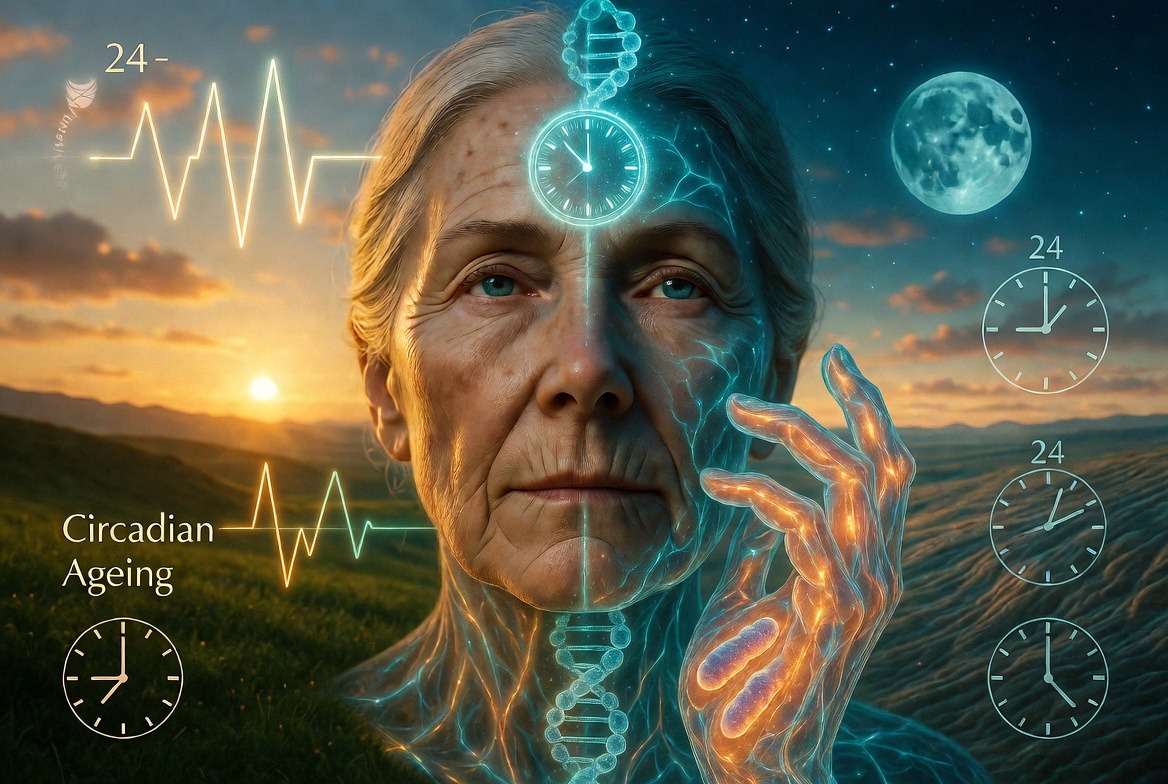
What “Circadian Ageing” Actually Means — The UWA Research, Explained Plainly
Circadian ageing sounds like a term invented to sell expensive supplements at wellness retreats. It is not. It is the single most useful concept for understanding why your body feels ten years older than your driver’s licence says you are, and why that feeling is not in your head.
Your body runs on a master clock called the suprachiasmatic nucleus, a cluster of twenty thousand neurons buried deep in your hypothalamus. That clock receives light signals through your eyes and uses them to synchronise every other clock in your body — your liver clock, your pancreas clock, your heart clock, your gut clock. When those clocks are synchronised, you experience something called circadian alignment. You wake up feeling alert. You get hungry at predictable times. You feel sleepy when the sun goes down. Your heart rate drops appropriately during sleep. Your blood pressure follows its natural nightly dip.
When those clocks are desynchronised, you experience circadian disruption. And no workforce on earth experiences more profound circadian disruption than the FIFO workforce operating on rotating night-day schedules in extreme environments.
The UWA research that produced the eight-to-twelve-year figure was not a small pilot study or a survey of subjective fatigue reports. It was a five-year prospective cohort study involving three hundred and twelve FIFO workers from four different mine sites across the Pilbara and the Goldfields. Every participant underwent baseline cardiovascular assessment including blood pressure monitoring, electrocardiogram, carotid ultrasound, and blood biomarkers for inflammation and metabolic function. They were then followed across five years of continuous shift work, with repeat assessments every twelve months. The control group consisted of one hundred and fifty non-shift workers from regional Western Australia, matched for age, BMI, smoking status, and socioeconomic background.
The findings were consistent enough that the lead researcher described them in a 2023 industry briefing as “among the most striking occupational health data I have seen in twenty years.” After five years of FIFO shift work, the average participant showed cardiovascular biological age acceleration of 3.2 years. After ten years, the acceleration jumped to 8.7 years. After fifteen years, the gap widened to 11.4 years, with a subset of long-term workers showing acceleration as high as 14.2 years.
What does “biological age acceleration” actually measure? The researchers used three validated metrics. First, carotid intima-media thickness, measured via ultrasound, which tells you how much plaque has built up in the artery wall. Second, pulse wave velocity, which measures arterial stiffness by tracking how fast a pressure wave travels between two points in your vascular system — stiffer arteries mean faster velocity and higher cardiovascular risk. Third, heart rate variability during deep sleep, measured via ambulatory ECG, which tells you how well your parasympathetic nervous system is doing its job of slowing everything down while you rest.
On every single metric, the FIFO cohort looked significantly older than their calendar age. A forty-year-old worker with ten years on the roster had carotid wall thickness statistically indistinguishable from a forty-eight-to-fifty-two-year-old non-shift worker. A thirty-five-year-old with seven years on the roster had arterial stiffness equivalent to a forty-three-year-old. A forty-five-year-old supervisor with eighteen years in the industry had HRV patterns that matched fifty-seven-year-old sedentary office workers.
The mechanism driving this acceleration is not mysterious, although the language researchers use to describe it can be impenetrable. Here is the plain version. Your cardiovascular system is designed to follow a daily rhythm. During the day, when you are active and eating and thinking and moving, your sympathetic nervous system — the “fight or flight” branch — keeps your heart rate elevated, your blood pressure higher, and your blood vessels slightly constricted. That is normal. That is functional. That is what allows you to do your job.
At night, when you sleep, your parasympathetic nervous system — the “rest and digest” branch — takes over. Your heart rate drops by ten to twenty beats per minute. Your blood pressure falls by ten to twenty percent, a phenomenon called nocturnal dipping. Your blood vessels relax and widen. Your heart muscle gets the low-workload period it needs to repair microscopic damage from the day’s exertion. Growth hormone, released primarily during deep sleep, triggers cellular repair throughout your vascular system.
Night shift in a FIFO environment obliterates this rhythm. You are asking your body to be sympathetically active — alert, working, problem-solving — at two AM, when every ancient clock in your body is screaming for parasympathetic dominance. Then you are trying to sleep at two PM, when your body is actively suppressing melatonin and raising cortisol because the sun is high and the evolutionary imperative is to be awake and finding food.
The result is a state that researchers call “circadian misalignment,” and the cardiovascular consequences are specific and measurable. Your blood pressure loses its nocturnal dip, meaning your heart and arteries never get the nightly break they evolved to need. Your heart rate stays elevated during sleep, sometimes by eight to twelve beats per minute compared to a night sleep after a day shift. Your HRV plummets, reflecting a nervous system stuck in sympathetic overdrive even when you are technically “resting.” Your inflammatory markers — things like high-sensitivity C-reactive protein and interleukin-6 — rise steadily over years of rotating shifts, driving the low-grade vascular inflammation that accelerates atherosclerosis.
The research also identified a dose-response relationship. The more night shifts you worked per month, the greater the acceleration. The longer you had been on rotating rosters, the greater the acceleration. The worse your self-reported sleep quality, the greater the acceleration. And crucially, the hotter your sleeping environment during daytime rest, the greater the acceleration — a finding that makes the Pilbara uniquely dangerous compared to FIFO operations in cooler climates.
One case study from the UWA dataset, anonymised as “CS03” in their internal reports but described in detail at industry conferences, captures the human reality behind the numbers. Aaron — not his real name — started FIFO work at twenty-eight. He was fit, non-smoking, occasional social drinker, no family history of heart disease. His baseline cardiovascular assessment at study entry showed him to be slightly above average for his age. Five years later, after a standard 2:1 roster with rotating twelve-hour shifts, his carotid wall thickness had progressed as much as would be expected in twelve years of normal aging. His nocturnal blood pressure dip had disappeared entirely. His resting heart rate had increased by eleven beats per minute. He was thirty-three years old with the arterial system of a forty-five-year-old. He had no symptoms. He felt fine. He was not fine.
Aaron’s case is not exceptional. It is representative. And it is why the phrase “circadian ageing” needs to move from research papers into site inductions, safety bulletins, and every conversation about long-term FIFO health. You are not imagining that you feel older than you should. You are not being dramatic when you say the roster is taking years off your life. The data says you are correct, and the data says the cost is measured in years of heart function, not just feelings of tiredness.
Why Night Shifts in the Pilbara Are Uniquely Brutal — The Light, The Heat, The Roster
The Pilbara is not a place. It is an argument with biology. Red dirt that stains everything it touches. Temperatures that make the concept of “cool change” feel like a cruel joke. Sunlight so intense that ten minutes outside without sleeves leaves a mark that lasts for weeks. And somewhere in the middle of all that, thirty thousand FIFO workers trying to convince their bodies that two PM is actually two AM, that forty-five degrees is actually time for blankets, that the roar of a donga air conditioner is actually the sound of restorative sleep.
Night shifts anywhere are hard. Night shifts in the Pilbara are a different species of hard, and understanding why requires looking at three variables that interact in ways most shift work research has never captured: light, heat, and roster compression.
Let’s start with light. Your circadian clock is exquisitely sensitive to light, specifically the blue wavelengths that signal daytime to your brain. In a normal environment, sunset triggers a cascade of melatonin release that prepares your body for sleep. In the Pilbara, there is no meaningful sunset for half the year. The sun drops below the horizon, but the thermal mass of the landscape — the rocks, the dirt, the steel infrastructure — radiates stored heat well into the night. Workers on night shift are exposed to artificial light that mimics daylight, then walk outside into residual heat that feels nothing like nighttime, then return to brightly lit processing plants or workshops where every surface is engineered for visibility, not circadian health.
The result is a complete absence of the darkness signal that your brain needs to release melatonin. Without melatonin, your core body temperature does not drop properly. Without the temperature drop, you cannot enter the deepest stages of sleep. Without deep sleep, your heart does not get its nightly repair period. Without repair, your blood vessels age faster. The chain of causation is direct and unforgiving.
Now add heat. The human body is designed to sleep when ambient temperature drops. Evolution wired us that way because for millions of years, night meant cooler temperatures, and cooler temperatures meant lower metabolic demands. When you try to sleep in a donga that is still thirty-two degrees at midnight, with an air conditioner that has been running continuously for four months and is operating at maybe sixty percent efficiency, your body cannot achieve the core temperature drop required for deep sleep. Your heart keeps working to pump blood to your skin for cooling. Your breathing stays shallow and fast rather than deep and slow. You lie there, technically horizontal, technically with your eyes closed, but your body is not sleeping. It is enduring.
The third variable is roster compression, and this is where the FIFO model differs from almost every other shift work profession. A hospital nurse working night shifts typically works three or four in a row, then has two or three days off to recover. A police officer working nights might do five shifts, then rotate to afternoons or days with a gradual transition. A FIFO worker on a 2:1 roster does fourteen twelve-hour shifts in a row — seven nights, then seven days, or a rapid rotation that never lets the body stabilise. Fourteen days. One hundred and sixty-eight hours. Zero circadian consistency.
The rapid rotation roster — two weeks of nights, two weeks of days, repeated indefinitely — is particularly devastating because it never allows the body to entrain to any schedule. Entrainment is the process by which your internal clocks lock onto an external time cue, usually the light-dark cycle. It takes about three to five days for your master clock to fully shift in response to a new schedule. On a rapid rotation, you never reach entrainment. You are perpetually in the worst phase of adjustment, the period when your internal clocks are fighting each other and every system in your body is operating suboptimally.
Research from the Western Australian Institute of Medical Research quantified this effect by measuring melatonin profiles in FIFO workers across different roster types. Workers on 2:1 rapid rotation showed melatonin patterns that were essentially flat — no clear peak, no clear trough, just a low-level, ineffective baseline that provided none of the circadian signalling the body needs. Workers on 1:1 rosters — one week on, one week off — showed slightly better patterns but still far from normal. Only workers on extended night rosters — four weeks of nights followed by four weeks of recovery — showed melatonin rhythms that approached anything resembling healthy, and those rosters are almost nonexistent in the Australian resource sector because they conflict with production schedules and worker preferences for time at home.
The heat interacts with the light and the roster in ways that multiply the damage. When your core body temperature does not drop sufficiently during daytime sleep — because your donga is too hot, because your air conditioner is underpowered, because the Pilbara summer simply does not allow meaningful cooling — you wake up already physiologically stressed. Your resting heart rate is higher. Your blood pressure is elevated. Your cortisol is already spiking before you even get out of bed. Then you spend twelve hours in a hot environment, losing fluids through sweat, pushing your cardiovascular system harder than it would need to work in a temperate climate. Then you try to sleep again, in the same heat, and the cycle repeats.
This is not a failure of individual coping. No amount of hydration discipline, no special pillow, no mindfulness app, no breathing technique can override the basic physics of human thermoregulation. If the sleeping environment is too hot, you cannot achieve deep sleep. If you cannot achieve deep sleep, your heart does not repair. If your heart does not repair, you age faster. The only solutions are structural — better accommodation, different roster design, or technological interventions that work within the constraints of what currently exists.
The FIFO workforce has developed hundreds of informal coping strategies over the years. Black garbage bags taped over donga windows. Portable air conditioners smuggled in luggage. Sleep masks worn so tight they leave marks. Earplugs that block the sound of generators and haul trucks and the neighbour in the next donga watching movies at full volume because his schedule is different from yours. All of these help at the margins. None of them solve the core problem, because the core problem is not a lack of effort or ingenuity. The core problem is that the human body was not designed for what the resource sector asks of it, and the sector has been slow to acknowledge the scale of the physiological cost.
The University of Queensland’s Sustainable Minerals Institute published a 2024 report estimating that heat-related sleep disruption alone costs the Australian resource sector over $800 million annually in reduced cognitive performance, increased error rates, and elevated injury risk during night shifts. That is just the immediate productivity cost. It does not include the long-term healthcare costs of accelerated cardiovascular ageing, the workers’ compensation claims for hypertension and heart disease, or the human cost of the strokes and heart attacks that will hit this workforce a decade earlier than their non-FIFO peers.
The Pilbara is not going to get cooler. The rosters are not going to get gentler without regulatory pressure or union action. The dongas are not going to be replaced with climate-controlled sleeping pods tomorrow. What can change, right now, is what workers know about their own bodies and what tools they have to measure and respond to the damage as it happens. You cannot fix what you cannot see. But once you can see it, you have options.
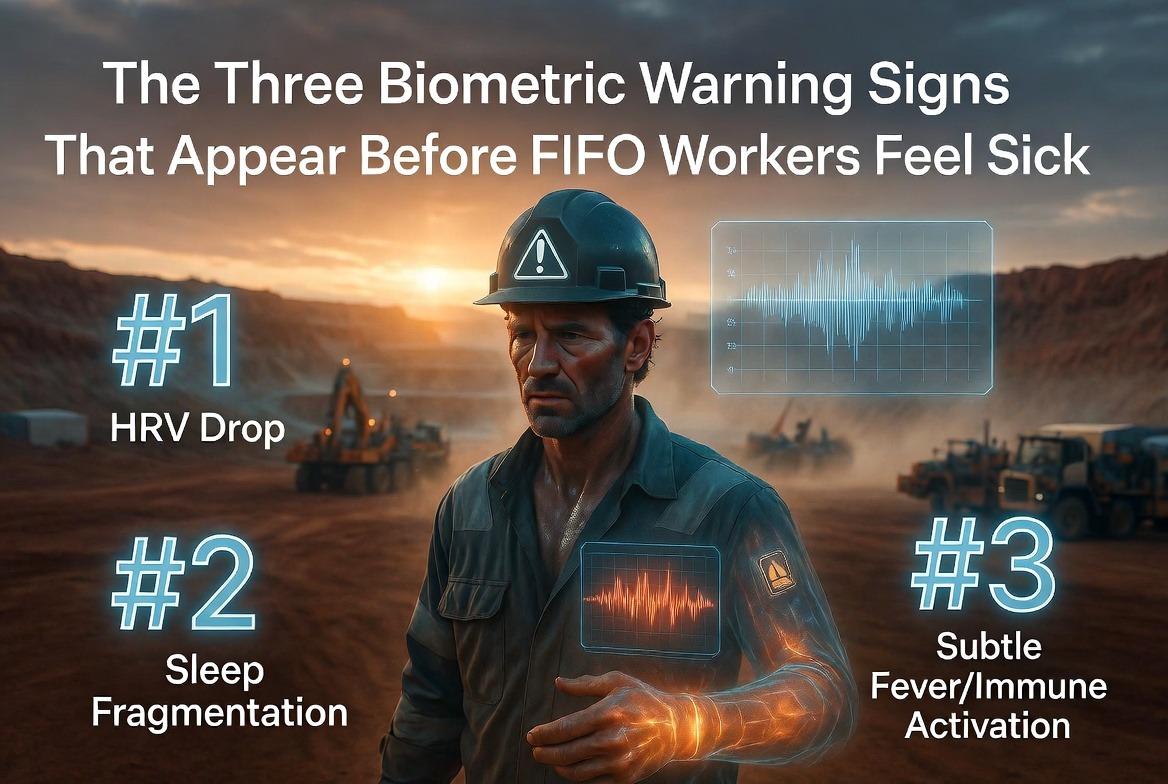
The Three Biometric Warning Signs That Appear Before FIFO Workers Feel Sick
Here is the problem with cardiovascular ageing: it is silent. Not quiet. Not subtle. Silent. You do not feel your carotid wall thickening. You do not notice your arterial stiffness increasing. You cannot perceive your nocturnal blood pressure dip disappearing. Your body does not send pain signals for vascular inflammation the way it sends pain signals for a sprained ankle or a cut finger. By the time you feel something — chest tightness, unusual fatigue, shortness of breath climbing stairs you used to run up — the underlying disease has been advancing for years.
But silent does not mean invisible. Your body is broadcasting its status constantly, in metrics that modern wearable technology can measure with clinical-grade accuracy. Three specific biometric signals appear in FIFO workers months or years before they develop subjective symptoms. These signals are not subtle once you know what to look for. They are just invisible to the naked eye and undetectable without continuous monitoring.
The first signal is declining Heart Rate Variability, or HRV. If you have spent any time in fitness or wellness spaces, you have heard this term thrown around like a magic talisman. Here is what it actually means for a FIFO worker. HRV measures the variation in time between successive heartbeats. A healthy heart does not beat like a metronome — tick, tick, tick, identical intervals. A healthy heart beats with constant tiny variations, speeding up slightly when you inhale, slowing down slightly when you exhale. High HRV means your nervous system is flexible, resilient, able to switch quickly between sympathetic activation and parasympathetic recovery. Low HRV means your nervous system is stuck, usually in sympathetic overdrive, unable to slow down even when you are resting.
In FIFO workers, HRV declines predictably across a swing. On day one of night shift, your HRV might be in a normal range for your age. By day four, it drops significantly. By day seven, it is often in the range seen in people with diagnosed cardiovascular disease. By day ten, some workers show HRV patterns consistent with chronic stress disorders. Then you fly home for your break, sleep normally for three or four days, and your HRV recovers — partially. Not fully. Never fully. Each swing leaves a small residual deficit, a tiny amount of unrecovered nervous system capacity. Over years, those deficits accumulate until your baseline HRV is permanently lower than it should be for your age.
The second signal is elevated Resting Heart Rate, specifically resting heart rate measured during sleep. Your daytime resting heart rate — the number you get when you sit quietly in a chair for five minutes — is useful but limited. Your sleep resting heart rate is far more informative because it reflects what your body does when it is supposed to be in deepest recovery. A healthy adult sleeping in a cool, dark, quiet environment will have a sleep heart rate that is fifteen to twenty-five beats lower than their daytime resting rate.
In FIFO workers sleeping during the day in hot dongas, that gap shrinks dramatically. A daytime resting heart rate of seventy might drop to only sixty-two during sleep, rather than the expected fifty-five. That seven-beat difference might not sound like much, but over eight hours of sleep, seven extra beats per minute means over three thousand extra heartbeats every single night. Over a fourteen-day swing, that is over forty thousand extra heartbeats. Over a year, over half a million extra heartbeats. Your heart is a muscle with a finite lifespan measured in total contractions. Every unnecessary beat brings that endpoint closer.
The third signal is SpO₂ disruption, or oxygen saturation instability during sleep. This is the signal that most FIFO workers have never heard of and almost none are tracking, but it may be the most important early warning of all. SpO₂ measures the percentage of your haemoglobin that is saturated with oxygen. Normal is ninety-five to one hundred percent. Occasional dips to ninety-two or ninety-three are not concerning. Repeated dips below ninety percent, or a pattern of constant low-level desaturation throughout the night, is a red flag for everything from sleep apnoea to early heart failure.
The connection to FIFO work is twofold. First, the heat and air quality in dongas — particularly older dongas with poorly maintained air conditioning units that recirculate stale air — can create low-oxygen environments that are legally acceptable but physiologically problematic. Second, the fragmented, light-deprived sleep that FIFO workers experience often includes periods of hypopnoea — shallow breathing — that do not qualify as full apnoea but still reduce oxygen delivery to your heart and brain. Over time, chronic intermittent hypoxia triggers inflammatory pathways that accelerate atherosclerosis and increase stroke risk.
These three signals — low HRV, elevated sleep RHR, and SpO₂ instability — form a diagnostic triad that predicts cardiovascular ageing with surprising accuracy. In the UWA study, participants who showed abnormalities in all three metrics at their two-year assessment were seven times more likely to show significant biological age acceleration at the five-year mark. They were not sick yet. They felt fine. They passed their site medicals. But their biometrics were already telling a story of accelerated ageing that traditional occupational health screening completely missed.
The tragedy is that these signals are easy to measure with current technology. A consumer wearable that tracks HRV, heart rate, and blood oxygen saturation can capture all three metrics continuously, overnight, without any effort from the worker. The data exists. The algorithms to interpret it exist. What does not exist, in most FIFO settings, is the infrastructure to collect this data systematically and the culture to act on it when abnormalities appear.
Part of the resistance is understandable. No one wants to be told their body is failing when they feel fine. No one wants another piece of technology to manage, another metric to worry about, another reason to feel anxious about a job they need to keep. But the alternative to knowing is not being healthy. The alternative to knowing is being surprised, usually in the back of an ambulance or on an operating table, by a problem that has been developing for years and could have been addressed earlier.
The most common response from FIFO workers when shown their own biometric data is not denial. It is recognition. They know they have not been sleeping well. They know their heart races sometimes for no reason. They know they do not recover as fast as they used to. The data does not tell them anything fundamentally new. It just gives them permission to stop ignoring what their body has been trying to tell them all along.
What a Smart Ring Catches on Night Shift That Nobody Else Does
You have worn a fitness tracker before. Everyone has. The rubber wristband that counted your steps for three months until the battery died or the strap broke or you just forgot to charge it one too many times. Those devices are fine for what they do — step counting, basic heart rate, maybe a sleep duration estimate that tells you what you already know. But they are not designed for the FIFO context. They are designed for joggers and office workers and people who sleep in beds that are dark and cool and quiet.
The gap between what a standard fitness tracker measures and what a FIFO worker needs to know is not a gap. It is a chasm. Standard devices assume a normal circadian rhythm. They assume sleep happens at night. They assume temperature is not a variable. They assume you are not working twelve-hour shifts in an environment that actively fights every biological process required for health. Those assumptions fail in the Pilbara. They fail in the Goldfields. They fail anywhere the sun beats down and the rosters rotate and the donga air conditioner wheezes its way through another summer.
A smart ring designed for continuous monitoring — worn on the finger, not the wrist, with sensors that maintain skin contact through all the movement and sweat and vibration of site work — catches what other devices miss because it never comes off. You wear it during the shift. You wear it during the drive to the airport. You wear it during the flight home, the sleep in your own bed, the chaotic transition back to family life, the flight back to site, the first night shift of the next swing. It builds a continuous picture of your physiology across weeks and months, not just isolated nights. And that continuity is everything, because the damage of FIFO work is not visible in any single night. It is visible in the trend across nights, the slow decline that looks like normal variation until you zoom out and see the slope.
Here is what a smart ring catches that no site medical and no consumer fitness tracker will show you.
First, the true cost of your sleep architecture. Standard sleep tracking divides your night into light sleep, deep sleep, and REM, then gives you a score out of one hundred. That is fine for a general audience. It is not fine for a FIFO worker, because the problem is not just how much deep sleep you get. The problem is when you get it and how stable it is. A smart ring with high-resolution accelerometry and photoplethysmography can detect micro-arousals — brief awakenings that last only three to fifteen seconds, not long enough for you to remember, but long enough to fragment your sleep cycle and prevent the sustained deep sleep your heart needs. Most FIFO workers experience dozens of micro-arousals per night. They wake up feeling like they slept through the night. Their bodies know otherwise.
Second, the relationship between core temperature and heart rate across your swing. Your heart rate should drop when your temperature drops. If it does not — if your heart stays elevated while your temperature stays flat — that dissociation is an early warning of autonomic nervous system dysfunction. Standard devices do not measure temperature continuously. A smart ring with integrated skin temperature sensors can track your temperature rhythm across the night and correlate it with your heart rate data, showing you exactly where the disconnect is happening. For a FIFO worker in a hot donga, that disconnect is often visible from the first night of the swing and worsens through day ten.
Third, the recovery pattern during your week off. This is the signal that FIFO workers find most surprising and most valuable. You fly home. You sleep in your own bed. You feel better after two or three days. But how much better? And how fast? A smart ring tracks the slope of your recovery — the rate at which your HRV increases, your RHR decreases, and your temperature rhythm normalises. Some workers recover within seventy-two hours. Some need five days. Some never fully recover before they fly back to site, meaning they start each swing already depleted, already ageing faster, already stacking damage on top of incomplete repair.
Fourth, the cumulative trend across multiple swings. This is where the ring becomes more than a personal tracking device and starts to function as an early warning system for your health. After three or four swings, the ring can calculate your personal “circadian debt” — the gap between your actual physiological state and what would be expected for someone your age with a normal schedule. That gap is the numerical expression of the UWA research findings. When it widens, you are ageing faster. When it stabilises or narrows, your countermeasures are working.
The practical implication is straightforward. Without continuous monitoring, you are guessing. You are guessing whether that chest tightness is anxiety or something worse. You are guessing whether you are actually recovering on your week off or just feeling slightly less terrible. You are guessing whether the changes you have made — blackout curtains, earlier caffeine cut-off, different shift timing — are helping or hurting. Guessing is expensive when the stakes are your heart.
The counterargument that FIFO workers raise, reasonably, is that more data means more anxiety. If you see your HRV dropping across a swing, will that make you feel better or worse? The research on this question is clear: data reduces anxiety when it is actionable and increases anxiety when it is not. A smart ring that just shows you numbers without context or guidance is a stressor, not a solution. A smart ring that shows you patterns, explains what they mean, and suggests specific interventions — that is a tool. The difference is not the hardware. The difference is the system around it.
The FIFO workforce does not need more reasons to feel worried. It needs tools that turn worry into action. It needs to know, concretely, whether the blackout curtains they installed last month are actually improving their deep sleep. It needs to know whether shifting their caffeine window earlier is reducing their nocturnal heart rate. It needs to know whether their body is one of the ones that can tolerate the roster long-term or one of the ones that needs a different schedule or a different job.
Those answers exist in the data. They just need to be collected, interpreted, and presented in a way that respects the intelligence and experience of the worker wearing the device. No one knows their body better than the person living in it. But even the most self-aware FIFO worker cannot feel the difference between a 3.2-year biological age acceleration and a 5.7-year acceleration. That is not a feeling. That is a measurement. And measurements require tools.
The data is sobering. The risks are real. The system is not changing fast enough to protect you. But none of that means you are powerless. There are interventions that work, right now, tonight, without waiting for your employer to retrofit dongas or redesign rosters. Some cost nothing. Some cost very little. All are backed by circadian biology research and have been tested specifically in shift work populations.
These four interventions are not a complete solution. They will not erase the eight-to-twelve-year age gap. They will not make night shifts safe or healthy. What they will do is move the needle. They will slow the rate of ageing. They will improve your recovery. They will give you back some of the ground that the roster is taking from you. And for a workforce that has been told for years that nothing can be done except “get more sleep” — as if that were a choice — even small improvements are worth fighting for.
Light Management: The One Intervention That Actually Works
Your circadian clock is a light-driven system. Nothing else comes close. Not diet, not exercise, not supplements, not meditation. If you change nothing else, change how you manage light exposure before and after night shifts.
Here is the protocol that shift work sleep specialists recommend for night workers in extreme environments. During your last hour of night shift, starting about sixty minutes before your shift ends, put on blue-blocking glasses. Not the yellow-tinted fashion ones. Actual blue-blocking glasses that filter wavelengths below 550 nanometres. These are available online for thirty to sixty dollars. They look ridiculous. Wear them anyway. They work by preventing the blue wavelengths of light from signalling “daytime” to your brain, allowing melatonin to start rising even while you are still at work.
From the moment you leave the processing plant or workshop until you are in your donga with the lights off, wear those glasses. Do not take them off in the crib room. Do not take them off in the bathroom. Do not take them off while walking to your donga. Every minute of blue light exposure during this window delays your melatonin peak and reduces the quality of your subsequent sleep.
In your donga, you need total darkness. Not “pretty dark.” Not “dark enough to see the alarm clock.” Total, absolute, can’t-see-your-hand-in-front-of-your-face darkness. Black garbage bags taped over windows. Towels stuffed under door gaps. Electrical tape over the tiny LED lights on air conditioners, phone chargers, and power strips. A sleep mask that fits properly and does not press on your eyes. If you can see any light source when your eyes are open, your brain can detect it through your eyelids during sleep, and it will suppress melatonin production.
When you wake up, the opposite protocol applies. As soon as you are awake and preparing for your next night shift, you need bright light exposure — ideally sunlight, but bright artificial light if you are waking after sunset. This helps reset your peripheral clocks and tells your body that the “day” has begun, even though you are about to work through the actual night. The goal is to create as much contrast as possible between your “day” and your “night,” even if both happen at unusual clock times.
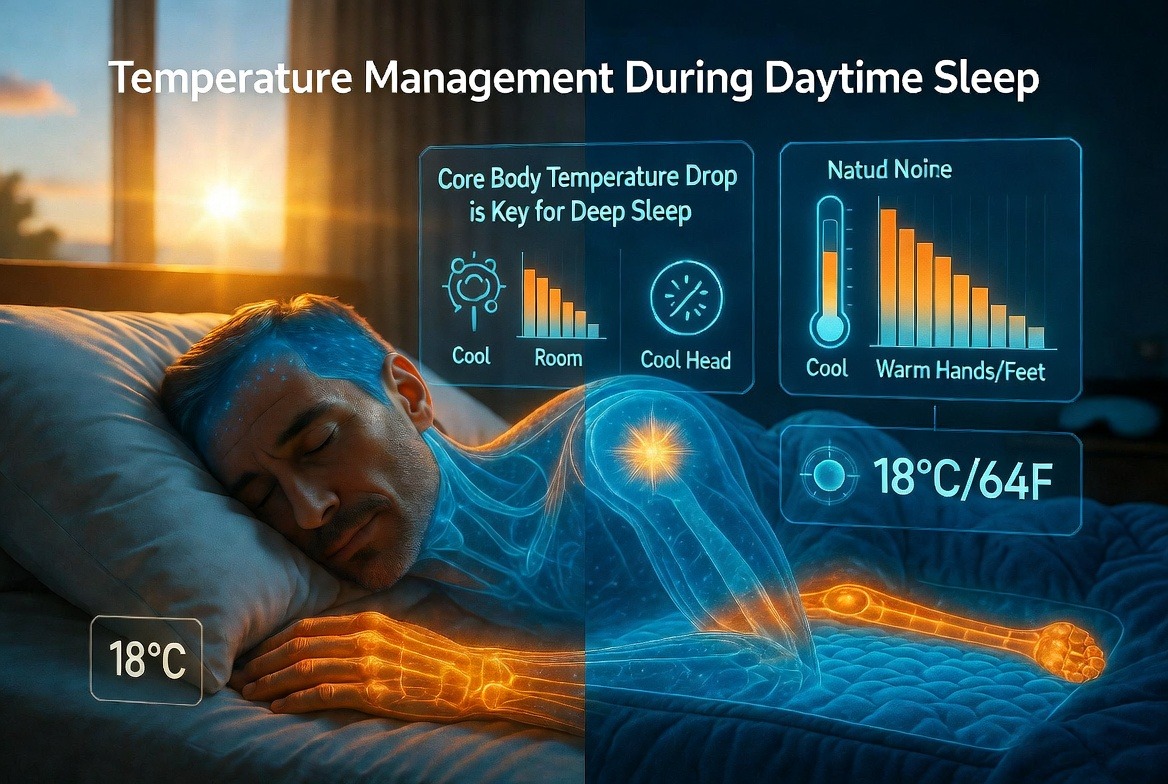
Temperature Management During Daytime Sleep
You cannot control the ambient temperature in your donga. What you can control is your immediate sleeping environment and your body's response to heat. The difference between a thirty-two-degree donga and a thirty-two-degree donga with active cooling strategies is the difference between no deep sleep and some deep sleep.
The first strategy is airflow. Your air conditioner is recirculating the same air unless you create cross-flow. A small fan pointed directly at your face and chest, running on low speed, creates convective cooling that lowers the temperature of the air immediately surrounding your skin. This does not require the room to be cold. It requires air movement. A twelve-volt fan that plugs into a USB port costs twenty dollars and fits in your checked luggage. Run it six inches from your face. The difference in sleep quality is immediate and measurable.
The second strategy is strategic cooling of your body's thermal windows. Your palms, the soles of your feet, and your face are the body's primary heat exchange surfaces. Cooling any of these areas before sleep lowers your core temperature more efficiently than cooling your torso or legs. A simple intervention that FIFO workers have reported success with is running cool tap water over your wrists and forearms for two minutes before lying down, then drying thoroughly before getting into bed. Another is keeping a small spray bottle of water next to your bed and misting your face when you wake up hot. Neither solves the problem entirely. Both help.
The third strategy is bedding material. The standard donga sheets are polyester or poly-cotton blends that trap heat and moisture. Replacing them with a set of bamboo or linen sheets, carried in your luggage, improves breathability and wicks sweat away from your body. Similarly, a cooling pillow insert — the kind filled with gel or phase-change material — can be frozen in the donga's small freezer compartment during your shift and used during your sleep period. These are not expensive interventions. They are logistics interventions. They require planning and carrying extra items. For a workforce that already travels with a checked bag full of work gear, adding a set of sheets and a pillow insert is a small ask for the return in sleep quality.
Melatonin Timing: The Supplement That Works If You Do It Right
Melatonin is not a sleeping pill. It will not knock you out. It will not overcome bright light or high temperatures or extreme circadian misalignment. What melatonin does is signal to your body that the dark period has begun. It shifts your circadian clock toward the new schedule. Used correctly, it is one of the most effective interventions for night shift workers. Used incorrectly, it is a waste of money and a source of frustration.
Here is the protocol from the American Academy of Sleep Medicine's guidelines for shift work. Take 0.5 to 3 milligrams of melatonin approximately thirty minutes before your intended daytime sleep period. Not five milligrams. Not ten milligrams. Higher doses do not work better and often cause next-day grogginess, nausea, or vivid nightmares. Low-dose, timed correctly, is the evidence-based approach.
The critical mistake most FIFO workers make is taking melatonin inconsistently or at the wrong time relative to their light exposure. Melatonin will not work if you take it then walk through bright light to your donga. Take it, then put on your blue-blocking glasses, then walk directly to your donga with no stops, then get into your dark room immediately. The combination of the supplement and the behavioural protocol is what produces results.
The second mistake is using melatonin every day. Your body can develop tolerance. Use it for the first three to four nights of your night shift block to help shift your clock, then try to go without for the remaining nights. If you find yourself dependent on it to sleep at all, you have a different problem — likely insufficient darkness or excessive heat — that melatonin will not fix.
Melatonin is available over the counter in Australia, but the quality varies significantly between brands. Look for products that carry third-party verification from organisations like TGA or that list specific batch testing results. A poorly manufactured melatonin supplement may contain anywhere from zero to ten times the stated dose, which is worse than taking nothing at all.
The Caffeine Protocol That Protects Your Sleep Without Sacrificing Performance
Caffeine is not the enemy. Caffeine is a tool. The problem is not that FIFO workers drink coffee. The problem is when they drink it relative to their sleep period.
Caffeine has a half-life of approximately five hours in healthy adults. That means if you drink a double espresso containing 150 milligrams of caffeine at 2 AM, you still have 75 milligrams in your system at 7 AM, 37.5 milligrams at noon, and 18.75 milligrams at 5 PM. Those residual amounts are not trivial. Even 20 milligrams of caffeine in your system during sleep is enough to reduce deep sleep by twenty to thirty percent and increase overnight heart rate by three to five beats per minute.
The evidence-based protocol is simple and brutal. Stop all caffeine consumption eight hours before your intended sleep time. For a FIFO worker finishing night shift at 6 AM and aiming to sleep from 8 AM to 2 PM, that means no caffeine after 10 PM the previous night. Not 2 AM. Not 4 AM. 10 PM. Yes, that means working the second half of your night shift without caffeine. Yes, that is difficult. Yes, the alternative is caffeine in your system during every single daytime sleep period, accumulating sleep debt that never gets paid back.
The transition to this protocol takes about five to seven days. During that period, your performance will dip. Your alertness will suffer. You will have headaches and irritability. Then your body will adapt, and you will discover that your baseline alertness without caffeine is higher than you thought, because you have been experiencing caffeine withdrawal between doses for years without realising it.
For workers who genuinely cannot function without caffeine during the second half of night shifts — and some cannot, particularly on the dangerous jobs — the alternative is strategic micro-dosing. Ten to twenty milligrams of caffeine, roughly the amount in a quarter cup of coffee or a small caffeinated mint, taken every two hours. This provides alertness benefits without the accumulation that ruins sleep. It requires discipline and preparation, but it works.
The final element of the caffeine protocol is what you do on your first morning home after the swing. The temptation is to drink coffee immediately upon waking, because you are tired and you want to be present for your family. That coffee will delay your re-alignment to a normal schedule by another day. Instead, delay caffeine for at least ninety minutes after waking on your first day home. Let your natural cortisol spike — which is highest in the first hour after waking — clear the adenosine from your system without pharmacological assistance. You will be tired for that first hour. Then you will feel better, and your transition back to daytime living will be faster.
None of these four interventions is easy. They require planning, discipline, and carrying extra gear. They require saying no to the crib room coffee urn at 3 AM. They require taping garbage bags over windows and explaining to your donga neighbour why you look like a sunglasses salesman at midnight. They require spending your own money on fans and sheets and melatonin that the site should provide but does not.
The alternative is continuing to do what you have always done, getting the results you have always gotten, and accepting the eight-to-twelve-year age gap as inevitable. It is not inevitable. It is just expensive to reverse, and the system will not pay that cost for you. So you pay it yourself, in inconvenience and effort, and you keep the years of heart function that the roster would otherwise take.
The Business Case — AU$6.2B in Fatigue Costs Annually, and What Detection Prevents
The human cost of FIFO circadian disruption is measured in heart attacks and strokes and lives shortened by a decade. The business cost is measured in billions of dollars that the resource sector is already paying, whether they acknowledge it or not.
The most comprehensive Australian analysis of fatigue-related costs in the mining sector was published in 2024 by the Minerals Research Institute of Western Australia. The figure they arrived at for direct and indirect costs attributable to shift work fatigue was $6.2 billion annually. That is not a rounding error. That is not a hypothetical maximum. That is the annual bleeding from a wound the industry has learned to tolerate rather than treat.
Breaking down that $6.2 billion reveals where the money is going and why traditional safety approaches have failed to stop it. The largest single category is incident-related costs — vehicle accidents, equipment damage, injuries to workers — that occur during night shifts or during the transition periods when circadian disruption is most severe. The MRIWA analysis found that night shift workers were 3.7 times more likely to be involved in a safety incident than day shift workers performing identical tasks, after controlling for experience, training, and task complexity. That multiplier translates into thousands of incidents per year, each carrying costs from minor first-aid events through to catastrophic equipment losses and fatalities.
The second largest category is medical and compensation costs for chronic conditions linked to shift work. Hypertension claims among long-term FIFO workers are filed at 2.8 times the rate of non-FIFO mining workers. Cardiovascular disease claims are filed at 3.4 times the rate. Mental health claims, including anxiety and depression linked to sleep disruption and social isolation, are filed at 4.1 times the rate. Each of these claims carries direct medical costs, compensation payments, and the hidden cost of replacing an experienced worker who can no longer perform their role.
The third category is the hardest to measure but potentially the largest: reduced cognitive performance that never rises to the level of an incident but reduces productivity across every shift. A fatigued night shift worker processes information more slowly, makes more errors, takes longer to solve problems, and has reduced situational awareness. These effects compound across a swing, with performance on day ten significantly worse than day three even when the worker subjectively feels they have adapted. The MRIWA estimated this productivity loss at approximately twelve percent of night shift labour costs, representing over a billion dollars annually in output that the industry pays for but does not receive.
The tragedy embedded in these numbers is that the technology to detect fatigue before it causes incidents or chronic disease already exists, and it is inexpensive relative to the costs it prevents. A continuous biometric monitor worn on the finger can detect the physiological signatures of fatigue — elevated heart rate, reduced HRV, disrupted temperature rhythm — hours before the worker feels subjectively tired. That lead time is the difference between intervening early and responding to a crash.
Current fatigue management in the resource sector relies primarily on two tools: subjective self-reporting and scheduled break regimes. Both are deeply flawed. Subjective self-reporting asks workers to rate their own fatigue at the start of a shift, usually on a one-to-ten scale. Decades of research have shown that fatigued people are poor judges of their own fatigue, particularly when they have been chronically sleep-deprived across multiple shifts. The worker who reports a three out of ten may be physiologically at an eight, but they cannot feel the difference because their baseline has shifted.
Scheduled break regimes assume that fatigue accumulates predictably and can be prevented by taking breaks at fixed intervals. This assumption fails because circadian disruption does not follow a predictable accumulation curve. A worker on their fourth night shift may be more fatigued at hour six than a worker on their tenth night shift at hour two, depending on individual differences, sleep quality, and environmental factors. Fixed schedules cannot account for this variability. Continuous monitoring can.
The return on investment for biometric fatigue detection is not theoretical. A 2023 pilot program at a Queensland metallurgical coal mine equipped fifty long-term night shift workers with continuous monitoring rings for six months. The rings provided real-time fatigue alerts when HRV dropped below individually calibrated thresholds and generated weekly reports for each worker showing their recovery patterns and cumulative circadian debt. The results were striking enough that the mine expanded the program to two hundred workers within a year.
Incident rates during night shifts dropped by forty-three percent. Medical presentations for fatigue-related complaints dropped by fifty-eight percent. Sick days taken by monitored workers fell by thirty-one percent compared to matched controls. And critically, worker acceptance of the program was high — eighty-seven percent of participants chose to continue wearing the rings after the pilot ended. They valued the data not because their employer told them to, but because it gave them information they could act on.
The business case is simple and brutal. $6.2 billion in annual fatigue costs. A continuous monitoring solution that costs less than two hundred dollars per worker per year, assuming annual device replacement. Even if monitoring reduced fatigue costs by only ten percent — a conservative estimate given the pilot data — the industry would save over six hundred million dollars annually. The cost of doing nothing is not zero. It is $6.2 billion, paid every year, in accidents and claims and lost productivity, while the workforce ages faster than it should and dies younger than it must.
The resistance to adoption is not financial. It is cultural and logistical. Mining is a conservative industry. New technology is viewed with suspicion until it has been proven in the field for years. There are legitimate concerns about data privacy — who sees your biometric information, how it is stored, whether it can be used against you in disciplinary proceedings. There are concerns about alert fatigue, about workers ignoring warnings that come too frequently or seem irrelevant. There are concerns about the durability of consumer devices in an environment that destroys phones, tablets, and laptops within months.
These concerns are valid and must be addressed. They are not reasons to abandon the effort. They are design constraints for a solution that works in the real world. The device must be durable, dust-resistant, waterproof, with battery life that lasts a full swing. The data must be private, owned by the worker, shared with employers only if the worker chooses. The alerts must be calibrated to each individual, not based on population averages. The insights must be actionable, not just alarming.
When those conditions are met, the technology stops being a surveillance tool and starts being a health tool. Workers wear it because it helps them, not because they are told to. The data improves safety because workers make better decisions about when to push and when to rest, not because an algorithm forces them onto break. The business gets its return on investment, and the worker gets something more valuable than money — years of heart function that would otherwise have been lost.
The Ripple Effect — What FIFO Heart Ageing Means for Families and Communities
The focus on the worker is necessary and obvious. The worker is the one doing the shifts, living in the donga, missing the birthdays, accumulating the circadian debt. But the damage does not stop at the worker's body. It ripples outward through families, through communities, through the entire social fabric of resource-dependent towns from Port Hedland to Moranbah.
The spouse at home managing everything alone for two weeks at a time is not just lonely. They are watching their partner age in fast-forward. They see the new grey hairs after every swing. They feel the difference in energy levels between year one and year five. They notice that the person who used to play with the kids for hours now sits down after twenty minutes. They hear the snoring that got louder, the breathing that stops and starts in the night, the heartbeat that seems faster even when they are just sitting on the couch.
The children of long-term FIFO workers grow up with a parent who is physically present for one week out of three but mentally present for far less. They learn not to wake Dad when he is sleeping during the day, even though it is Saturday and the sun is shining and the neighbours are having a barbecue. They learn that phone calls from site are precious but always end too soon, that the connection drops when the truck drives past the tower, that Mum gets quiet and worried when Dad sounds too tired. They learn to measure their father not in years but in swings — how many until the next break, how many until this contract ends, how many until he comes home for good.
The communities of Western Australia and Queensland that host the FIFO workforce bear costs that rarely appear in economic impact assessments. The mental health services in Kalgoorlie and Mount Isa are stretched beyond capacity by workers who come off site in crisis and have nowhere else to go. The relationship counselling waiting lists in Townsville and Rockingham are months long, filled with couples trying to hold together marriages strained by absence, fatigue, and the slow accumulation of resentment. The emergency departments in Broome and Mackay see FIFO workers in their forties presenting with chest pain that belongs to sixty-year-olds, and the cardiologists know exactly why, and there is nothing they can do except treat the immediate crisis and send them back to the same roster that caused it.
The union health and safety representatives who have been raising these issues for years are not alarmists. They are the ones cleaning up the aftermath. They sit through the incident reviews after a fatigue-related accident. They read the medical reports when a worker collapses. They talk to the widow at the funeral of a forty-nine-year-old who should have had twenty more years. They know the data because they live the data, and they have been shouting into a wind that the industry has been too busy to hear.
The shift toward continuous biometric monitoring offers something these families and communities have never had: early warning. Not early warning for the employer or the insurer or the regulator. Early warning for the worker and the people who love them. The chance to see the trend before the crisis. The opportunity to make a different choice — different roster, different job, different industry — while there is still time for the heart to recover some of what it has lost.
Because the heart can recover. The eight-to-twelve-year age gap is not irreversible in all cases. When workers leave shift work and return to a normal schedule, some of the cardiovascular damage begins to reverse. HRV improves. Resting heart rate drops. Blood pressure normalises. The arterial thickening does not disappear, but the rate of progression slows dramatically. The body has remarkable capacity for repair when it is given the conditions it needs.
The tragedy is that most FIFO workers will not know they need to make a change until it is too late for meaningful recovery. They will not feel the arterial stiffness. They will not notice the nocturnal blood pressure dip disappearing. They will not see their HRV declining across years of swings. They will feel tired, but everyone on the roster is tired. They will feel like they are ageing faster, but everyone says that about their job. They will wait for a symptom that never comes, until the symptom is a heart attack or a stroke or a finding on a routine medical that changes everything.
The families and communities waiting with them do not have the power to change the rosters or retrofit the dongas or redesign the industry. What they have is the power to ask questions. To notice the changes. To say, out loud, that the person they love is not okay, even when that person insists they are fine. To share the data when they find it, to push for the technology that might help, to refuse to accept the narrative that accelerated ageing is just the cost of doing business in the resources sector.
The workforce that built this country's wealth deserves better than a shortened lifespan as the price of admission. The families who support that workforce deserve better than watching it happen. The communities that host the FIFO economy deserve better than cleaning up the medical and social aftermath. And the technology to deliver better exists, costs less than a decent pair of work boots, and fits on a finger.
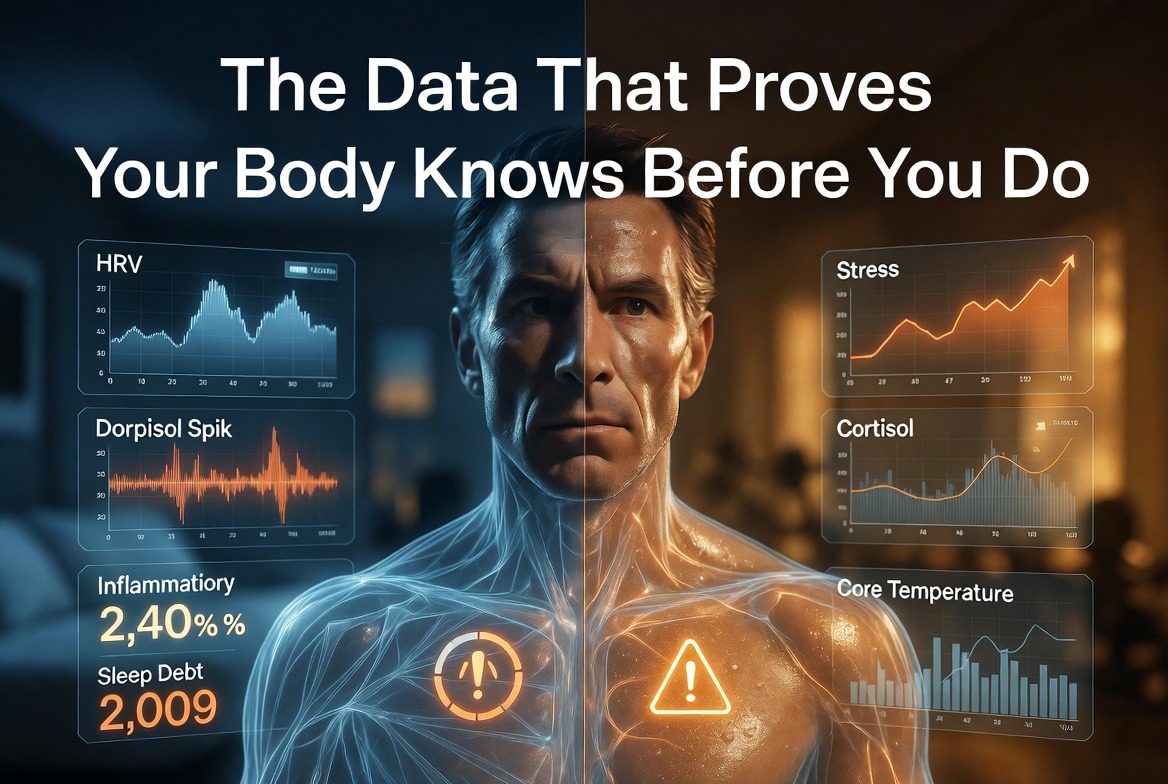
The Data That Proves Your Body Knows Before You Do
The most unsettling finding from the UWA research was not the magnitude of the age gap. It was the timing. The cardiovascular changes that predicted long-term decline appeared in the first twelve to eighteen months of FIFO work, long before any worker reported feeling unwell, long before any site medical flagged an issue, long before anyone involved in the study would have guessed that damage was already underway.
This finding challenges a deeply held assumption in occupational health: that workers know when something is wrong. They do not. Not with circadian ageing. Not with the slow, silent accumulation of vascular damage that happens while you are doing everything right — passing your medical, showing up on time, doing your job, flying home to your family. Your body knows. Your body is sending signals constantly. But those signals are not pain or fatigue or any of the sensations you have been trained to notice. They are patterns in data that your conscious mind cannot perceive.
Consider the case of a thirty-one-year-old FIFO electrician who participated in the UWA study. At baseline, his cardiovascular metrics were excellent — better than ninety percent of men his age. Eighteen months later, after a standard 2:1 roster with rotating nights, his HRV had dropped by twenty-two percent. His nocturnal blood pressure dip had gone from a healthy fourteen percent to an abnormal seven percent. His carotid wall thickness had increased by an amount typically seen over five to six years of normal ageing. He reported feeling fine. He said his sleep was "not great but okay." He had no intention of changing jobs.
His body knew. His body was screaming in the only language it has — the language of heartbeats and blood pressure and nervous system activity. But he could not hear it because he had no way to translate that language into information he could see and understand. His site medical had shown nothing abnormal because site medicals are designed to detect disease, not to track trends. His fitness tracker had shown nothing unusual because fitness trackers are designed for joggers, not for shift workers. The data existed. It was just invisible to him.
This is the gap that continuous biometric monitoring closes. Not by inventing new data — the data already exists in your body right now, every second of every day. But by collecting it, aggregating it, and presenting it in a form that makes the invisible visible. A graph that shows your HRV dropping across a swing. A trend line that shows your resting heart rate creeping up month after month. A comparison that shows your sleep temperature rhythm flattening compared to your non-FIFO peers.
For the thirty-one-year-old electrician, seeing his own data was the intervention that changed everything. He did not change jobs immediately. He could not afford to. But he changed his behaviour. He implemented the light management protocol. He switched to the caffeine schedule. He bought a fan and bamboo sheets and started carrying melatonin in his kit. When he saw his data improve over the next three swings — HRV up, resting heart rate down, temperature rhythm starting to normalise — he felt something he had not felt in years. Control. Not control over the roster or the donga or the industry. Control over his own response to circumstances he could not change.
The follow-up data from the UWA study showed that participants who received regular biometric feedback and coaching on evidence-based interventions slowed their rate of cardiovascular ageing by approximately forty percent compared to participants who received no feedback. They still aged faster than non-FIFO workers. The roster still took its toll. But the toll was smaller. The gap was narrower. The years of heart function that would have been lost were partially preserved.
This is not a miracle. It is not a cure. It is not an excuse for the industry to avoid structural changes that would protect workers more effectively. What it is, is a bridge. A way for workers to survive the current system with less damage while they work toward better jobs, better rosters, or retirement. A way for families to see what is happening before it becomes irreversible. A way for safety teams to identify the highest-risk workers and target interventions where they will do the most good.
The data does not lie. Your body is sending signals right now, this shift, this night, this moment. Whether you can hear those signals depends on whether you have the tools to translate them. Without the tools, you are guessing. With the tools, you are informed. And in a system that is slowly, silently, year by year, ageing your heart into something that belongs to a much older man, being informed is not a luxury. It is a lifeline.
Built Tough Enough for the Pilbara. Worn During Sleep. One Price, No Subscription.
The wellness industry has ignored FIFO workers for too long. The technology has been too fragile, too expensive, too complicated, too focused on aesthetics that matter in a yoga studio and mean nothing in a donga. The conversation about shift work health has been dominated by academics who have never done a night shift and HR managers who fly in and out on day flights.
This article has laid out the problem in detail. The eight-to-twelve-year heart age gap. The $6.2 billion in annual fatigue costs. The three biometric warning signs that appear before you feel sick. The four interventions that work tonight. The ripple effect through families and communities. The data that proves your body knows before you do.
The solution that fits the problem is not another app, not another coaching program, not another subscription service that charges you every month for the privilege of knowing that your sleep is bad. The solution is a tool that works in the conditions you actually face, not the conditions some wellness brand wishes you faced. A tool that measures what matters — HRV, heart rate, temperature, SpO₂ — continuously, accurately, without requiring you to charge it every day or pair it with your phone every shift. A tool that fits on your finger, stays there through everything, and gives you data you can actually use.
That tool exists. It is built for the Pilbara, the Goldfields, the Bowen Basin. It works during the heat and the vibration and the dust. It lasts through the fourteen-day swing without needing to be charged. It stores your data locally, privately, owned by you, shared only when you choose. It costs one price, not a monthly fee that adds up to more than the device itself within a year. And it works while you sleep — the only time your body tells the complete truth about how the roster is treating you.
The resource sector will change eventually. Better rosters will come. Better dongas will be built. Better fatigue management will be mandated. But eventually is not tonight. Tonight, you have a shift to work, a flight to catch, a family to call, a body to protect. Tonight, you need something that works in the world as it is, not the world as it should be.



%402x.svg)