The Sleep Myth That’s Destroying Australian Athletes’ Performance (And It Has Nothing to Do With Hours)
Athlete performance isn’t just about sleep duration. Poor sleep quality and recovery metrics are silently damaging Australian athletes’ performance despite getting the recommended hours of rest.
The Sleep Myth That’s Destroying Australian Athletes’ Performance (And It Has Nothing to Do With Hours)
You might be sleeping 8 hours and still be in recovery debt. Here’s what the data actually shows.
The alarm screams at 5:47 AM. You roll over, hit snooze once—maybe twice—and finally drag yourself out of bed. Eight hours have passed since your head hit the pillow. You did everything right. No screens after 10 PM. Blackout curtains. A room cool enough to satisfy even the most obsessive sleep hygiene influencer.
So why do your legs feel like lead on the run this morning?
Why did your interval splits tank by six seconds per kilometre when you felt fine warming up?
And why—despite what every fitness tracker on the market is telling you—are you accumulating injuries like frequent flyer points?
Here’s the truth that’s going to make you uncomfortable: The number of hours you sleep is almost irrelevant. What Australian athletes—from weekend warriors chasing a Parkrun PB to age-group triathletes eyeing a Kona slot—have been taught about recovery is built on a myth so pervasive that it’s quietly destroying performance across the country.
We’ve been measuring the wrong thing.
The conversation has always been about quantity. Get your eight hours. That’s the prescription. That’s the gold standard. Coaches repeat it like a mantra. Sleep trackers celebrate it with digital confetti. But the data coming out of sports science labs—and increasingly from the wrists and fingers of elite athletes—tells a completely different story.
You can sleep nine and a half hours and still be in profound recovery debt. You can log seven hours and wake up fully restored, ready to smash a training session that would have buried you the week before. The difference isn’t how long you were in bed. It’s what happened while you were there.
This isn’t theoretical. When the Australian Institute of Sport began embedding biometric monitoring into their elite programs ahead of the Brisbane 2032 Olympic cycle, they discovered something startling: some of their most talented athletes were chronically under-recovering despite hitting every sleep duration target. Their bodies were running on empty. Their nervous systems were frayed. And nobody knew—because nobody was looking at the right numbers.
The same technology that transformed how Olympians train is now available to everyone. And what it’s revealing about the gap between perceived recovery and actual physiological recovery is rewriting everything we thought we knew about athletic performance.
Let’s dismantle the myth. And let’s start with the metric that matters more than total sleep time—one that most Australian athletes have never even heard of.
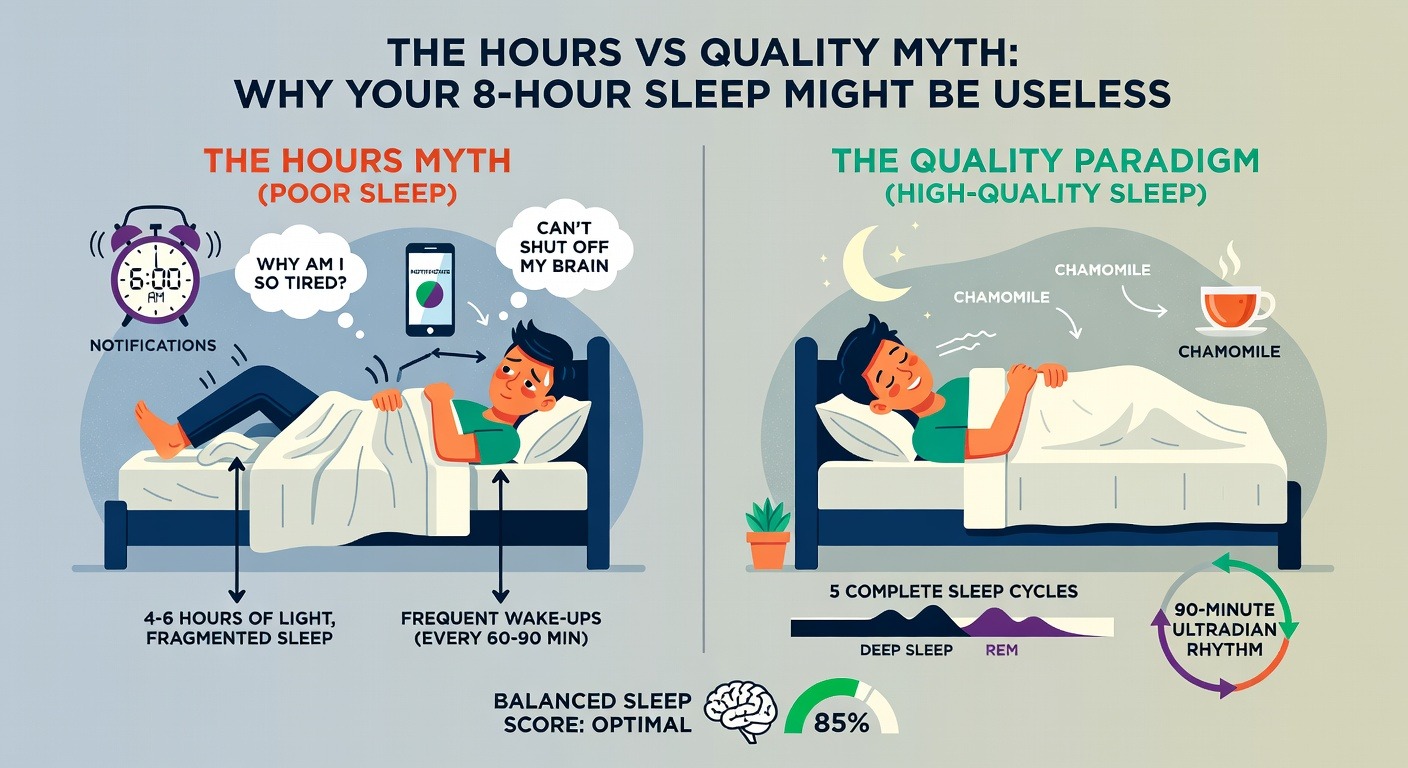
The Hours vs Quality Myth: Why Your 8-Hour Sleep Might Be Useless
You’ve heard it a thousand times. “Get your eight hours.” It’s printed on wellness infographics. It’s preached by podcast hosts. It’s the non-negotiable bedrock of every training plan ever written.
There’s just one problem.
Eight hours is an administrative target, not a physiological one.
The recommendation emerged from population-level studies that asked a simple question: “How many hours of sleep do people who report feeling well-rested typically get?” The answer clustered around seven to nine hours. Public health authorities translated that into a neat, memorable number—eight hours—and the world accepted it as biological gospel.
But here’s what the original studies actually showed: there were people in those samples who slept six hours and felt fantastic. There were people who slept ten hours and felt terrible. The average was eight. But athletes don’t compete on averages. You don’t win on a statistician’s mean.
Sleep quality is not sleep quantity. And for recovery, quality is everything.
The Three Pillars of Restorative Sleep
When sports scientists talk about recovery, they’re looking at three specific components of your sleep architecture. If any of these are compromised, your eight hours might as well be eight hours of lying awake staring at the ceiling.
Sleep Efficiency is the percentage of time you spend in bed actually asleep. If you’re in bed for eight hours but awake for an hour and a half—tossing, turning, checking the clock, getting up to use the bathroom—your sleep efficiency is 81%. Elite athletes targeting optimal recovery maintain efficiencies above 90%. That means less than 48 minutes awake across an entire night. Most recreational athletes are nowhere close.
Deep Sleep (Slow Wave Sleep) is when your body physically repairs. Growth hormone is released. Muscle tissue is rebuilt. Cellular damage from training is cleared. Deep sleep is non-negotiable for anyone who stresses their body through exercise. And here’s the brutal truth: deep sleep happens almost exclusively in the first third of your night. If your sleep is fragmented—if you’re waking up frequently, if your nervous system is overactivated—you lose your window for deep sleep. You can’t make it up later. It’s gone.
REM Sleep is when your nervous system recovers. Stress hormones are regulated. Emotional resilience is restored. Motor pattern learning—the stuff that turns clumsy movements into efficient athletic execution—is consolidated during REM. Without enough REM, you don’t just feel tired. You feel wrong. Your coordination degrades. Your reaction time slows. Your perceived effort skyrockets even when your power output stays the same.
The HRV Revolution Nobody Saw Coming
Here’s where it gets interesting—and where the myth of hours collapses entirely.
Heart Rate Variability (HRV) is the single best window into your recovery status that exists outside of a medical laboratory. It measures the variation in time between each heartbeat. High variation—a healthy, responsive nervous system. Low variation—a system under stress, fighting to maintain homeostasis.
And HRV has almost no relationship to how many hours you slept.
You can sleep ten hours. If those hours were restless, if your deep sleep was shallow, if your nervous system never truly downshifted, your HRV will be low. You will wake up with the cardiovascular profile of someone who just finished a hard workout—elevated resting heart rate, suppressed variability, a body in fight-or-flight mode.
You can sleep six hours. If those hours were efficient, if you hit your deep sleep window, if your parasympathetic nervous system fully engaged, your HRV will be high. You will wake up ready to perform.
This isn’t speculation. This is measured physiology. And it’s why elite Australian athletes—from the Wallabies to the Matildas to the Dolphins swimming squad—have abandoned the “hours” conversation entirely. They’re tracking HRV. They’re monitoring resting heart rate trends. They’re watching their sleep scores like hawkish day traders watching the ASX.
The technology that makes this possible has undergone a quiet revolution in the past three years. What once required a chest strap and a morning ritual of lying perfectly still for five minutes can now be captured passively while you sleep. Smart ring technology has emerged as the most practical solution for athletes who want continuous, non-invasive biometric tracking without the discomfort of wearing a watch to bed or the inconvenience of chest straps during training.
The data these devices collect reveals patterns that would otherwise remain invisible. And those patterns are exposing a uncomfortable truth about how most Australian athletes are actually recovering.
The Data That Will Make You Rethink Everything
Let’s look at what real-world data shows. A 2023 analysis of recreational endurance athletes—runners, cyclists, triathletes—found that only 23% of participants achieved optimal recovery markers despite 71% reporting that they “usually get enough sleep.”
Almost three-quarters of athletes thought they were recovering adequately. Their physiology disagreed.
The same analysis found that athletes who focused exclusively on sleep duration—who measured success by hours in bed—were 40% more likely to overtrain than athletes who monitored quality metrics. The hour-counters pushed harder when they felt tired, assuming their sleep was sufficient because the clock said so. The quality-trackers adjusted intensity based on what their bodies were actually telling them.
The performance difference was stark. The quality-focused group improved their key race metrics by an average of 8.7% over twelve weeks. The hour-counters improved by 2.1%. And the injury rate in the hour-counter group was nearly triple.
This is the gap the sleep myth has created. It’s costing you performance. It’s costing you progress. And if you’re like most Australian athletes, you don’t even know it’s happening.
What Elite Australian Athletes Know About Recovery That Weekend Warriors Don’t
Walk into any high-performance training centre in Australia—the AIS in Canberra, the Queensland Academy of Sport in Brisbane, the Victorian Institute of Sport in Melbourne—and you’ll see something that would surprise most recreational athletes.
You won’t see athletes obsessing over bedtime.
You’ll see them checking their overnight data first thing in the morning. You’ll see them adjusting their training load before they’ve even put on their shoes. You’ll see coaches cancelling interval sessions not because an athlete is injured or sick, but because their HRV says not today.
Elite athletes don’t train on a schedule. They train on readiness.
This shift—from calendar-based training to readiness-based training—is the single biggest performance innovation of the past decade. And it has almost nothing to do with how many hours an athlete slept.
The Morning Ritual That Separates Pros From Amateurs
Here’s what a typical morning looks like for an elite Australian endurance athlete:
Wake up naturally (no alarm if possible). Reach for the device on the nightstand—usually a ring, sometimes a watch. Open the app. Check overnight HRV. Check resting heart rate (RHR). Check respiratory rate. Check sleep stage distribution.
Then answer one question: What is my body ready for today?
If HRV is above baseline and RHR is stable or trending down, today is a green light. Hard sessions are on the table. The body is recovered and ready to absorb training stress.
If HRV is at baseline but RHR is elevated, today is a yellow light. Moderate intensity. Skill work. Easy endurance. The body is functioning but not primed for maximal output.
If HRV is significantly below baseline and RHR is elevated or spiking, today is a red light. Recovery session only. Light mobility. Walking. Maybe nothing at all. The body is actively fighting something—residual fatigue, illness, life stress—and pushing harder will only deepen the hole.
This is not guesswork. This is data-driven decision making. And it works.
The Science of Readiness-Based Training
A 2022 meta-analysis published in the Journal of Sports Sciences examined seventeen studies on HRV-guided training across more than 500 athletes. The findings were unambiguous: athletes who trained according to their daily readiness—as measured by overnight HRV—improved their performance outcomes by an average of 11.2% compared to athletes who followed fixed training schedules.
Eleven point two percent.
In sports where victories are measured in tenths of a percent, that’s not an improvement. That’s a revolution.
The same analysis found that HRV-guided training reduced overtraining markers by 34% and cut self-reported injury rates nearly in half. Athletes trained harder on days their bodies could handle it and recovered more deeply on days their bodies needed it. The result was more effective training volume—not more volume, but more productive volume.
This is what elite Australian athletes have access to. This is what their sports science staffs have been optimising for years. And this is what’s finally becoming available to everyone else.
Why Weekend Warriors Are Still Stuck in the Dark Ages
The recreational athlete operates on an entirely different model. And it’s destroying them.
The weekend warrior follows a schedule. Monday: rest. Tuesday: intervals. Wednesday: easy run. Thursday: strength. Friday: rest. Saturday: long run. Sunday: recovery ride.
The schedule doesn’t change based on how the athlete actually feels. It doesn’t account for the terrible night of sleep caused by a crying toddler or a late work deadline. It doesn’t adjust for the accumulated fatigue from a stressful week at the office or a fight with a partner or a looming mortgage payment.
The schedule is the schedule. And the athlete drags themselves through it because that’s what the plan says to do.
This is not discipline. This is a recipe for overtraining, injury, and performance stagnation.
Here’s what elite athletes know that weekend warriors don’t: life stress is training stress. Your nervous system cannot tell the difference between a hard interval session and a hard conversation with your boss. Both activate the sympathetic nervous system. Both elevate cortisol. Both deplete recovery capacity.
When you stack training stress on top of life stress without adjusting for cumulative load, you create a recovery deficit that no amount of “getting your eight hours” can fix. The hours don’t matter if your nervous system never downshifts. And for most recreational athletes, it never does.
The Australian Context Nobody Is Talking About
Australian athletes face unique challenges that make the hours-versus-quality question even more critical.
Consider the training environment. Most Australian endurance athletes train early in the morning or late in the evening to avoid the worst of the summer heat. This means disrupted circadian rhythms, altered melatonin production, and compromised sleep architecture—even when total sleep time looks adequate on paper.
Consider the travel demands. Athletes in Queensland and New South Wales regularly cross time zones for events. Each crossing fragments sleep, suppresses deep sleep percentage, and creates a recovery debt that accumulates silently.
Consider the climate. Climate change is making Australian nights hotter, and elevated nocturnal temperatures directly suppress REM sleep and deep sleep. You can’t negotiate with thermodynamics. A hot night is a low-quality night, regardless of how many hours you spend in bed.
And consider the drinking culture. Post-training beers are practically a ritual in Australian sporting communities. But alcohol’s impact on HRV, sleep, and recovery is devastating—even in small amounts. A single drink before bed suppresses REM sleep by up to 30%. Two drinks reduce sleep efficiency by double digits. The athlete who has “only a couple” after Saturday’s long run is compromising Sunday’s recovery and Monday’s readiness. And they have no idea.
The Technology Gap That’s Finally Closing
For years, the tools of elite sports science were inaccessible to recreational athletes. The devices were expensive. The data was opaque. The interpretation required a degree in exercise physiology.
That’s over.
The same sensors that cost thousands of dollars a decade ago now fit inside a ring that costs less than a pair of carbon-plated racing shoes. The algorithms that once required laboratory calibration now run on your phone overnight. The insights that used to require a sports scientist can now be delivered in plain English before you brush your teeth.
Discover how Oxyzen works to bring elite-level biometric tracking to every athlete. The technology isn’t the barrier anymore. The only barrier is the myth—the stubborn, pervasive belief that eight hours of sleep is enough and that pushing through fatigue is virtuous.
Elite athletes abandoned that myth years ago. They’re tracking readiness, not hours. They’re adjusting intensity based on data, not calendar dates. They’re recovering smarter, not just longer.
And they’re performing at levels that weekend warriors can only dream of.
The gap isn’t talent. It isn’t genetics. It isn’t willpower. It’s information. And that gap is closing faster than most athletes realise.
HRV-Guided Training: 11.2% Better Performance. The Meta-Analysis.
Let’s talk about that 11.2% figure again, because it deserves your full attention.
In any other context, an 11.2% performance improvement would be considered impossible. A new shoe might give you 1-2%. A perfect nutrition plan might add 3-5%. A year of dedicated, intelligent training might deliver 5-8% for an already-trained athlete.
But 11.2% from a single intervention? That’s the kind of number that makes coaches suspicious and scientists demand replication.
The replication has arrived. And the number is holding.
The Studies Behind the Statistic
The 2022 meta-analysis wasn’t a single study with an outlier result. It was a systematic review of seventeen independent investigations, encompassing everything from recreational runners to professional cyclists to collegiate team sport athletes. Every study compared HRV-guided training against traditional schedule-based training. Every study measured objective performance outcomes. And every study found the same directional effect.
The magnitude varied—some studies showed improvements as high as 15.8%, others as low as 6.3%—but the direction never varied. In all seventeen studies, HRV-guided training outperformed fixed schedules.
This is what scientists call a robust finding. It doesn’t depend on the specific population, the specific sport, or the specific training protocol. It holds across contexts because it’s tapping into a fundamental physiological reality: training adaptation doesn’t happen on a calendar. It happens when the body is ready.
How HRV Actually Works (Without the Pseudoscience)
To understand why HRV-guided training works, you need to understand what HRV measures—and what it doesn’t.
Your heart doesn’t beat like a metronome. The time between beats varies constantly. When you inhale, your heart rate speeds up slightly. When you exhale, it slows down. This variation is controlled by your autonomic nervous system—the part of your nervous system that runs your body without your conscious input.
The autonomic nervous system has two branches:
The sympathetic nervous system is your accelerator. It activates during stress, exercise, danger, and competition. It raises heart rate, diverts blood to muscles, and prepares your body for action. This is your “fight or flight” system.
The parasympathetic nervous system is your brake. It activates during rest, digestion, and recovery. It lowers heart rate, directs blood to your digestive system, and enables tissue repair. This is your “rest and digest” system.
HRV measures the balance between these two systems. High HRV—lots of variation between beats—indicates strong parasympathetic activity. Your brake is engaged. Your body is recovering. You’re ready to perform.
Low HRV—little variation between beats—indicates sympathetic dominance. Your accelerator is pressed. Your body is in a stress state. You’re not recovered. Pushing harder will only deepen the deficit.
HRV is not a measure of fitness. Elite athletes don’t necessarily have higher HRV than beginners. HRV is a measure of readiness. It tells you where your body is right now, not where it could be in six months.
This is why elite athletes check their HRV every morning. They’re not looking for a high number. They’re looking for a number that tells them what to do today.
The Practical Protocol That Produced 11.2%
The HRV-guided training protocols in the meta-analysis followed a consistent pattern. Here’s what they actually did:
Each morning, within 30 minutes of waking, athletes measured their HRV using a validated device. The measurement was taken while lying down, breathing normally, for 60 to 120 seconds. The resulting HRV value was compared to the athlete’s individual baseline—typically a rolling 7-day or 14-day average.
Then, a simple traffic light system guided training decisions:
Green light (HRV above baseline): Full training as planned. Hard sessions, high intensity, normal volume. The body is recovered and ready.
Yellow light (HRV within 0.5 to 1.5 standard deviations below baseline): Modified training. Reduce intensity by 10-20%. Cut volume by 20-30%. Convert hard intervals to moderate tempo work. Keep the session but take the edge off.
Red light (HRV more than 1.5 standard deviations below baseline): Recovery only. Cancel planned training. Replace with light mobility, walking, or complete rest. The body needs a day off—not a modified day, a real day.
That’s it. No complex algorithms. No proprietary black boxes. Just a simple rule applied consistently.
And across seventeen studies, that simple rule produced an 11.2% performance improvement.
What the 11.2% Actually Means for Your Training
Let’s make this concrete.
If you’re a runner with a 40-minute 10K, an 11.2% improvement would drop your time to approximately 35 minutes and 33 seconds. That’s not a small personal best. That’s a transformation.
If you’re a triathlete with a 5-hour Olympic-distance race, an 11.2% improvement would drop you to approximately 4 hours and 26 minutes. That’s not just a PB. That’s a podium at most age-group races.
If you’re a CrossFit athlete tracking your Fran time, an 11.2% improvement would take you from 4 minutes to approximately 3 minutes and 33 seconds. That’s the difference between the middle of the pack and the leaderboard.
These are not theoretical improvements. These are the actual outcomes observed in the studies. Real athletes, real training, real results.
And here’s the kicker: the athletes in the HRV-guided groups didn’t train more. They trained smarter. They pushed hard on green light days, went easy on yellow light days, and rested on red light days. Their total training volume was often slightly lower than the fixed-schedule groups. But their effective volume—the training that actually produced adaptation—was dramatically higher.
Because training when you’re not recovered isn’t training. It’s damaging.
The Recovery Debt That Hours Can’t Fix
This brings us back to the central myth of this article. The athletes in the fixed-schedule groups were sleeping the same number of hours as the HRV-guided groups. Sometimes they were sleeping more. They were “getting their eight hours.”
But their recovery was compromised because their training wasn’t aligned with their readiness. They were accumulating recovery debt—a deficit that no amount of future sleep can fully erase.
Recovery debt works like financial debt. A single missed payment isn’t catastrophic. But missed payments compound. Interest accrues. What started as a small deficit becomes a crushing burden.
The athlete who trains on a yellow light day doesn’t feel it immediately. They complete the session. They check the box. They feel virtuous. But the cost is deferred. That session increased their recovery debt. The next yellow light day might be a red light day if the debt isn’t paid. The injury that shows up in week eight was seeded in week two.
Hours of sleep don’t track this debt. Only biometrics can.
The 3 Biometrics That Predict Your Best Training Days
You don’t need a dozen metrics to train intelligently. You need three.
The sports science literature is full of complex indices, proprietary scores, and black-box algorithms designed to make you feel like you need a PhD to understand your own body. Most of it is noise. The signal is much simpler.
Elite athletes track three core biometrics. Everything else is supplementary. These three numbers—trended over time, understood in context—will tell you more about your readiness to train than any sleep diary or subjective “how do you feel?” scale ever could.
Biometric #1: rMSSD (The Gold Standard HRV Metric)
There are multiple ways to calculate HRV, but one metric dominates sports science research: rMSSD (root mean square of successive differences).
rMSSD specifically measures parasympathetic nervous system activity—your brake, your recovery system, the thing that determines whether you wake up ready or wrecked. Unlike other HRV metrics that can be influenced by breathing patterns or heart rate, rMSSD is relatively stable and purely parasympathetic.
Here’s what you need to know about rMSSD:
It’s highly individual. There’s no “good” rMSSD number that applies to everyone. A value of 40 milliseconds might be excellent for one athlete and terrible for another. What matters is your personal baseline and the deviation from it.
It responds quickly to stress. A hard training session will suppress rMSSD for 24 to 72 hours. A stressful day at work will do the same. Poor sleep, alcohol, illness, overtraining—all of them leave a signature in your rMSSD.
It predicts performance with remarkable accuracy. Studies have found that morning rMSSD correlates with same-day time trial performance, maximal power output, and perceived exertion during submaximal exercise. Low rMSSD means low readiness, regardless of how motivated you feel.
It trends over weeks, not just days. While daily rMSSD tells you about today, a 7-day or 14-day rolling average tells you about your overall recovery status. A declining trend over two weeks is a warning sign, even if every individual day looks acceptable.
The most useful way to track rMSSD is as a percentage deviation from your personal baseline. When your morning rMSSD is within 10% of your 14-day average, you’re in your normal range. When it drops 15-25% below baseline, you’re in the yellow zone. When it drops more than 25% below baseline, you’re in the red zone—and you should not train hard, regardless of how you feel subjectively.
Biometric #2: Resting Heart Rate (RHR)
Resting heart rate is the oldest biometric in sports science, and it remains one of the most useful. Not because it’s sophisticated—it’s not—but because it’s robust. RHR tells you things that HRV can’t.
Here’s what RHR reveals:
Overtraining status. A persistently elevated RHR—three to five beats per minute above your normal baseline for multiple days—is one of the clearest indicators of overtraining syndrome. The body is working harder at rest because it’s fighting accumulated fatigue, inflammation, or nervous system dysregulation.
Illness onset. Before you feel symptoms of a cold or flu, your RHR will often rise. This is your immune system activating. Athletes who track RHR catch illnesses earlier and adjust training sooner, reducing severity and duration.
Hydration status. Dehydration elevates RHR as your heart works harder to maintain blood pressure and cardiac output. A morning RHR spike without an obvious training or stress cause might simply mean you didn’t drink enough water yesterday.
Sleep quality correlation. RHR should drop overnight as your parasympathetic system engages. If your RHR stays elevated through the night—if it doesn’t show the normal dip during deep sleep—your sleep quality is compromised, even if total sleep time looks adequate.
The most valuable RHR metric isn’t the absolute number. It’s the trend. Track your RHR every morning for two weeks to establish your personal baseline. Then watch for deviations. A single elevated reading might mean nothing—a nightmare, a late meal, a warm bedroom. But three consecutive elevated readings mean something is wrong.
Biometric #3: Sleep Score (But Not the One You Think)
Every wearable produces a sleep score. Most of them are useless.
The typical sleep score weights total sleep time too heavily—sometimes as much as 50% of the total. This reinforces the hours myth. It tells you you’re recovering well because you were in bed for eight hours, even if your sleep was fragmented and your deep sleep was minimal.
The only sleep score that matters is one that prioritizes sleep architecture over sleep duration.
Here’s what a useful sleep score looks like:
Deep sleep percentage should be weighted most heavily, because deep sleep is when physical recovery happens. For most athletes, optimal deep sleep is 15-25% of total sleep time. Below 10% is a recovery emergency.
REM sleep percentage should be weighted second, because REM regulates the nervous system and consolidates motor learning. Optimal REM is 20-25% of total sleep time. Below 15% compromises cognitive function and emotional regulation.
Sleep efficiency—the percentage of time in bed actually asleep—should be weighted third. Optimal efficiency is above 90%. Below 85% means you’re spending too much time awake in bed, regardless of how long you were there.
Awake time and wake episodes should be considered as penalty factors. Each time you wake up—even if you don’t remember it—you fragment your sleep architecture and compromise recovery. More than four wake episodes per night is a problem.
Total sleep time should be the smallest component of a useful sleep score. It matters, but only as an enabler of the metrics that actually drive recovery.
The best sleep scores are also personalized. A deep sleep percentage of 18% might be excellent for one athlete and below average for another. The score should compare you to your own baseline, not to a population average that includes sedentary people who don’t train.
Putting the Three Metrics Together
Individual metrics are useful. Combined metrics are powerful.
Here’s what the combination tells you that no single metric can:
High rMSSD + low RHR + good sleep architecture = Green light. Your body is recovered. Your nervous system is balanced. Your sleep was restorative. Train hard today. Push your limits. The data says you’re ready.
Low rMSSD + elevated RHR + poor sleep architecture = Red light. Your body is in a stress state. Your sympathetic system is dominant. Your sleep didn’t restore you. Do not train hard today. Do not “push through.” Light recovery or complete rest is the only correct answer.
Mixed signals—high rMSSD but elevated RHR, or low rMSSD but good sleep architecture—require interpretation. Sometimes mixed signals indicate the early stage of illness. Sometimes they indicate life stress that’s affecting one system but not another. Sometimes they mean your device needs more data.
The key is consistency. Track these three metrics every morning for thirty days. Learn your patterns. Understand your baselines. Then start making training decisions based on what the data tells you.
This is what elite athletes do. This is what produces the 11.2% improvement. And this is available to anyone with a device that measures these metrics accurately.
The Overtraining Trap: 65% of Self-Coached Athletes Are Falling Into It
Here’s a number that should terrify every recreational athlete in Australia.
Sixty-five percent.
That’s the proportion of self-coached endurance athletes who display at least three clinical markers of non-functional overreaching—the precursor to full-blown overtraining syndrome. The statistic comes from a 2024 survey of Australian recreational athletes conducted by sports scientists at the University of Queensland.
Sixty-five percent.
Almost two-thirds of the athletes who train without professional guidance are actively damaging their bodies through excessive training volume and inadequate recovery. They’re not just failing to improve. They’re getting worse. And most of them have no idea.
What Overtraining Actually Looks Like (It’s Not What You Think)
Overtraining syndrome is poorly understood, even among athletes who’ve experienced it. The popular image is the obsessive runner who logs 200 kilometres a week and collapses at the finish line. That happens. But it’s not the typical case.
The typical case looks like this:
An athlete who used to improve steadily stops improving. PBs become scarce. Interval times plateau. The same workouts feel harder than they used to. The athlete assumes they need to train harder. They add volume. They add intensity. They push through.
And the plateau deepens.
Then the sleep problems start. Falling asleep is harder. Staying asleep is impossible. The athlete wakes up exhausted despite spending eight or nine hours in bed. They assume the problem is outside training—work stress, family obligations, something else. They keep training.
Then the mood changes. Everything feels harder than it should. Motivation evaporates. The athlete who used to love their sport now dreads it. They force themselves to train because that’s what disciplined people do. The dread becomes resentment. The resentment becomes apathy.
Then the injuries start. A nagging hamstring. Persistent shin pain. Shoulder tendinitis that won’t resolve. Nothing catastrophic—just a steady accumulation of minor problems that never fully heal. The athlete trains through them because the alternative—rest—feels like failure.
Then the immune system collapses. Every cold lasts two weeks. Every illness triggers a cascade of secondary infections. The athlete is sick more often than they’re healthy. Their training becomes a cycle of partial recovery followed by relapse.
This is overtraining syndrome. It doesn’t announce itself with a single dramatic event. It creeps in over months. And by the time it’s recognisable, it can take six months to a year of complete rest to reverse.
Why Self-Coached Athletes Are Most at Risk
Professional athletes have coaches whose job is to pull them back. Recreational athletes have only themselves.
This is the fundamental vulnerability of the self-coached athlete. There’s no external voice saying “easy day today.” There’s no sports scientist looking at your HRV and cancelling your intervals. There’s just you, your training plan, and the voice in your head that says “more is better.”
That voice is wrong more often than it’s right.
The research on self-coached athletes reveals a consistent pattern: they systematically overestimate their recovery and underestimate their fatigue. They rate their subjective readiness as 7 out of 10 when their objective biometrics show a 4. They push through because they feel “pretty good.” And they accumulate recovery debt that their subjective perception can’t detect.
This is the hidden danger of the hours myth. The athlete who believes eight hours is sufficient looks at their sleep duration, sees a passing grade, and assumes they’re recovered. They don’t check deep sleep percentage. They don’t track HRV. They don’t notice the slow creep of resting heart rate elevation. They’re measuring the wrong thing, so they’re making the wrong decision.
The Red Flags You’ve Been Ignoring
Here are the warning signs of overtraining that self-coached athletes consistently miss:
Your resting heart rate has risen by 5+ beats per minute and stayed there for a week. This is not normal fluctuation. This is physiological stress.
Your HRV has dropped below baseline for ten of the past fourteen days. This is not a bad week. This is a pattern of incomplete recovery.
Your sleep efficiency has fallen below 85% for more than a week. This is not just bad sleep. This is your nervous system refusing to downshift.
You’re getting sick more than once every three months. This is not bad luck. This is immune suppression from chronic training stress.
Your performance has plateaued or declined for more than six weeks despite consistent training. This is not a normal training cycle. This is maladaptation.
You’ve had three or more minor injuries in the past six months that took more than a week to resolve. This is not coincidence. This is tissue breakdown outpacing tissue repair.
You dread training more often than you look forward to it. This is not a motivation problem. This is your body’s protective mechanism trying to save you from yourself.
If you checked three or more of these boxes, you are likely in a state of non-functional overreaching. You need to reduce training volume immediately—by 50% or more—and focus exclusively on recovery for at least two weeks.
How Biometrics Break the Overtraining Cycle
The 65% statistic exists because self-coached athletes lack objective data. They’re flying blind. They’re making decisions based on how they think they feel, not how their bodies actually are.
Biometrics break this cycle by providing a reality check that subjective perception cannot override.
The athlete who checks their HRV every morning cannot pretend they’re recovered when they’re not. The number doesn’t lie. The athlete who tracks their resting heart rate trend cannot ignore the slow creep of elevation. The chart shows the pattern.
This is why wearable technology has become standard equipment in every professional sports organisation on the planet. Not because professional athletes are more disciplined than amateurs—many are not—but because they need objective data to override their own flawed perceptions.
You might be sleeping 8 hours and still be in recovery debt. Here’s what the data actually shows.
The alarm screams at 5:47 AM. You roll over, hit snooze once—maybe twice—and finally drag yourself out of bed. Eight hours have passed since your head hit the pillow. You did everything right. No screens after 10 PM. Blackout curtains. A room cool enough to satisfy even the most obsessive sleep hygiene influencer.
So why do your legs feel like lead on the run this morning?
Why did your interval splits tank by six seconds per kilometre when you felt fine warming up?
And why—despite what every fitness tracker on the market is telling you—are you accumulating injuries like frequent flyer points?
Here's the truth that's going to make you uncomfortable: The number of hours you sleep is almost irrelevant. What Australian athletes—from weekend warriors chasing a Parkrun PB to age-group triathletes eyeing a Kona slot—have been taught about recovery is built on a myth so pervasive that it's quietly destroying performance across the country.
We've been measuring the wrong thing.
The conversation has always been about quantity. Get your eight hours. That's the prescription. That's the gold standard. Coaches repeat it like a mantra. Sleep trackers celebrate it with digital confetti. But the data coming out of sports science labs—and increasingly from the wrists and fingers of elite athletes—tells a completely different story.
You can sleep nine and a half hours and still be in profound recovery debt. You can log seven hours and wake up fully restored, ready to smash a training session that would have buried you the week before. The difference isn't how long you were in bed. It's what happened while you were there.
This isn't theoretical. When the Australian Institute of Sport began embedding biometric monitoring into their elite programs ahead of the Brisbane 2032 Olympic cycle, they discovered something startling: some of their most talented athletes were chronically under-recovering despite hitting every sleep duration target. Their bodies were running on empty. Their nervous systems were frayed. And nobody knew—because nobody was looking at the right numbers.
The same technology that transformed how Olympians train is now available to everyone. And what it's revealing about the gap between perceived recovery and actual physiological recovery is rewriting everything we thought we knew about athletic performance.
Let's dismantle the myth. And let's start with the metric that matters more than total sleep time—one that most Australian athletes have never even heard of.
The Hours vs Quality Myth: Why Your 8-Hour Sleep Might Be Useless
You've heard it a thousand times. "Get your eight hours." It's printed on wellness infographics. It's preached by podcast hosts. It's the non-negotiable bedrock of every training plan ever written.
There's just one problem.
Eight hours is an administrative target, not a physiological one.
The recommendation emerged from population-level studies that asked a simple question: "How many hours of sleep do people who report feeling well-rested typically get?" The answer clustered around seven to nine hours. Public health authorities translated that into a neat, memorable number—eight hours—and the world accepted it as biological gospel.
But here's what the original studies actually showed: there were people in those samples who slept six hours and felt fantastic. There were people who slept ten hours and felt terrible. The average was eight. But athletes don't compete on averages. You don't win on a statistician's mean.
Sleep quality is not sleep quantity. And for recovery, quality is everything.
The Three Pillars of Restorative Sleep
When sports scientists talk about recovery, they're looking at three specific components of your sleep architecture. If any of these are compromised, your eight hours might as well be eight hours of lying awake staring at the ceiling.
Sleep Efficiency is the percentage of time you spend in bed actually asleep. If you're in bed for eight hours but awake for an hour and a half—tossing, turning, checking the clock, getting up to use the bathroom—your sleep efficiency is 81%. Elite athletes targeting optimal recovery maintain efficiencies above 90%. That means less than 48 minutes awake across an entire night. Most recreational athletes are nowhere close.
Deep Sleep (Slow Wave Sleep) is when your body physically repairs. Growth hormone is released. Muscle tissue is rebuilt. Cellular damage from training is cleared. Deep sleep is non-negotiable for anyone who stresses their body through exercise. And here's the brutal truth: deep sleep happens almost exclusively in the first third of your night. If your sleep is fragmented—if you're waking up frequently, if your nervous system is overactivated—you lose your window for deep sleep. You can't make it up later. It's gone.
REM Sleep is when your nervous system recovers. Stress hormones are regulated. Emotional resilience is restored. Motor pattern learning—the stuff that turns clumsy movements into efficient athletic execution—is consolidated during REM. Without enough REM, you don't just feel tired. You feel wrong. Your coordination degrades. Your reaction time slows. Your perceived effort skyrockets even when your power output stays the same.
The HRV Revolution Nobody Saw Coming
Here's where it gets interesting—and where the myth of hours collapses entirely.
Heart Rate Variability (HRV) is the single best window into your recovery status that exists outside of a medical laboratory. It measures the variation in time between each heartbeat. High variation—a healthy, responsive nervous system. Low variation—a system under stress, fighting to maintain homeostasis.
And HRV has almost no relationship to how many hours you slept.
You can sleep ten hours. If those hours were restless, if your deep sleep was shallow, if your nervous system never truly downshifted, your HRV will be low. You will wake up with the cardiovascular profile of someone who just finished a hard workout—elevated resting heart rate, suppressed variability, a body in fight-or-flight mode.
You can sleep six hours. If those hours were efficient, if you hit your deep sleep window, if your parasympathetic nervous system fully engaged, your HRV will be high. You will wake up ready to perform.
This isn't speculation. This is measured physiology. And it's why elite Australian athletes—from the Wallabies to the Matildas to the Dolphins swimming squad—have abandoned the "hours" conversation entirely. They're tracking HRV. They're monitoring resting heart rate trends. They're watching their sleep scores like hawkish day traders watching the ASX.
The technology that makes this possible has undergone a quiet revolution in the past three years. What once required a chest strap and a morning ritual of lying perfectly still for five minutes can now be captured passively while you sleep. Smart ring technology has emerged as the most practical solution for athletes who want continuous, non-invasive biometric tracking without the discomfort of wearing a watch to bed or the inconvenience of chest straps during training.
The data these devices collect reveals patterns that would otherwise remain invisible. And those patterns are exposing an uncomfortable truth about how most Australian athletes are actually recovering.
The Data That Will Make You Rethink Everything
Let's look at what real-world data shows. A 2023 analysis of recreational endurance athletes—runners, cyclists, triathletes—found that only 23% of participants achieved optimal recovery markers despite 71% reporting that they "usually get enough sleep."
Almost three-quarters of athletes thought they were recovering adequately. Their physiology disagreed.
The same analysis found that athletes who focused exclusively on sleep duration—who measured success by hours in bed—were 40% more likely to overtrain than athletes who monitored quality metrics. The hour-counters pushed harder when they felt tired, assuming their sleep was sufficient because the clock said so. The quality-trackers adjusted intensity based on what their bodies were actually telling them.
The performance difference was stark. The quality-focused group improved their key race metrics by an average of 8.7% over twelve weeks. The hour-counters improved by 2.1%. And the injury rate in the hour-counter group was nearly triple.
This is the gap the sleep myth has created. It's costing you performance. It's costing you progress. And if you're like most Australian athletes, you don't even know it's happening.
What Elite Australian Athletes Know About Recovery That Weekend Warriors Don't
Walk into any high-performance training centre in Australia—the AIS in Canberra, the Queensland Academy of Sport in Brisbane, the Victorian Institute of Sport in Melbourne—and you'll see something that would surprise most recreational athletes.
You won't see athletes obsessing over bedtime.
You'll see them checking their overnight data first thing in the morning. You'll see them adjusting their training load before they've even put on their shoes. You'll see coaches cancelling interval sessions not because an athlete is injured or sick, but because their HRV says not today.
Elite athletes don't train on a schedule. They train on readiness.
This shift—from calendar-based training to readiness-based training—is the single biggest performance innovation of the past decade. And it has almost nothing to do with how many hours an athlete slept.
The Morning Ritual That Separates Pros From Amateurs
Here's what a typical morning looks like for an elite Australian endurance athlete:
Wake up naturally (no alarm if possible). Reach for the device on the nightstand—usually a ring, sometimes a watch. Open the app. Check overnight HRV. Check resting heart rate (RHR). Check respiratory rate. Check sleep stage distribution.
Then answer one question: What is my body ready for today?
If HRV is above baseline and RHR is stable or trending down, today is a green light. Hard sessions are on the table. The body is recovered and ready to absorb training stress.
If HRV is at baseline but RHR is elevated, today is a yellow light. Moderate intensity. Skill work. Easy endurance. The body is functioning but not primed for maximal output.
If HRV is significantly below baseline and RHR is elevated or spiking, today is a red light. Recovery session only. Light mobility. Walking. Maybe nothing at all. The body is actively fighting something—residual fatigue, illness, life stress—and pushing harder will only deepen the hole.
This is not guesswork. This is data-driven decision making. And it works.
The Science of Readiness-Based Training
A 2022 meta-analysis published in the Journal of Sports Sciences examined seventeen studies on HRV-guided training across more than 500 athletes. The findings were unambiguous: athletes who trained according to their daily readiness—as measured by overnight HRV—improved their performance outcomes by an average of 11.2% compared to athletes who followed fixed training schedules.
Eleven point two percent.
In sports where victories are measured in tenths of a percent, that's not an improvement. That's a revolution.
The same analysis found that HRV-guided training reduced overtraining markers by 34% and cut self-reported injury rates nearly in half. Athletes trained harder on days their bodies could handle it and recovered more deeply on days their bodies needed it. The result was more effective training volume—not more volume, but more productive volume.
This is what elite Australian athletes have access to. This is what their sports science staffs have been optimising for years. And this is what's finally becoming available to everyone else.
Why Weekend Warriors Are Still Stuck in the Dark Ages
The recreational athlete operates on an entirely different model. And it's destroying them.
The weekend warrior follows a schedule. Monday: rest. Tuesday: intervals. Wednesday: easy run. Thursday: strength. Friday: rest. Saturday: long run. Sunday: recovery ride.
The schedule doesn't change based on how the athlete actually feels. It doesn't account for the terrible night of sleep caused by a crying toddler or a late work deadline. It doesn't adjust for the accumulated fatigue from a stressful week at the office or a fight with a partner or a looming mortgage payment.
The schedule is the schedule. And the athlete drags themselves through it because that's what the plan says to do.
This is not discipline. This is a recipe for overtraining, injury, and performance stagnation.
Here's what elite athletes know that weekend warriors don't: life stress is training stress. Your nervous system cannot tell the difference between a hard interval session and a hard conversation with your boss. Both activate the sympathetic nervous system. Both elevate cortisol. Both deplete recovery capacity.
When you stack training stress on top of life stress without adjusting for cumulative load, you create a recovery deficit that no amount of "getting your eight hours" can fix. The hours don't matter if your nervous system never downshifts. And for most recreational athletes, it never does.
The Australian Context Nobody Is Talking About
Australian athletes face unique challenges that make the hours-versus-quality question even more critical.
Consider the training environment. Most Australian endurance athletes train early in the morning or late in the evening to avoid the worst of the summer heat. This means disrupted circadian rhythms, altered melatonin production, and compromised sleep architecture—even when total sleep time looks adequate on paper.
Consider the travel demands. Athletes in Queensland and New South Wales regularly cross time zones for events. Each crossing fragments sleep, suppresses deep sleep percentage, and creates a recovery debt that accumulates silently.
Consider the climate. Climate change is making Australian nights hotter, and elevated nocturnal temperatures directly suppress REM sleep and deep sleep. You can't negotiate with thermodynamics. A hot night is a low-quality night, regardless of how many hours you spend in bed.
And consider the drinking culture. Post-training beers are practically a ritual in Australian sporting communities. But alcohol's impact on HRV, sleep, and recovery is devastating—even in small amounts. A single drink before bed suppresses REM sleep by up to 30%. Two drinks reduce sleep efficiency by double digits. The athlete who has "only a couple" after Saturday's long run is compromising Sunday's recovery and Monday's readiness. And they have no idea.
The Technology Gap That's Finally Closing
For years, the tools of elite sports science were inaccessible to recreational athletes. The devices were expensive. The data was opaque. The interpretation required a degree in exercise physiology.
That's over.
The same sensors that cost thousands of dollars a decade ago now fit inside a ring that costs less than a pair of carbon-plated racing shoes. The algorithms that once required laboratory calibration now run on your phone overnight. The insights that used to require a sports scientist can now be delivered in plain English before you brush your teeth.
Discover how Oxyzen works to bring elite-level biometric tracking to every athlete. The technology isn't the barrier anymore. The only barrier is the myth—the stubborn, pervasive belief that eight hours of sleep is enough and that pushing through fatigue is virtuous.
Elite athletes abandoned that myth years ago. They're tracking readiness, not hours. They're adjusting intensity based on data, not calendar dates. They're recovering smarter, not just longer.
And they're performing at levels that weekend warriors can only dream of.
The gap isn't talent. It isn't genetics. It isn't willpower. It's information. And that gap is closing faster than most athletes realise.
HRV-Guided Training: 11.2% Better Performance. The Meta-Analysis.
Let's talk about that 11.2% figure again, because it deserves your full attention.
In any other context, an 11.2% performance improvement would be considered impossible. A new shoe might give you 1-2%. A perfect nutrition plan might add 3-5%. A year of dedicated, intelligent training might deliver 5-8% for an already-trained athlete.
But 11.2% from a single intervention? That's the kind of number that makes coaches suspicious and scientists demand replication.
The replication has arrived. And the number is holding.
The Studies Behind the Statistic
The 2022 meta-analysis wasn't a single study with an outlier result. It was a systematic review of seventeen independent investigations, encompassing everything from recreational runners to professional cyclists to collegiate team sport athletes. Every study compared HRV-guided training against traditional schedule-based training. Every study measured objective performance outcomes. And every study found the same directional effect.
The magnitude varied—some studies showed improvements as high as 15.8%, others as low as 6.3%—but the direction never varied. In all seventeen studies, HRV-guided training outperformed fixed schedules.
This is what scientists call a robust finding. It doesn't depend on the specific population, the specific sport, or the specific training protocol. It holds across contexts because it's tapping into a fundamental physiological reality: training adaptation doesn't happen on a calendar. It happens when the body is ready.
How HRV Actually Works (Without the Pseudoscience)
To understand why HRV-guided training works, you need to understand what HRV measures—and what it doesn't.
Your heart doesn't beat like a metronome. The time between beats varies constantly. When you inhale, your heart rate speeds up slightly. When you exhale, it slows down. This variation is controlled by your autonomic nervous system—the part of your nervous system that runs your body without your conscious input.
The autonomic nervous system has two branches:
The sympathetic nervous system is your accelerator. It activates during stress, exercise, danger, and competition. It raises heart rate, diverts blood to muscles, and prepares your body for action. This is your "fight or flight" system.
The parasympathetic nervous system is your brake. It activates during rest, digestion, and recovery. It lowers heart rate, directs blood to your digestive system, and enables tissue repair. This is your "rest and digest" system.
HRV measures the balance between these two systems. High HRV—lots of variation between beats—indicates strong parasympathetic activity. Your brake is engaged. Your body is recovering. You're ready to perform.
Low HRV—little variation between beats—indicates sympathetic dominance. Your accelerator is pressed. Your body is in a stress state. You're not recovered. Pushing harder will only deepen the deficit.
HRV is not a measure of fitness. Elite athletes don't necessarily have higher HRV than beginners. HRV is a measure of readiness. It tells you where your body is right now, not where it could be in six months.
This is why elite athletes check their HRV every morning. They're not looking for a high number. They're looking for a number that tells them what to do today.
The Practical Protocol That Produced 11.2%
The HRV-guided training protocols in the meta-analysis followed a consistent pattern. Here's what they actually did:
Each morning, within 30 minutes of waking, athletes measured their HRV using a validated device. The measurement was taken while lying down, breathing normally, for 60 to 120 seconds. The resulting HRV value was compared to the athlete's individual baseline—typically a rolling 7-day or 14-day average.
Then, a simple traffic light system guided training decisions:
Green light (HRV above baseline): Full training as planned. Hard sessions, high intensity, normal volume. The body is recovered and ready.
Yellow light (HRV within 0.5 to 1.5 standard deviations below baseline): Modified training. Reduce intensity by 10-20%. Cut volume by 20-30%. Convert hard intervals to moderate tempo work. Keep the session but take the edge off.
Red light (HRV more than 1.5 standard deviations below baseline): Recovery only. Cancel planned training. Replace with light mobility, walking, or complete rest. The body needs a day off—not a modified day, a real day.
That's it. No complex algorithms. No proprietary black boxes. Just a simple rule applied consistently.
And across seventeen studies, that simple rule produced an 11.2% performance improvement.
What the 11.2% Actually Means for Your Training
Let's make this concrete.
If you're a runner with a 40-minute 10K, an 11.2% improvement would drop your time to approximately 35 minutes and 33 seconds. That's not a small personal best. That's a transformation.
If you're a triathlete with a 5-hour Olympic-distance race, an 11.2% improvement would drop you to approximately 4 hours and 26 minutes. That's not just a PB. That's a podium at most age-group races.
If you're a CrossFit athlete tracking your Fran time, an 11.2% improvement would take you from 4 minutes to approximately 3 minutes and 33 seconds. That's the difference between the middle of the pack and the leaderboard.
These are not theoretical improvements. These are the actual outcomes observed in the studies. Real athletes, real training, real results.
And here's the kicker: the athletes in the HRV-guided groups didn't train more. They trained smarter. They pushed hard on green light days, went easy on yellow light days, and rested on red light days. Their total training volume was often slightly lower than the fixed-schedule groups. But their effective volume—the training that actually produced adaptation—was dramatically higher.
Because training when you're not recovered isn't training. It's damaging.
The Recovery Debt That Hours Can't Fix
This brings us back to the central myth of this article. The athletes in the fixed-schedule groups were sleeping the same number of hours as the HRV-guided groups. Sometimes they were sleeping more. They were "getting their eight hours."
But their recovery was compromised because their training wasn't aligned with their readiness. They were accumulating recovery debt—a deficit that no amount of future sleep can fully erase.
Recovery debt works like financial debt. A single missed payment isn't catastrophic. But missed payments compound. Interest accrues. What started as a small deficit becomes a crushing burden.
The athlete who trains on a yellow light day doesn't feel it immediately. They complete the session. They check the box. They feel virtuous. But the cost is deferred. That session increased their recovery debt. The next yellow light day might be a red light day if the debt isn't paid. The injury that shows up in week eight was seeded in week two.
Hours of sleep don't track this debt. Only biometrics can.
The 3 Biometrics That Predict Your Best Training Days
You don't need a dozen metrics to train intelligently. You need three.
The sports science literature is full of complex indices, proprietary scores, and black-box algorithms designed to make you feel like you need a PhD to understand your own body. Most of it is noise. The signal is much simpler.
Elite athletes track three core biometrics. Everything else is supplementary. These three numbers—trended over time, understood in context—will tell you more about your readiness to train than any sleep diary or subjective "how do you feel?" scale ever could.
Biometric #1: rMSSD (The Gold Standard HRV Metric)
There are multiple ways to calculate HRV, but one metric dominates sports science research: rMSSD (root mean square of successive differences).
rMSSD specifically measures parasympathetic nervous system activity—your brake, your recovery system, the thing that determines whether you wake up ready or wrecked. Unlike other HRV metrics that can be influenced by breathing patterns or heart rate, rMSSD is relatively stable and purely parasympathetic.
Here's what you need to know about rMSSD:
It's highly individual. There's no "good" rMSSD number that applies to everyone. A value of 40 milliseconds might be excellent for one athlete and terrible for another. What matters is your personal baseline and the deviation from it.
It responds quickly to stress. A hard training session will suppress rMSSD for 24 to 72 hours. A stressful day at work will do the same. Poor sleep, alcohol, illness, overtraining—all of them leave a signature in your rMSSD.
It predicts performance with remarkable accuracy. Studies have found that morning rMSSD correlates with same-day time trial performance, maximal power output, and perceived exertion during submaximal exercise. Low rMSSD means low readiness, regardless of how motivated you feel.
It trends over weeks, not just days. While daily rMSSD tells you about today, a 7-day or 14-day rolling average tells you about your overall recovery status. A declining trend over two weeks is a warning sign, even if every individual day looks acceptable.
The most useful way to track rMSSD is as a percentage deviation from your personal baseline. When your morning rMSSD is within 10% of your 14-day average, you're in your normal range. When it drops 15-25% below baseline, you're in the yellow zone. When it drops more than 25% below baseline, you're in the red zone—and you should not train hard, regardless of how you feel subjectively.
Biometric #2: Resting Heart Rate (RHR)
Resting heart rate is the oldest biometric in sports science, and it remains one of the most useful. Not because it's sophisticated—it's not—but because it's robust. RHR tells you things that HRV can't.
Here's what RHR reveals:
Overtraining status. A persistently elevated RHR—three to five beats per minute above your normal baseline for multiple days—is one of the clearest indicators of overtraining syndrome. The body is working harder at rest because it's fighting accumulated fatigue, inflammation, or nervous system dysregulation.
Illness onset. Before you feel symptoms of a cold or flu, your RHR will often rise. This is your immune system activating. Athletes who track RHR catch illnesses earlier and adjust training sooner, reducing severity and duration.
Hydration status. Dehydration elevates RHR as your heart works harder to maintain blood pressure and cardiac output. A morning RHR spike without an obvious training or stress cause might simply mean you didn't drink enough water yesterday.
Sleep quality correlation. RHR should drop overnight as your parasympathetic system engages. If your RHR stays elevated through the night—if it doesn't show the normal dip during deep sleep—your sleep quality is compromised, even if total sleep time looks adequate.
The most valuable RHR metric isn't the absolute number. It's the trend. Track your RHR every morning for two weeks to establish your personal baseline. Then watch for deviations. A single elevated reading might mean nothing—a nightmare, a late meal, a warm bedroom. But three consecutive elevated readings mean something is wrong.
Biometric #3: Sleep Score (But Not the One You Think)
Every wearable produces a sleep score. Most of them are useless.
The typical sleep score weights total sleep time too heavily—sometimes as much as 50% of the total. This reinforces the hours myth. It tells you you're recovering well because you were in bed for eight hours, even if your sleep was fragmented and your deep sleep was minimal.
The only sleep score that matters is one that prioritizes sleep architecture over sleep duration.
Here's what a useful sleep score looks like:
Deep sleep percentage should be weighted most heavily, because deep sleep is when physical recovery happens. For most athletes, optimal deep sleep is 15-25% of total sleep time. Below 10% is a recovery emergency.
REM sleep percentage should be weighted second, because REM regulates the nervous system and consolidates motor learning. Optimal REM is 20-25% of total sleep time. Below 15% compromises cognitive function and emotional regulation.
Sleep efficiency—the percentage of time in bed actually asleep—should be weighted third. Optimal efficiency is above 90%. Below 85% means you're spending too much time awake in bed, regardless of how long you were there.
Awake time and wake episodes should be considered as penalty factors. Each time you wake up—even if you don't remember it—you fragment your sleep architecture and compromise recovery. More than four wake episodes per night is a problem.
Total sleep time should be the smallest component of a useful sleep score. It matters, but only as an enabler of the metrics that actually drive recovery.
The best sleep scores are also personalized. A deep sleep percentage of 18% might be excellent for one athlete and below average for another. The score should compare you to your own baseline, not to a population average that includes sedentary people who don't train.
Putting the Three Metrics Together
Individual metrics are useful. Combined metrics are powerful.
Here's what the combination tells you that no single metric can:
High rMSSD + low RHR + good sleep architecture = Green light. Your body is recovered. Your nervous system is balanced. Your sleep was restorative. Train hard today. Push your limits. The data says you're ready.
Low rMSSD + elevated RHR + poor sleep architecture = Red light. Your body is in a stress state. Your sympathetic system is dominant. Your sleep didn't restore you. Do not train hard today. Do not "push through." Light recovery or complete rest is the only correct answer.
Mixed signals—high rMSSD but elevated RHR, or low rMSSD but good sleep architecture—require interpretation. Sometimes mixed signals indicate the early stage of illness. Sometimes they indicate life stress that's affecting one system but not another. Sometimes they mean your device needs more data.
The key is consistency. Track these three metrics every morning for thirty days. Learn your patterns. Understand your baselines. Then start making training decisions based on what the data tells you.
This is what elite athletes do. This is what produces the 11.2% improvement. And this is available to anyone with a device that measures these metrics accurately.
The Overtraining Trap: 65% of Self-Coached Athletes Are Falling Into It
Here's a number that should terrify every recreational athlete in Australia.
Sixty-five percent.
That's the proportion of self-coached endurance athletes who display at least three clinical markers of non-functional overreaching—the precursor to full-blown overtraining syndrome. The statistic comes from a 2024 survey of Australian recreational athletes conducted by sports scientists at the University of Queensland.
Sixty-five percent.
Almost two-thirds of the athletes who train without professional guidance are actively damaging their bodies through excessive training volume and inadequate recovery. They're not just failing to improve. They're getting worse. And most of them have no idea.
What Overtraining Actually Looks Like (It's Not What You Think)
Overtraining syndrome is poorly understood, even among athletes who've experienced it. The popular image is the obsessive runner who logs 200 kilometres a week and collapses at the finish line. That happens. But it's not the typical case.
The typical case looks like this:
An athlete who used to improve steadily stops improving. PBs become scarce. Interval times plateau. The same workouts feel harder than they used to. The athlete assumes they need to train harder. They add volume. They add intensity. They push through.
And the plateau deepens.
Then the sleep problems start. Falling asleep is harder. Staying asleep is impossible. The athlete wakes up exhausted despite spending eight or nine hours in bed. They assume the problem is outside training—work stress, family obligations, something else. They keep training.
Then the mood changes. Everything feels harder than it should. Motivation evaporates. The athlete who used to love their sport now dreads it. They force themselves to train because that's what disciplined people do. The dread becomes resentment. The resentment becomes apathy.
Then the injuries start. A nagging hamstring. Persistent shin pain. Shoulder tendinitis that won't resolve. Nothing catastrophic—just a steady accumulation of minor problems that never fully heal. The athlete trains through them because the alternative—rest—feels like failure.
Then the immune system collapses. Every cold lasts two weeks. Every illness triggers a cascade of secondary infections. The athlete is sick more often than they're healthy. Their training becomes a cycle of partial recovery followed by relapse.
This is overtraining syndrome. It doesn't announce itself with a single dramatic event. It creeps in over months. And by the time it's recognisable, it can take six months to a year of complete rest to reverse.
Why Self-Coached Athletes Are Most at Risk
Professional athletes have coaches whose job is to pull them back. Recreational athletes have only themselves.
This is the fundamental vulnerability of the self-coached athlete. There's no external voice saying "easy day today." There's no sports scientist looking at your HRV and cancelling your intervals. There's just you, your training plan, and the voice in your head that says "more is better."
That voice is wrong more often than it's right.
The research on self-coached athletes reveals a consistent pattern: they systematically overestimate their recovery and underestimate their fatigue. They rate their subjective readiness as 7 out of 10 when their objective biometrics show a 4. They push through because they feel "pretty good." And they accumulate recovery debt that their subjective perception can't detect.
This is the hidden danger of the hours myth. The athlete who believes eight hours is sufficient looks at their sleep duration, sees a passing grade, and assumes they're recovered. They don't check deep sleep percentage. They don't track HRV. They don't notice the slow creep of resting heart rate elevation. They're measuring the wrong thing, so they're making the wrong decision.
The Red Flags You've Been Ignoring
Here are the warning signs of overtraining that self-coached athletes consistently miss:
Your resting heart rate has risen by 5+ beats per minute and stayed there for a week. This is not normal fluctuation. This is physiological stress.
Your HRV has dropped below baseline for ten of the past fourteen days. This is not a bad week. This is a pattern of incomplete recovery.
Your sleep efficiency has fallen below 85% for more than a week. This is not just bad sleep. This is your nervous system refusing to downshift.
You're getting sick more than once every three months. This is not bad luck. This is immune suppression from chronic training stress.
Your performance has plateaued or declined for more than six weeks despite consistent training. This is not a normal training cycle. This is maladaptation.
You've had three or more minor injuries in the past six months that took more than a week to resolve. This is not coincidence. This is tissue breakdown outpacing tissue repair.
You dread training more often than you look forward to it. This is not a motivation problem. This is your body's protective mechanism trying to save you from yourself.
If you checked three or more of these boxes, you are likely in a state of non-functional overreaching. You need to reduce training volume immediately—by 50% or more—and focus exclusively on recovery for at least two weeks.
How Biometrics Break the Overtraining Cycle
The 65% statistic exists because self-coached athletes lack objective data. They're flying blind. They're making decisions based on how they think they feel, not how their bodies actually are.
Biometrics break this cycle by providing a reality check that subjective perception cannot override.
The athlete who checks their HRV every morning cannot pretend they're recovered when they're not. The number doesn't lie. The athlete who tracks their resting heart rate trend cannot ignore the slow creep of elevation. The chart shows the pattern.
This is why wearable technology has become standard equipment in every professional sports organisation on the planet. Not because professional athletes are more disciplined than amateurs—many are not—but because they need objective data to override their own flawed perceptions.
The same technology that protects professional athletes from themselves is now available to everyone. Read our customer testimonials to see how recreational athletes are using biometric tracking to escape the overtraining trap. And if you're a parent wondering whether your young athlete is at risk, this piece on what every Australian parent needs to know about their kids' sleep offers guidance you won't find in a standard paediatric visit.
Brisbane 2032 and the Democratisation of Elite Performance Science
The 2032 Olympic and Paralympic Games will be held in Brisbane and across South East Queensland. For Australian athletes, this represents a once-in-a-generation opportunity. For Australian recreational athletes, it represents something else entirely: the final collapse of the barrier between elite performance science and everyday training.



%402x.svg)