The Subscription Trap: Why Oura and Whoop Are Charging You to Access Your Own Health Data
Subscription models from Oura and Whoop limit access to your own health data, raising concerns about ownership, transparency, and the true cost of tracking your personal wellness insights.
The Subscription Trap: Why Oura and Whoop Are Charging You to Access Your Own Health Data
Oura costs AU$1,600 over 5 years once you include the subscription. OxyZen costs one price. Forever.
Let that number sink in for a moment.
Nearly two thousand Australian dollars. For a ring. A ring that, without an active monthly payment, becomes about as useful as the cheap jewellery you’d find at a weekend market stall. No insights. No scores. No historical data. Just a pretty piece of titanium that used to know your heart better than you did.
This isn’t an exaggeration. This is the reality millions of health-conscious consumers have silently accepted—month after month, direct debit after direct debit—because they were told this is simply how premium health technology works now.
But here’s the question nobody at Oura or Whoop wants you to ask: Why are you paying every single month to access information your own body generated?
Your heart didn’t send an invoice when it recorded those深夜心率变异性 readings. Your temperature didn’t demand a subscription fee when it detected that subtle overnight elevation. Your sleep stages didn’t require a credit card to distinguish between REM and deep sleep.
The data is yours. The hardware is yours. So why is the insight being held hostage?
Welcome to the subscription trap—a business model so deeply embedded in modern wellness tech that most users don’t even realise they’ve been locked into a lifetime of payments until they try to cancel. And by then, the trap has already snapped shut.
This isn’t just about money, though money matters enormously, especially as Australian households navigate a relentless cost-of-living crisis. This is about ownership. This is about access. This is about the fundamental question of whether you truly own the technology you purchased—or whether you’re simply renting the right to understand yourself.
Over the course of this long-form investigation, we’re going to pull back the curtain on the subscription economy in health technology. We’ll show you exactly what you’re paying for, what you lose the moment you stop paying, and why the data on your finger might not actually belong to you. We’ll look at this through the distinctly Australian lens of consumer scepticism and rising living costs. And we’ll introduce you to an alternative that doesn’t believe your health insights should come with a monthly fee.
Because here’s the truth the subscription giants don’t want you to realise: You can have world-class health tracking without being billed forever. The only question is whether you’re willing to demand better.
The Hidden Subscription Economy in Health Technology
Remember when you bought something and that was it? You handed over your money, the transaction ended, and the product was yours—fully yours—until it physically wore out or you chose to replace it. No ongoing fees. No surprise charges. No creeping realisation that your “purchase” was actually just a down payment on a lifetime of monthly obligations.
That world still exists, of course. Your toaster doesn’t demand $12.99 a month to keep making toast. Your coffee machine doesn’t lock its temperature controls behind a paywall. But somewhere in the last decade, as hardware became smarter and software became more central to product functionality, an entire industry realised something extraordinary: they could sell you a device once and charge you for it forever.
The subscription economy is now worth more than $650 billion globally, and health technology has become one of its most aggressive frontiers. According to recent market analysis, the average Australian household now spends over $1,200 annually on various subscriptions—streaming services, software licenses, gym memberships, meal kits, and increasingly, health tracking devices. That’s nearly $10,000 over eight years that simply evaporates from household budgets.
But here’s what makes health tech subscriptions different from Netflix or Spotify. When you cancel your streaming service, you lose access to movies you didn’t own anyway. When you cancel your health tracker subscription, you lose access to data about your own body—data that took months or years to collect, data that contains patterns about your sleep, recovery, heart health, and stress levels that cannot be recreated.
The Psychology of the Monthly Payment
There’s a reason companies love subscriptions, and it’s not just the predictable revenue (though that certainly helps their quarterly earnings calls). It’s the psychology of incremental payment.
Research in consumer behaviour consistently shows that people perceive monthly fees as smaller than they actually are. A $10 monthly charge feels trivial—it’s less than a sandwich, less than two coffees, less than what you might lose down the back of the couch. But $120 per year feels more substantial. And $600 over five years feels genuinely significant. By breaking the cost into tiny, bite-sized pieces, subscription companies train you to stop thinking about the total.
This is the same psychological principle that makes “only $9.99 per month” far more appealing than “$120 per year,” even though they’re identical. Your brain processes the small number as low risk, low commitment, barely worth noticing. And that’s exactly what these companies are counting on.
For Oura users, the maths works like this: The Oura Ring Gen3 Heritage costs approximately $449 AUD for the hardware. That’s a significant purchase, but not outrageous for premium health technology. Then comes the subscription: $8.99 USD (approximately $13.80 AUD) per month. Over one year, that’s an additional $165 AUD. Over three years, that’s $495 AUD—more than the ring itself. Over five years, that’s $825 AUD in subscription fees alone, bringing your total investment to $1,274 AUD. And that’s before the inevitable hardware upgrade they’ll encourage you to purchase every two to three years.
Whoop operates on an even more aggressive model. The Whoop 4.0 doesn’t even pretend to sell you hardware—the device itself is “free” (shipping costs apply), but the subscription starts at $30 AUD per month for a minimum commitment. That’s $360 per year. Over three years, you’ve paid $1,080. Over five years, $1,800. And you own nothing at the end except the right to keep paying.
The Industry-Wide Shift Nobody Asked For
What makes this particularly galling is that subscription-based health tracking wasn’t always the norm. When Fitbit first popularised wearable health tracking, you bought the device and all its features were yours. When Garmin built its ecosystem, most advanced metrics came standard with the hardware purchase. The subscription model was introduced not because technology demanded it, but because business models demanded it.
Venture capital firms love subscription revenue because it’s predictable, recurring, and generates higher valuations. When Oura raised its Series C funding round at a $2.5 billion valuation, investors weren’t excited about a ring company. They were excited about a subscription company that happened to sell rings. The hardware is just the gateway. The real product is the monthly payment.
This distinction matters enormously for consumers because it changes who the company answers to. A hardware company answers to you—the person who bought the product. A subscription company answers to its monthly recurring revenue targets. When those two interests conflict, guess which one wins?
We’ve already seen this play out repeatedly. When Oura launched the Gen3 ring, existing Gen2 users discovered that features which had previously been free were now locked behind the subscription paywall. Heart rate monitoring during workouts? Subscription. Guided meditation? Subscription. Detailed sleep staging? Subscription. Oura didn’t add new features that required ongoing development costs. They took existing functionality and moved it behind a monthly fee.
This is the subscription trap in its purest form. You buy the hardware believing you own the experience, only to discover that the experience is leased. And the landlord can change the terms whenever they want.
The Australian Context
For Australian consumers, this subscription creep hits particularly hard. We already pay some of the highest prices in the world for technology—the infamous “Australia tax” has long meant that everything from software to electronics costs significantly more than in the US or Europe. Adding ongoing subscription fees on top of inflated hardware prices has created a wellness tracking market that’s increasingly inaccessible to anyone outside higher income brackets.
The Australian Securities and Investments Commission (ASIC) has recently begun scrutinising subscription traps across various industries, noting that consumers often lose track of recurring payments and end up paying for services they no longer use or value. Health tracking subscriptions are particularly insidious because they’re marketed as health investments—making people feel guilty for cancelling, as if stopping the payment means stopping caring about their wellbeing.
But here’s the uncomfortable truth these companies don’t want you to confront: If tracking your health requires a perpetual financial commitment, the only person whose health is being protected is the company’s bottom line.
Before we go further, it’s worth understanding exactly what you’re paying for each month—and what happens to your data if you decide to stop. The answer might surprise you, and it should absolutely concern you.
What You’re Actually Paying For — And What You Lose When You Cancel
Let’s be precise about what your monthly subscription fee actually buys you. Not what the marketing materials claim. Not what the influencer reviews suggest. But the actual, functional difference between a fully subscribed device and one whose payments have stopped.
For Oura Ring users, the subscription unlocks what Oura calls their “three pillars”: Readiness, Sleep, and Activity. These are the algorithm-generated scores that synthesise your raw biometric data into digestible daily numbers. Without the subscription, your ring still collects data—the hardware continues to measure your heart rate, temperature, respiratory rate, and movement—but you cannot see most of it.
Here’s the specific breakdown of what disappears when you cancel your Oura subscription:
Your Readiness Score vanishes. This is the headline metric Oura uses to tell you how prepared your body is for the day ahead. Without it, you see only your raw sleep and activity data, but not the proprietary algorithm that interprets it.
Your Sleep Score disappears. You can still see basic sleep duration and rough sleep stages, but the detailed breakdown of REM, deep sleep, and light sleep becomes inaccessible. The overnight heart rate variability (HRV) graphs? Gone. Respiratory rate trends? Gone. Temperature deviation tracking? Gone.
Your Activity Score requires the subscription. Step counting remains, but the sophisticated analysis of your activity patterns, workout detection, and recovery recommendations all require an active payment.
Perhaps most frustratingly, your historical data becomes inaccessible. That six months of sleep tracking you diligently collected? Those HRV patterns that showed how your body responded to different training loads? That temperature data that might have helped you understand your menstrual cycle or detect early illness? Locked. Not deleted, technically—Oura retains your data if you ever resubscribe—but you cannot view, export, or analyse it while your subscription is inactive.
The Whoop Model: Even More Extreme
Whoop takes this subscription dependency to another level entirely. Because Whoop doesn’t sell hardware, cancelling your subscription means returning the device. All of it. Every piece of data you’ve collected over months or years remains on Whoop’s servers, accessible only if you resume paying.
When you cancel Whoop, you lose:
Real-time heart rate monitoring. The device continues to collect data but you cannot view it. Your current heart rate, your workout zones, your strain score—all inaccessible.
Sleep tracking and analysis. Whoop’s detailed sleep staging, including their proprietary sleep need calculator and nap detection, disappears completely.
Recovery metrics. The daily recovery score that athletes and fitness enthusiasts rely on to guide training intensity? Gone. HRV, resting heart rate, respiratory rate—all locked.
The journal feature. Any correlations you’ve been tracking between behaviours (alcohol consumption, late meals, stress levels) and your biometric responses become inaccessible.
Strain coach. The feature that helps you optimise workout intensity based on your recovery status requires an active subscription.
And unlike Oura, where at least the hardware remains yours (even if its functionality is crippled), Whoop customers own nothing. Every dollar paid over the subscription period was pure rental cost. Cancel, and you have nothing to show for it except memories of when you used to know how well you were sleeping.
What You’re Actually Paying For: The Technical Reality
Here’s where the subscription justification becomes genuinely questionable. Companies like Oura and Whoop argue that monthly fees are necessary to fund ongoing software development, algorithm improvements, and cloud infrastructure. Your data doesn’t live on your ring—it’s uploaded to their servers, processed by their proprietary algorithms, and delivered back to your phone. That requires servers, engineers, data scientists, and customer support. All of that costs money, and that money has to come from somewhere.
This argument sounds reasonable on the surface. Cloud infrastructure isn’t free. Software updates cost money to develop. The algorithms that turn raw sensor data into meaningful health insights represent years of research and development investment.
But here’s where the argument falls apart: Many health technology companies manage to provide sophisticated tracking without ongoing fees. Garmin offers advanced sleep tracking, HRV analysis, training readiness scores, and detailed health metrics without a subscription. Apple provides comprehensive health tracking across their wearable ecosystem with no monthly fee. Polar, Coros, and numerous other fitness technology companies have built profitable businesses selling hardware that includes full software functionality.
The difference isn’t technical feasibility. It’s business model choice.
Cloud storage costs have plummeted over the past decade. What once cost dollars per gigabyte now costs fractions of a cent. The actual infrastructure expense of storing your nightly sleep data is negligible—we’re talking about kilobytes per user per day. The real cost isn’t the cloud. It’s the profit margin the subscription model generates.
The Feature Paywall Problem
Perhaps most frustrating for consumers is how subscription companies manage their feature roadmaps. Without a subscription, you don’t just lose access to future updates—you lose access to features that existed when you bought the hardware.
When you purchased your Oura Ring Gen3, certain features were included with the hardware. But as Oura has developed new algorithms and insights, they’ve consistently placed them behind the subscription paywall rather than including them as hardware upgrades. Your device is physically capable of measuring everything the subscription unlocks. The sensors haven’t changed. The data is being collected regardless. The only difference is whether the software will let you see it.
This is the equivalent of buying a car with a speedometer, then discovering that reading your speed requires a monthly payment. The hardware exists. The measurement happens. The display is intentionally disabled.
Several Oura users have documented this frustration in online forums and customer review platforms like testimonials from real users, where the pattern is consistent: People love the hardware. They appreciate the data. They resent being charged every month to access information their own body generated.
The Cancellation Penalty
There’s also the psychological cost of cancellation that companies have carefully engineered. Once you’ve accumulated months or years of health data, the thought of losing access to that historical record creates genuine anxiety. That HRV trend that shows how much your stress levels have improved since you started meditating? Those temperature patterns that helped you understand your menstrual cycle? That sleep data that finally helped you diagnose why you wake up exhausted despite eight hours in bed?
All of it becomes inaccessible the moment you stop paying.
This creates a lock-in effect that has nothing to do with product quality and everything to do with dependency. You don’t stay subscribed because the monthly fee is good value. You stay subscribed because leaving would mean losing something irreplaceable.
One Oura user put it bluntly in a Reddit thread that generated hundreds of comments: “I don’t pay $10 a month because I love the app. I pay $10 a month because I’m terrified of losing two years of sleep data that helped me finally understand my insomnia.”
That’s not a subscription based on value. That’s a subscription based on hostage negotiation.
What Reasonable Subscription Economics Would Look Like
To be fair, not every subscription model is predatory. There are legitimate arguments for ongoing payments when a service provides ongoing value that requires ongoing costs. Streaming services pay for content licensing that changes monthly. Cloud backup services pay for storage that grows as you add data. Software-as-a-service products provide continuous updates and support.
The question is whether health tracking falls into this category.
A reasonable subscription model for health tracking might look something like this: A low annual fee (say, $20-30 AUD) to cover cloud storage and basic server maintenance. Optional premium features for users who want advanced analytics or coaching. Transparent pricing that clearly separates what’s included with hardware from what requires ongoing payment. Most importantly, full access to your raw data even if you cancel—the ability to export everything you’ve collected in standard formats you can use elsewhere.
What we have instead is a model where basic access to your own data requires perpetual payment, where features that worked at purchase are later moved behind paywalls, and where cancellation means losing years of health history.
For Australian consumers already feeling the squeeze of rising interest rates, increasing rent, and stubborn inflation, adding another $10-30 monthly subscription for the privilege of understanding your own body feels less like premium wellness and more like exploitation.
But the subscription cost, frustrating as it is, isn’t the most troubling aspect of this business model. There’s a deeper question lurking beneath the monthly fees—one that gets to the heart of who actually owns the most intimate data your body produces. And the answer might keep you up at night.
The Data Ownership Question: Who Really Owns Your Biometric Information?
You wake up. You check your readiness score. You see how well you slept, how stressed your nervous system is, whether your body temperature shifted overnight. You make decisions based on this information—to train hard or rest, to push through or recover, to see a doctor or wait it out.
All day, every day, your ring collects data. Your heart beats 100,000 times. Your temperature fluctuates. Your movement patterns reveal where you go, how intensely you exert yourself, when you sit and when you stand. At night, the data becomes even more intimate: your respiratory rate during REM sleep, your overnight HRV patterns, the subtle temperature changes that might indicate ovulation or illness.
This is not abstract metadata. This is the story of your body, written in biometric ink, collected moment by moment by a device you paid for and wear willingly.
The question that subscription companies would prefer you never ask is simple: Who owns that story?
The Fine Print Nobody Reads
Somewhere in the terms of service you clicked “agree” to without reading—because who actually reads 47-page legal documents written at a postgraduate reading level?—the answer is buried. And the answer is almost certainly not what you hope.
Most health tracking companies operate on a data model that gives them extensive rights to your biometric information. Not just to store it and show it to you, but to use it, analyse it, aggregate it, anonymise it, and in some cases, sell insights derived from it.
Let’s be clear about what this means in practice.
When you wear an Oura Ring or Whoop band, you generate data continuously. That data flows from the device to your phone to the company’s cloud servers. On those servers, it joins millions of other users’ data in massive databases that represent one of the largest collections of human biometric information ever assembled.
This data is extraordinarily valuable. Pharmaceutical companies want to understand how real people sleep. Insurance companies want to correlate lifestyle factors with health outcomes. Researchers want to identify patterns that predict illness. Employers want to optimise workforce wellness. Every single one of these entities would pay significant money for access to aggregated biometric data.
The subscription companies know this. Their privacy policies are carefully written to preserve their ability to monetise your data while technically giving you ownership of the raw information. It’s a legal distinction without a practical difference—you “own” data you cannot access without paying, cannot export in usable formats, and cannot prevent the company from using in aggregated form.
The Australian Privacy Landscape
For Australian consumers, this data ownership question takes on additional complexity. Australia’s privacy framework—governed by the Privacy Act 1988 and the Australian Privacy Principles—provides some protections for personal information, but these protections have significant gaps when it comes to biometric data from wearable devices.
The Office of the Australian Information Commissioner (OAIC) has noted that many health tracking devices fall into regulatory grey areas. They’re not medical devices (most of the time), so they’re not subject to therapeutic goods regulations. They collect health information, but often classify it as “wellness data” rather than medical data, which changes how privacy laws apply.
What this means practically is that your Oura data enjoys fewer legal protections than your medical records at a doctor’s surgery. Your GP cannot share your health information without your explicit consent. Your ring manufacturer can use your anonymised data for almost any purpose, as long as they’ve buried that permission somewhere in their terms of service.
Several Australian consumer advocacy groups have raised concerns about this regulatory gap. CHOICE, the country’s leading consumer advocacy organisation, has called for stronger protections around wearable health data, noting that most consumers have no idea how broadly their information is being used.
The Cancellation Data Dilemma
Remember what happens when you cancel your subscription? You lose access to your historical data. But the company doesn’t lose access to it. Your data remains on their servers, in their databases, available for their algorithms to learn from, available for their aggregated analytics, available for whatever purposes their privacy policy permits.
You cannot delete it in most cases. Or rather, you can request deletion, but the process is opaque, the timelines are lengthy, and you have no way of verifying that your data has actually been removed from all their systems, including backup archives and machine learning training sets.
This creates an extraordinary power imbalance. The company holds the most intimate record of your physiology. You cannot see it without paying. You cannot take it elsewhere in most cases. You cannot verify its deletion. And the company can use it—in anonymised form—for purposes that may have nothing to do with improving your experience.
Several legal scholars have begun characterising this as a form of digital serfdom—you generate valuable data through your daily activities, the company extracts that value, and you pay them for the privilege of being the data source.
What Real Data Ownership Would Look Like
True data ownership would mean several things that currently do not exist in the subscription health tracking market.
First, you would have the ability to export all of your raw data in open, machine-readable formats. Not just the summary scores and pretty graphs, but the actual sensor data—every heart rate measurement, every temperature reading, every movement detection—in formats you could analyse with your own tools or import into competing platforms.
Second, you would retain access to your data regardless of your subscription status. The company might charge for ongoing cloud storage or advanced analytics, but your ability to view and export historical data would not disappear when payments stop.
Third, you would have meaningful control over how your data is used beyond your personal dashboard. Clear, opt-in consent for any secondary use. The ability to revoke that consent at any time. Transparent reporting on what data has been shared and with whom. Genuine deletion that you can verify.
Fourth, the company would not be able to change the terms of data usage after you purchased the hardware. No retroactive privacy policy updates that grant new rights to your historical data. No feature paywalls that lock previously accessible data.
These are not radical demands. They are the basic expectations of ownership applied to the digital realm. You own your car, so you can access its diagnostic data. You own your phone, so you can access its files. You own your computer, so you can install whatever software you want.
But you don’t own the data your body produces, even though you’re the one who generated it, even though you paid for the device that collected it, even though the insights from that data directly affect your health decisions.
The Medical Data Distinction
There’s an additional layer to this conversation that rarely gets discussed: the potential medical value of long-term biometric data.
Your sleep patterns over five years contain information no doctor could otherwise obtain. Your HRV trends might reveal developing health issues before symptoms appear. Your temperature patterns might help diagnose conditions that are notoriously difficult to detect.
If this data is locked behind a subscription paywall, or if it disappears when you cancel, or if the company that holds it goes out of business, that medical value is lost. You cannot go back and recollect five years of sleep data. Those patterns are gone forever.
This is why the relationship between continuous health monitoring and preventative care is so important to understand. Your doctor sees you for maybe fifteen minutes once a year. Your body sends signals twenty-four hours a day, seven days a week. The gap between those two realities is filled by wearable technology—but only if you can access and share that data freely.
Several Australian GPs have told us stories of patients bringing in screenshots from their smart rings, showing temperature elevations that preceded COVID infections, HRV crashes that correlated with overtraining injuries, sleep pattern disruptions that revealed undiagnosed sleep apnoea. This data saves lives. But it only saves lives if patients can access it and share it.
The subscription model puts a price tag on that access. Not a one-time price, but a recurring fee that never ends. For some Australians, that fee is manageable. For many, it’s a genuine barrier to understanding their own health.
The OxyZen Alternative
This is where the conversation shifts from what’s wrong with the current market to what’s possible instead. Because the subscription trap isn’t inevitable. It’s a choice companies make. And some companies have chosen differently.
OxyZen represents a fundamental rejection of the subscription model in health tracking. One price. Forever. Full access to all your data, all your insights, all your historical trends, without a monthly fee. The hardware you buy is the product you own—not a gateway to a lifetime of payments.
When you wear OxyZen, every heartbeat recorded, every temperature measured, every sleep stage detected belongs to you. Not in the legalistic “you own it but can’t access it” sense. In the practical, meaningful sense. You can see your data. You can export your data. You can share your data with your doctor. You can stop wearing the ring for six months and pick up right where you left off, because your data doesn’t disappear when you’re not paying.
This isn’t a minor feature difference. It’s a philosophical difference about the relationship between technology companies and the people who use their products. Do you rent your insights or own them? Do you subscribe to self-knowledge or possess it? Do you pay monthly for the right to understand your own body, or do you buy a tool that serves you without ongoing extraction?
For millions of Australians already navigating a cost-of-living crisis, these questions aren’t abstract philosophical debates. They’re household budget decisions. And the answer increasingly seems to be that subscription fatigue has reached a breaking point.
The Australian Consumer Perspective: Cost-of-Living Meets Subscription Fatigue
Let’s talk about money. Specifically, let’s talk about where an extra $10-30 per month fits into the average Australian household budget in 2026.
The Reserve Bank of Australia has raised interest rates thirteen times since 2022. The cash rate sits at levels not seen in over a decade. Mortgage repayments for the average variable-rate loan have increased by thousands of dollars per month. Rent inflation has pushed housing costs to record highs across every major capital city. Electricity prices have jumped by more than 20 percent in some states. Grocery bills regularly shock even careful shoppers at the checkout.
Into this environment walks a wellness company asking for another monthly subscription. Not for electricity or housing or food—for the privilege of knowing how well you slept.
This isn’t hyperbole. This is the actual trade-off Australians are being asked to make every single month. And the resentment is real, growing, and increasingly vocal.
The Subscription Audit Phenomenon
Over the past eighteen months, a new financial habit has emerged among cost-conscious Australians: the subscription audit. Personal finance influencers, budgeting apps, and even mainstream banks have begun encouraging people to review their recurring payments quarterly, identifying subscriptions they don’t use enough to justify.
The results have been striking. The average Australian household is paying for fourteen active subscriptions, according to comparison site Finder, but only uses about half of them regularly. That’s hundreds of dollars per month disappearing into automatic payments for streaming services, app subscriptions, gym memberships, and software licenses that go largely unused.
Health tracking subscriptions are increasingly ending up on the chopping block. Unlike Netflix, which provides clear entertainment value that multiple household members use daily, health tracking subscriptions often serve a single person with benefits that are subtle and long-term rather than immediate and obvious.
One Sydney-based Oura user described her decision to cancel after eighteen months: “I loved the data. I really did. But when I looked at my bank statement and saw $13.80 leaving my account every single month, I asked myself what I was actually getting for that money. The ring still worked. It still collected data. The only thing I lost was the algorithm’s interpretation. Was that worth $165 a year? In this economy? Absolutely not.”
The Value Proposition Problem
This speaks to a deeper issue with subscription health tracking: the value proposition becomes harder to justify the longer you use the device.
In the first month, everything is new. You’re discovering patterns you never knew existed. You’re seeing how alcohol affects your sleep, how stress impacts your HRV, how late meals shift your temperature. The insights feel revolutionary.
By month twelve, you know most of these patterns already. You know that wine before bed destroys your deep sleep. You know that training late raises your resting heart rate. You know that stress at work shows up in your overnight recovery. The subscription isn’t teaching you anything new—it’s just confirming what you already learned.
At this point, what are you actually paying for? The algorithm still processes your data. The servers still store your history. But the marginal value of each additional month of insights approaches zero. You’re paying the same amount for dramatically less learning.
This is the opposite of how most products work. With a car, the value comes from ongoing transportation. With a phone, the value comes from ongoing communication. With a health tracker subscription, the highest value is front-loaded in the discovery phase, then declines steadily. Yet the price never decreases.
The Australian Scepticism Advantage
Australians have a cultural characteristic that serves us well in navigating subscription traps: we’re sceptical of being overcharged. The tall poppy syndrome, the fair go mentality, the reflexive suspicion of anyone trying to lock us into ongoing payments—these aren’t bugs in the Australian character. They’re features.
Research from consumer behaviour firms consistently shows that Australians are more likely than Americans or Europeans to question subscription models, to calculate long-term costs, and to cancel services they don’t perceive as good value. We’re less patient with “it’s just $10 a month” rationalisations. We do the multiplication. We see the five-year total. And we baulk.
This cultural scepticism is exactly why the subscription trap conversation is gaining traction in Australia ahead of other markets. We’re not willing to accept “that’s just how it works” as an answer. We want to know why we’re paying, what we’re getting, and whether there’s a better way.
The Hidden Costs Beyond the Monthly Fee
The monthly subscription fee isn’t the only cost to consider. There’s also the opportunity cost of being locked into an ecosystem that discourages comparison shopping and competitive pressure.
When your health data is held hostage by a subscription, switching to a different device becomes punishing. You don’t just buy new hardware. You lose years of historical data that can’t be transferred. The company knows this. They’ve designed their data export tools to be deliberately difficult, providing summary files that can’t be imported into competing platforms, ensuring that leaving feels like starting over from zero.
This lack of interoperability is a feature, not a bug. It’s why companies like Oura and Whoop have resisted adopting open standards for health data, despite industry pressure and consumer demand. Open standards would allow you to take your data elsewhere. Locked ecosystems ensure you stay.
For Australian consumers, this means the true cost of subscription health tracking isn’t just the monthly fee—it’s the forfeited ability to ever leave without losing everything you’ve learned about your body.
The Generational Shift
There’s evidence that younger Australians are particularly sensitive to subscription fatigue. Gen Z and younger millennials grew up watching their parents accumulate streaming subscriptions, gym memberships, and software licenses that quietly drained bank accounts. They’ve inherited a world where everything seems to require a monthly payment, and they’re pushing back.
Survey data from consumer research firms shows that Australians under 35 are more likely to calculate five-year costs before making technology purchases, more likely to seek out one-time payment alternatives, and more likely to cancel subscriptions during financial pressure. They’ve seen how subscription creep eroded their parents’ disposable income, and they’re determined not to repeat the pattern.
This generational shift is already reshaping markets. Companies that rely on subscription models are facing increasing resistance from younger consumers who’ve grown up sceptical of recurring payments. Meanwhile, products that offer one-time pricing are seeing renewed interest from demographics that had been trained to accept subscriptions as inevitable.
The Wellness Industry’s Reckoning
The broader wellness industry is watching these trends closely. The subscription model delivered enormous growth for early movers like Oura and Whoop, but the long-term sustainability is increasingly questionable.
Customer acquisition costs are rising as the market becomes saturated. Churn rates are increasing as subscription fatigue sets in. And competition is emerging from companies offering subscription-free alternatives that address the exact pain points consumers are complaining about.
The real reason you wake up exhausted despite eight hours of sleep isn’t that you need a more expensive subscription. It’s that quality matters more than quantity, and understanding your sleep architecture matters more than tracking hours. And you shouldn’t have to pay monthly to learn that.
The Australian market, with its sceptical consumers and rising cost pressures, may be where this reckoning happens first. We’ve seen it before—Australians were early adopters of streaming cancellation, early resisters of automatic renewal traps, early advocates for consumer protection laws around subscription transparency. The same pattern is now playing out in health technology.
The OxyZen Difference: Subscription-Free, Always
So what does the alternative look like? Not a theoretical alternative, not a future promise, but an actual product you can buy today that rejects the subscription trap entirely.
OxyZen represents a fundamentally different approach to health tracking. One that puts ownership back where it belongs—with the person wearing the device. One that recognises that your health data is yours, not something you should have to rent month after month. One that understands Australians are tired of being charged for everything, including access to their own biology.
One Price. Forever.
The core promise is simple: You pay once for the hardware. That’s it. No monthly fee. No annual membership. No premium tier that unlocks features the hardware already supports. No surprise charges when new algorithms are released. No hostage negotiation when you want to see your historical data.
When you buy an OxyZen smart ring, you own the complete experience. Every feature, every insight, every data point is included with your purchase. The sleep tracking. The HRV analysis. The temperature monitoring. The activity detection. The recovery scores. All of it. No subscriptions. No upgrades. No surprises.
This isn’t a promotional offer or a limited-time deal. It’s the permanent business model. OxyZen was built specifically to address the subscription fatigue that has made so many Australians resentful of their health tracking devices. The founders looked at the market, saw consumers being charged monthly for access to their own data, and decided to build something different.
What You Get Without the Monthly Fee
Let’s be specific about the features you access with OxyZen—all included in the one-time hardware purchase.
Continuous heart rate monitoring that tracks your cardiovascular activity throughout the day and night. Not just average heart rate, but the variations that reveal your autonomic nervous system function, your stress recovery, your overall cardiovascular fitness.
Advanced sleep staging that distinguishes between light sleep, deep sleep, and REM sleep with clinical-grade accuracy. You’ll see not just how long you slept, but how restorative that sleep actually was for your body and brain.
Temperature tracking that detects overnight variations as small as 0.1 degrees Celsius. This isn’t just interesting data—it’s genuinely useful for detecting illness before symptoms appear, understanding menstrual cycles, and optimising recovery protocols.
HRV analysis that measures the time between your heartbeats, revealing your body’s stress response and recovery capacity. Low HRV indicates a stressed, recovering, or overtrained body. High HRV indicates readiness and resilience. You see both your real-time HRV and long-term trends.
Activity detection that automatically recognises different types of movement, from walking and running to cycling and strength training. No manual logging required. No workout modes to select. The ring just knows what you’re doing and tracks it appropriately.
Recovery scores that synthesise all this data into actionable insights about whether you should push hard, take it easy, or focus on recovery. The same kind of guidance subscription competitors charge monthly for, included in your one-time purchase.
Historical data access that never expires. Every night of sleep you’ve tracked, every workout you’ve completed, every HRV measurement you’ve recorded remains accessible forever. No subscription required to see last month’s trends or last year’s patterns.
The Technical Difference
How does OxyZen deliver all this without a subscription when competitors claim subscriptions are necessary for cloud infrastructure and algorithm updates?
The answer lies in a different technical architecture. OxyZen processes as much data as possible directly on the device rather than uploading everything to the cloud. Your sensitive biometric information stays on your finger and your phone, not on corporate servers where it can be analysed, monetised, or held hostage.
Cloud infrastructure is used primarily for optional features like long-term storage and cross-device synchronisation—not as the core processing engine that makes
How does OxyZen deliver all this without a subscription when competitors claim subscriptions are necessary for cloud infrastructure and algorithm updates?
The answer lies in a different technical architecture. OxyZen processes as much data as possible directly on the device rather than uploading everything to the cloud. Your sensitive biometric information stays on your finger and your phone, not on corporate servers where it can be analysed, monetised, or held hostage.
Cloud infrastructure is used primarily for optional features like long-term storage and cross-device synchronisation—not as the core processing engine that makes the device functional. If you never connect to the cloud, your OxyZen ring still works. Still tracks. Still analyses. Still provides insights. The cloud enhances the experience but isn't required for basic functionality.
This architectural choice has profound implications for both privacy and cost. Processing data locally means OxyZen doesn't need to maintain massive server farms to analyse every user's biometric information. Those savings are passed directly to you in the form of no subscription fees. Your data isn't being uploaded to train corporate algorithms or populate investor dashboards. It's staying where it belongs—with you.
Algorithm updates work differently too. Rather than locking improvements behind subscription paywalls, OxyZen releases firmware updates that you can install when you choose. New features, better accuracy, enhanced insights—all included with your original purchase. The company's incentive is to keep improving the product so you'll recommend it to others, not to keep extracting monthly payments from existing users.
Real Stories from Real Users
The difference between subscription and subscription-free health tracking becomes clearest when you hear from people who have experienced both.
Sarah, a 34-year-old teacher from Brisbane, wore an Oura Ring for two years before switching to OxyZen. "I loved the ring itself. It was comfortable, accurate, and the data genuinely helped me understand my sleep problems. But I started to resent the monthly payment. Every time I saw that charge on my bank statement, I'd ask myself what I was actually getting for it. The ring hadn't changed. The features hadn't improved. I was just paying to keep accessing data I'd already paid to collect."
When Sarah's Oura subscription lapsed during a financially tight month, she discovered what she'd lost. "Suddenly I couldn't see my detailed sleep stages. My readiness score was gone. I could see that I'd slept for seven hours, but not whether it was good sleep or bad sleep. The ring was still on my finger. It was still collecting the data. The app just wouldn't show it to me anymore. That felt like a betrayal. I bought the hardware. Why was I being locked out of my own information?"
She switched to OxyZen and hasn't looked back. "The tracking is just as accurate. The insights are just as useful. But there's no resentment. I don't open the app and think 'there's another $13 gone.' I just use it. That peace of mind is worth more than any subscription feature."
Mark, a 47-year-old FIFO worker from Perth, had a different journey. He'd never bought a subscription tracker because the ongoing cost put him off. "I work in mining. I'm gone for two weeks at a time. The last thing I need is another bill to track, another direct debit to manage, another subscription that'll keep charging me even when I'm in the middle of nowhere with no phone reception."
Mark wanted health tracking that worked on his terms. New data shows FIFO workers' hearts are ageing 8-12 years faster than their biological age, so reliable tracking isn't just convenient—it's potentially life-saving. "I need to know my heart health, my recovery, my sleep quality. But I don't need another company sending me monthly invoices. OxyZen gives me the data without the ongoing commitment. That works for my lifestyle."
The Privacy Advantage
Beyond the cost savings, the subscription-free model offers significant privacy advantages that are increasingly important to Australian consumers.
When you're not paying a monthly fee, the company's financial incentive to monetise your data decreases dramatically. Subscription companies need recurring revenue, and data monetisation is an attractive secondary revenue stream. One-time purchase companies make their money when you buy the hardware. After that, their financial interest in your data is minimal.
This changes the privacy calculus entirely. OxyZen has no incentive to analyse your sleep patterns for advertisers, to sell aggregated insights to insurance companies, or to keep your data on their servers indefinitely. You're not the product. You're the customer. The transaction is complete when you buy the ring.
The privacy policy reflects this different relationship. OxyZen doesn't claim ownership of your biometric data. Doesn't reserve the right to use your information for unspecified "research purposes." Doesn't leave the door open for selling insights to third parties. Your data is yours. Full stop.
For Australians who've become increasingly concerned about data privacy—particularly after high-profile breaches at major companies—this matters. Your health information is among the most sensitive data you possess. Entrusting it to a company whose business model depends on extracting ongoing value from that data feels fundamentally different from buying a device from a company that just wants to sell you hardware.
The Environmental Argument
There's an environmental dimension to the subscription trap that rarely gets discussed. Subscription models encourage planned obsolescence and frequent upgrades.
When a company's revenue comes from ongoing subscriptions rather than hardware sales, they have less incentive to build durable, long-lasting devices. In fact, they have the opposite incentive—encouraging users to upgrade frequently keeps the hardware pipeline flowing and gives subscribers a sense of getting "new value" for their monthly payment.
Whoop's model is the purest expression of this. You don't own the device at all. You're renting it. When you cancel, you send it back. Whoop then refurbishes it and sends it to another subscriber. The device is designed for multiple users, not for long-term ownership by a single person.
Oura's model is slightly different but still encourages churn. The subscription makes switching to a newer ring feel less painful—you're already paying monthly, so upgrading hardware doesn't change your ongoing costs significantly.
Subscription-free models flip this incentive. OxyZen wants you to keep your ring for years. They've designed it with replaceable batteries, durable materials, and modular components that can be repaired rather than replaced. Your one-time purchase is meant to be a long-term relationship with the device, not a gateway to perpetual payments.
This matters environmentally. E-waste is one of the fastest-growing waste streams globally, and wearable technology is a significant contributor. Devices designed for years of use rather than months of subscription cycles represent a genuinely more sustainable approach to consumer technology.
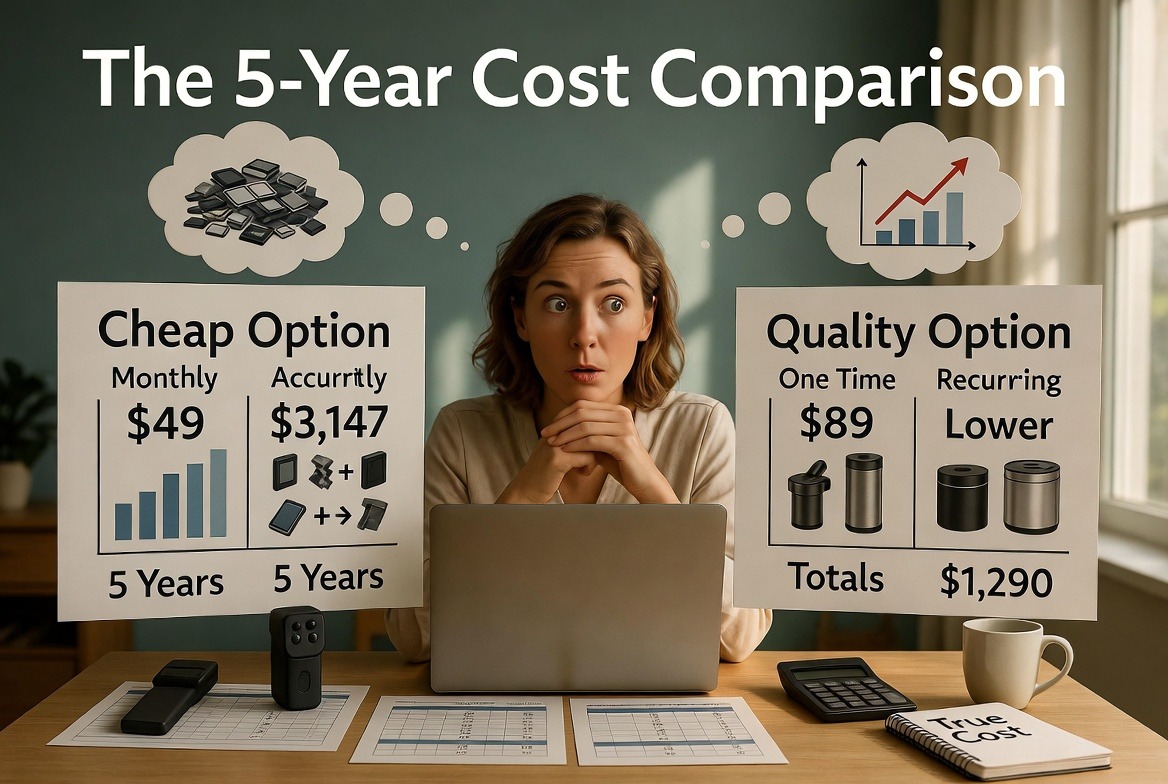
The 5-Year Cost Comparison
Let's put actual numbers on this difference. Over five years, here's what you'll pay for different health tracking options:
Oura Ring (with subscription): $449 AUD for hardware + $13.80 monthly subscription × 60 months = $449 + $828 = $1,277 AUD total. And that's assuming the hardware lasts five years without needing replacement, which is optimistic given battery degradation in small wearables.
Whoop (minimum subscription): $0 for "free" hardware + $30 AUD monthly subscription × 60 months = $1,800 AUD total. You own nothing at the end. If you cancel, you return the device and lose all data access.
OxyZen: One-time hardware purchase. No subscription fees. The total over five years is exactly what you paid on day one. You own the device. You own your data. You keep everything if you never pay another cent.
That $1,277 for Oura could instead be $550-650 for OxyZen hardware, saving you more than $600 over five years. That's not pocket change. That's several weeks of groceries. That's multiple utility bills. That's meaningful money in a cost-of-living crisis.
And unlike subscription services where you're paying for ongoing access to something that doesn't accumulate value, OxyZen is an asset you own. The ring has resale value if you decide to upgrade. Your data remains accessible forever regardless of your payment status. The relationship is clean, transparent, and complete at the point of sale.
Why This Matters for Australian Families
The subscription trap isn't just an individual annoyance. It's a household finance issue that disproportionately affects families already struggling with rising costs.
When every family member wants health tracking—parents monitoring sleep, teenagers tracking activity, older relatives keeping an eye on recovery—the subscription costs multiply. A family of four using Oura would pay over $5,000 across five years. A family of four using Whoop would pay over $7,200. That's not wellness technology. That's a second mortgage payment.
Subscription-free tracking changes this calculation dramatically. One-time purchases for each family member, no ongoing costs, no difficult decisions about whose subscription to keep when money gets tight. Everyone gets the health insights they need without the financial stress.
The same logic applies to Australia's 3.3 million people with pre-diabetes, most of whom don't know they're at risk. Continuous health monitoring could catch these conditions early, but only if the monitoring is accessible and sustainable. Subscription fees create a barrier that subscription-free tracking eliminates.
The Emotional Cost of Subscription Anxiety
Beyond the financial calculation, there's an emotional dimension to subscription fatigue that's harder to quantify but no less real.
Psychologists have begun studying what they call "subscription anxiety"—the low-grade stress that comes from managing multiple recurring payments, worrying about forgotten cancellations, calculating whether you're getting value for money, and feeling trapped in relationships with companies you no longer trust.
This anxiety affects how you use health tracking devices. Do you check your Oura app less often because you're resentful of the monthly fee? Do you avoid recommending Whoop to friends because you don't want to subject them to the same payment trap? Do you feel a small spike of irritation every time you see that charge on your bank statement?
These emotional responses aren't trivial. They affect your relationship with the technology and ultimately with your own health tracking. The device that was supposed to reduce stress by giving you insights into your body ends up creating a different kind of stress entirely.
Subscription-free tracking eliminates this emotional tax entirely. You buy the device. You use the device. You never think about payments again. The relationship is clean, simple, and complete. That peace of mind has value that doesn't appear on any spreadsheet.
What the Industry Doesn't Want You to Know
The subscription health tracking industry has invested heavily in normalising monthly fees as inevitable. Their messaging consistently suggests that subscriptions are necessary for "continuous improvement," "cloud infrastructure," and "ongoing support." They rarely mention that many technology companies manage all of these things without subscriptions.
Here's what they don't want you to know:
Your data storage costs them almost nothing. Cloud storage prices have fallen by more than 99 percent over the past decade. The actual cost of storing your nightly sleep data is measured in fractions of a cent per month.
Algorithm improvements don't require monthly payments from existing users. Companies like Apple and Garmin release algorithm updates for free because those updates improve their products and drive future hardware sales. The subscription model isn't technically necessary—it's commercially convenient.
Your subscription fee mostly goes to profit margins and investor returns, not to product development. Oura's subscription revenue far exceeds their cloud infrastructure and software development costs. The difference is pure profit.
Competition is emerging that proves subscriptions aren't necessary. OxyZen and other subscription-free trackers are demonstrating that you can provide excellent health insights without locking customers into perpetual payments.
The subscription trap exists because consumers have accepted it, not because technology requires it. Every month you pay, you're voting with your wallet for a business model that treats your health data as a recurring revenue stream rather than a relationship of trust.
Breaking Free from the Trap
If you're currently paying a subscription for your health tracker, what should you do?
First, calculate your five-year cost. Really look at the number. Multiply your monthly fee by 60 and add the hardware cost. Ask yourself if that amount feels reasonable for what you're receiving.
Second, assess your actual usage. Are you still getting value from the insights, or have you fallen into automatic payment mode where the subscription renews because it's easier to keep paying than to cancel? Many people continue subscriptions long after the value has diminished.
Third, explore your options. The subscription-free market is growing, and you can learn more about smart ring technology that doesn't require ongoing payments. Compare features, accuracy, and total cost of ownership.
Fourth, consider your data. If you cancel your current subscription, what happens to your historical information? Can you export it? Will you lose access? Factor this into your decision—but also recognise that staying in a bad relationship because leaving would be painful is exactly the lock-in dynamic these companies are counting on.
Fifth, make a decision based on your values and your budget. There's no shame in continuing a subscription that genuinely provides value. But there's also no reason to continue one out of inertia or ignorance.
The Future of Health Tracking
The broader trend in consumer technology is moving away from subscriptions, not toward them. After years of subscription creep across every industry, consumers are pushing back. Streaming services are seeing record cancellations. Software companies are reintroducing perpetual licenses. Hardware companies are emphasising one-time purchases.
Health tracking is part of this larger shift. The early movers who normalised subscriptions are now facing competition from companies offering better value. The market is maturing, and consumers are getting smarter about calculating total cost of ownership.
For Australian consumers, the future looks bright. The heart attack Australia didn't see coming—where 50 percent of first cardiac events happen to people with no prior symptoms—could be prevented by better continuous monitoring. The reason Australians keep injuring themselves training for marathons often has nothing to do with their training programme and everything to do with ignoring recovery signals. Access to this data shouldn't be limited by who can afford ongoing subscriptions.
The technology exists. The insights are valuable. The only question is whether the business model serves the user or exploits them.
Making the Switch
If you're ready to break free from subscription fatigue, switching to a subscription-free tracker is straightforward. The hardware works the same way—you wear it, it collects data, you view insights in an app. The only difference is what happens at the end of the month. Nothing. No charge. No decision fatigue. No resentment.
Thousands of Australians have already made the switch. They're getting the same accurate tracking, the same actionable insights, the same peace of mind about their health—without the monthly invoice that reminds them their data is being held hostage.
A Final Word on Ownership
This article began with a question: Why are you paying every month to access information your own body generated?
The answer, it turns out, is that you don't have to. The subscription trap is real, but it's not inescapable. Companies like Oura and Whoop have built their business models around convincing you that monthly fees are necessary for quality health tracking. They've invested millions in marketing to normalise this arrangement. They've designed their products to make leaving painful.
But none of this changes the fundamental truth: Your body's data belongs to you. Not to a subscription company. Not to an algorithm. Not to investors who need to see growing recurring revenue. To you.
Every technology company makes choices about how to treat their customers. Some choose ongoing extraction disguised as ongoing value. Others choose a clean transaction—you pay, you own, the relationship is complete.
Discover how OxyZen works and why thousands of Australians are choosing subscription-free health tracking. Your body generates data every second of every day. You shouldn't have to rent the right to understand it.
Ready to calculate your savings? Visit our 5-year cost comparison tool to see exactly how much subscription fees are costing you—and how much you could keep in your pocket with subscription-free tracking.
For more insights on health tracking, data ownership, and wellness technology, explore our complete blog archive featuring articles on sleep science, heart health, recovery optimisation, and the future of personal biometrics.



%402x.svg)