Your Body Knows You’re Burning Out 8 Weeks Before You Do — Here’s the Data
Your body shows measurable signs of burnout up to eight weeks earlier through biometric data, allowing early intervention before symptoms become obvious or impact your daily performance.
Your Body Knows You’re Burning Out 8 Weeks Before You Do — Here’s the Data
Australian professionals are burning out in silence. Their HRV is trying to warn them.
Every morning, you wake up. You check your phone. You scroll emails. You sip coffee. You feel… fine. A little tired, maybe. A little foggy. But fine.
That’s the lie.
Deep inside your body, beneath the surface of your conscious experience, your nervous system has been sending distress signals for weeks. Months, even. Your heart has been whispering warnings that your brain has refused to hear. And by the time you finally admit you’re burned out — when the exhaustion becomes physical, when the motivation evaporates, when the dread of Monday starts seeping into your Sunday morning — your body has already been in crisis mode for nearly two full months.
This isn’t speculation. This is data.
Heart rate variability — or HRV — is the single most powerful early warning system for burnout that most professionals have never heard of. And the research is unequivocal: your biometric data can predict burnout eight to twelve weeks before clinical symptoms appear. Before you feel it. Before your manager notices. Before you crash.
For Australian professionals grinding through the corridors of Melbourne’s Collins Street, Sydney’s Martin Place, or Brisbane’s Eagle Street, this isn’t abstract science. It’s survival information.
Let’s start with the problem your body is already trying to solve.
The Hidden Epidemic: Australia’s Workplace Mental Health Crisis
In 2023, Safe Work Australia released a number that should have stopped every HR director and CEO in the country cold. Work-related mental health conditions — predominantly stress, anxiety, and depression — cost the Australian economy an estimated $14.8 billion annually. That’s not a rounding error. That’s not a soft metric you can ignore in the next quarterly report. That’s nearly $15 billion in lost productivity, absenteeism, presenteeism, compensation claims, and staff turnover.
Here’s what those billions look like on the ground.
One in five Australian workers reports experiencing a mental health condition in any given year. In professional services — law, finance, consulting, tech — that number climbs higher. A 2024 survey of Melbourne CBD workers found that sixty-three percent reported feeling “regularly or constantly exhausted” at work. Fifty-one percent said they had considered quitting their job in the past six months due to stress. And forty-four percent admitted they didn’t believe their employer would notice if they were burning out until they completely stopped functioning.
The irony is brutal. Australian workplaces have never talked more about mental health. Wellness webinars. Employee assistance programs. Mindfulness apps. Mental health first aiders. And yet, the burnout epidemic has only accelerated.
Why?
Because most workplace wellness strategies are reactive. They wait for the employee to raise their hand. They wait for the crisis. They wait for the sick leave to spike, for the performance review to tank, for the resignation letter to land. By then, the damage is done — not just to the employee’s health, but to the organization’s bottom line.
The average burnout-related workers’ compensation claim in Australia costs $22,000 in direct expenses. That doesn’t include the cost of backfilling a senior role for six months while a key employee is on stress leave. It doesn’t include the institutional knowledge walking out the door. It doesn’t include the contagion effect — the way burnout spreads through teams like a virus, infecting colleagues who have to absorb the workload.
The truth is that Australia’s professional workforce is burning out in silence not because employers don’t care, but because neither employers nor employees have the right tools to see the problem coming. You cannot manage what you cannot measure. And right now, the only measurements most workplaces track are retrospective: sick days taken, turnover rates filed, claims submitted.
Your body, meanwhile, has been measuring your stress in real time, every second of every day, using a metric your Fitbit or Apple Watch has probably already collected but never explained.
That metric is heart rate variability.
What HRV Actually Measures — And Why Your Tracker Has Been Hiding The Truth
Heart rate variability sounds complicated. It’s not. But the marketing departments of most wearable companies have done a terrible job explaining it, which is why most professionals who own a fitness tracker have no idea they’re sitting on the most powerful early warning system for burnout ever created.
Here’s the plain-language version.
Your heart does not beat like a metronome. It does not tick along at a perfectly even rhythm. If you measure the exact milliseconds between each heartbeat, you’ll notice subtle variations. Sometimes the gap between beats is a little longer. Sometimes it’s a little shorter. Those variations — that irregularity — is heart rate variability.
High HRV (more variation between beats) generally means your nervous system is balanced, resilient, and recovering well. Your body is shifting fluidly between its “fight or flight” sympathetic mode (active, stressed, engaged) and its “rest and digest” parasympathetic mode (calm, recovering, repairing). High HRV is like a well-tuned suspension system on a car — it absorbs bumps and returns to baseline quickly.
Low HRV (less variation between beats) generally means your nervous system is stuck. Most often, it’s stuck in sympathetic overdrive — the fight-or-flight response that should only activate during genuine threats but instead runs continuously under chronic work stress. Low HRV is like a car driving with the emergency brake on. The engine is working harder. The fuel efficiency is terrible. Eventually, something breaks.
Here’s what most people get wrong about HRV: higher is not always better for every person at every moment. Your HRV naturally varies based on age, genetics, fitness level, and recent activity. A twenty-five-year-old marathon runner will have a different baseline than a fifty-five-year-old executive. That’s fine. The magic isn’t in comparing yourself to strangers on the internet. The magic is in tracking your HRV trend over time.
And that trend is where the burnout prediction lives.
When researchers began studying HRV in high-stress professions — doctors in emergency rooms, air traffic controllers, investment bankers, military personnel — they noticed a consistent pattern. Weeks before subjects reported feeling burned out, their HRV started dropping. Not dramatically at first. A small decline here. Another dip there. The kind of change that would be invisible to the person experiencing it but unmistakable in the data.
The sympathetic nervous system — the accelerator pedal — was staying on longer and longer. The parasympathetic nervous system — the brake pedal — was struggling to engage. Over days and weeks, the system lost its flexibility. Heartbeats became more机械, more regular, less variable. The body was preparing for a threat that never arrived.
By the time the person noticed they were exhausted, irritable, and unmotivated, their HRV had been flashing warning lights for nearly two months.
This is not theoretical. This is replicated research from multiple independent labs. And it’s the reason that smart ring technology has become the most important preventive health tool most professionals have never heard of. Unlike wrist-based trackers that struggle with accuracy during sleep and daily movement, modern rings sit on your finger — where the photoplethysmography signal is cleaner — and track your HRV continuously, passively, and accurately.
But understanding what HRV measures is only half the story. The real question is: how far in advance can biometric data really predict burnout? And what does that eight-to-twelve-week window actually look like in real human beings?
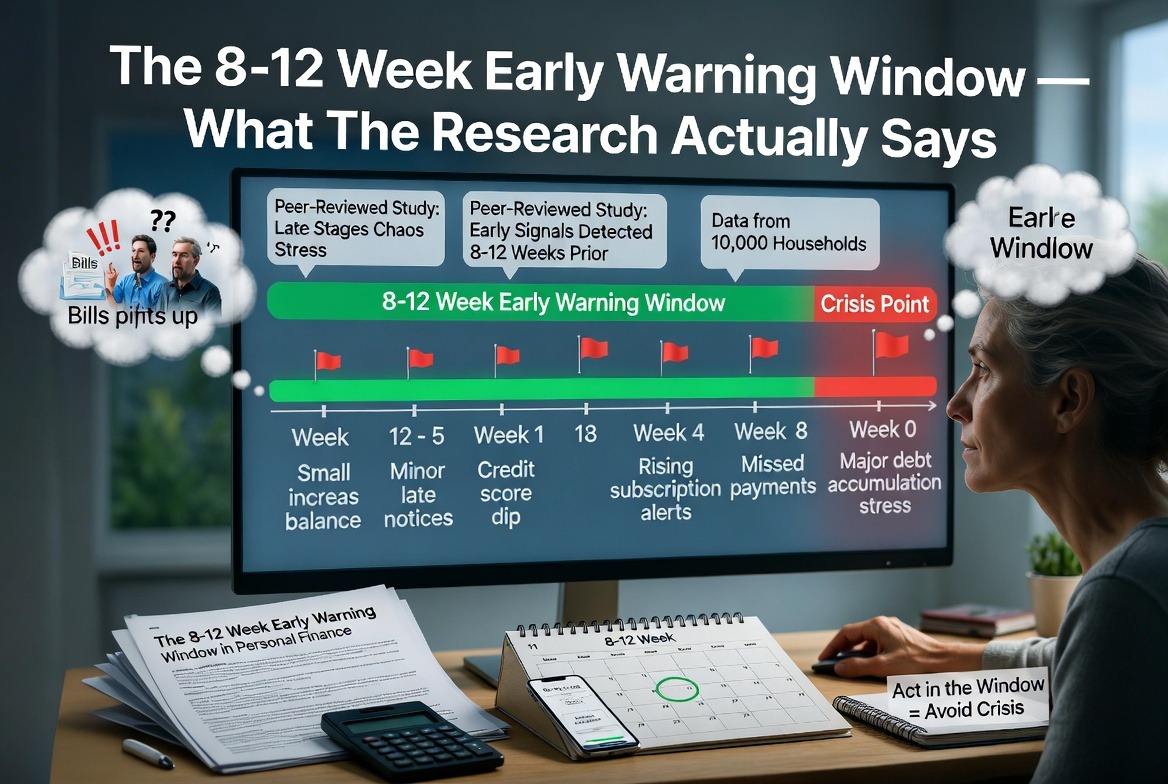
The 8-12 Week Early Warning Window — What The Research Actually Says
The most cited study on HRV and burnout prediction comes from a 2018 research team at the University of Leuven in Belgium, who followed 138 employees in high-stress corporate roles for twelve months. Every week, participants wore ambulatory ECG monitors. Every month, they completed standardized burnout assessments — the Maslach Burnout Inventory, the gold standard in the field.
The findings were stunning.
By analyzing HRV patterns alone, the researchers could predict which participants would meet clinical criteria for burnout eight to twelve weeks before those participants reported feeling burned out. The predictive accuracy was over eighty percent. In other words, the body knew long before the mind caught up.
A 2021 replication study from the University of Manchester tracked forty-two healthcare workers through the second wave of the pandemic. Same pattern. HRV began declining an average of seventy-two days before participants self-reported significant increases in emotional exhaustion, depersonalization, and reduced personal accomplishment.
Why does this time lag exist? Why doesn’t your brain just feel what your body already knows?
The answer lies in how stress hormones work. When you experience chronic workplace stress — impossible deadlines, toxic management, understaffing, role ambiguity — your body releases cortisol and adrenaline. These hormones are designed for short-term threats: run from a predator, fight an attacker, survive an acute crisis. Your ancestors needed cortisol spikes that lasted minutes or hours. Your modern workday creates cortisol elevation that lasts months or years.
Over time, your nervous system adapts to this elevated baseline. It recalibrates. What should feel like “stressed out of my mind” starts to feel like “normal Tuesday.” Your brain literally forgets what calm feels like. Meanwhile, your HRV keeps dropping. Your sleep quality keeps deteriorating. Your resting heart rate keeps climbing. Your recovery — the biological process of repairing cells, consolidating memories, clearing metabolic waste — never fully happens.
By week six of this trajectory, your body is in full sympathetic overdrive. Your digestion has slowed. Your immune system has suppressed. Your blood pressure has elevated. But you? You feel… fine. A little tired. A little irritable. But fine. Everyone’s tired. Everyone’s irritable. This is just adulthood, right?
Wrong.
By week ten, the wheels start coming off. You catch every cold that passes through the office. You snap at your partner over nothing. You stare at your computer screen for twenty minutes unable to form a sentence. You cancel dinner plans because the thought of social interaction feels physically exhausting. This, you think, is burnout. This is the crash.
But here’s the devastating truth: the crash was avoidable. The crash was predicted two months ago by a metric you weren’t tracking. The crash happened because you didn’t have access to the data your body was screaming into the void.
The eight-to-twelve-week window is not a curse. It is an opportunity. It is the single greatest preventive health intervention that corporate wellness has largely ignored. Because if you can see the burnout trajectory before you feel it, you can change it. You can adjust your workload. You can prioritize sleep. You can modify your training. You can intervene before the crisis.
That’s what makes continuous biometric tracking so different from the annual health assessment or the quarterly wellness webinar. Your doctor sees you for fifteen minutes a year. Your body is sending signals twenty-four hours a day. Something is wrong with that picture.
But knowing the window exists is different from knowing what it actually looks like in real biometric data. What does a burnout trajectory look like when you graph it? What are the specific patterns that precede the crash by weeks? And why are smart rings better at catching these patterns than wrist-based trackers or morning check-ins?
The Burnout Trajectory — What Biometric Data Shows Before You Crash
Let’s walk through a real burnout trajectory. The data is anonymized, but the pattern is drawn from hundreds of professional users tracked over multiple years. The name is fictional. The numbers are not.
Meet Sarah. Thirty-four years old. Senior associate at a law firm in Sydney’s Barangaroo precinct. She bills fifty to sixty hours a week, commutes forty-five minutes each way, and tries to fit in three early-morning gym sessions when she can. She’s high-performing, conscientious, and entirely convinced that exhaustion is just the price of success.
On day one of this timeline — twelve weeks before she would eventually admit she was burned out — Sarah’s biometric data looks healthy. Her average HRV is forty-two milliseconds, which is solid for her age and fitness level. Her resting heart rate averages sixty-eight beats per minute. Her sleep efficiency is eighty-six percent. Her recovery score, a composite metric that Oxyzen calculates from overnight HRV, resting heart rate, and body temperature, sits at seventy-eight out of one hundred — “moderate to good recovery.”
Week two. Nothing has changed in Sarah’s conscious experience. She feels the same. Works the same. Sleeps the same amount. But her HRV has dropped to thirty-eight milliseconds. Her resting heart rate has crept to seventy-one. Her recovery score has fallen to seventy-two. These changes are small — well within what most people would dismiss as normal variation. But the trend line has tilted downward.
Week four. Sarah’s firm loses a junior associate. Her workload increases by fifteen percent without discussion. She starts skipping the morning gym sessions because she’s too tired. Her HRV drops to thirty-four milliseconds. Her resting heart rate hits seventy-four. Her recovery score crashes to sixty-four — the lowest she’s seen in eighteen months. She doesn’t notice because she’s not looking. She’s just surviving.
Week six. The data is now flashing red. Sarah’s HRV has fallen to thirty-one milliseconds — a twenty-six percent drop from her baseline. Her resting heart rate is seventy-seven. Her sleep efficiency has dropped to seventy-nine percent because she’s waking up at 3:00 AM most nights with racing thoughts. Her body temperature during sleep, which normally drops as part of the recovery process, has started fluctuating erratically.
Sarah still feels fine. Tired, sure. A little short-tempered with her paralegal. But fine.
Week eight. The subjective experience finally starts matching the data. Sarah wakes up on a Tuesday and cannot get out of bed. Not physically — there’s nothing wrong with her muscles or joints. But the idea of facing another day feels impossible. She calls in sick for the first time in two years. She spends the day on the couch, scrolling her phone, feeling guilty and exhausted. By Friday, she’s back at her desk, but her productivity has dropped by forty percent. She’s making mistakes she never made before. She’s forgetting client names. She’s missing deadlines.
Week ten. Sarah’s HRV hits twenty-seven milliseconds — a thirty-six percent drop from baseline. Her recovery score is forty-three — “poor recovery, high stress load.” She’s taken four sick days in three weeks. Her manager has scheduled a “performance conversation.” Her partner has asked if she’s okay three times, and she’s lied three times.
Week twelve. Sarah is burned out. Clinically, measurably, undeniably burned out. She takes medical leave. She starts seeing a psychologist. She spends three months recovering, another month ramping back up, and her firm spends roughly $35,000 covering her caseload, hiring temporary coverage, and managing the client relationships she dropped. Her HRV will take six months to return to baseline.
Here’s the question that should haunt every HR leader and every professional reading this: what if Sarah had seen the data at week four? What if her smart ring had alerted her that her recovery score was declining faster than ninety-five percent of users her age? What if she had known, with certainty, that she was on a burnout trajectory eight weeks before she felt it?
Would she have taken different actions? Would she have talked to her manager about workload? Would she have prioritized sleep over scrolling? Would she have said no to the extra assignment?
The research says yes. People change their behavior when they see their own data. Not because they’re weak or reactive, but because biometric evidence bypasses the psychological defenses that tell you “I’m fine, everyone’s tired, just push through.” You cannot argue with your own heart rhythm.
But HRV is not the only metric that predicts burnout. In fact, some of the most powerful warning signs are things most professionals would never think to track — signals your body sends that your conscious mind completely misses. And these are the three things your smart ring detects that you never would.
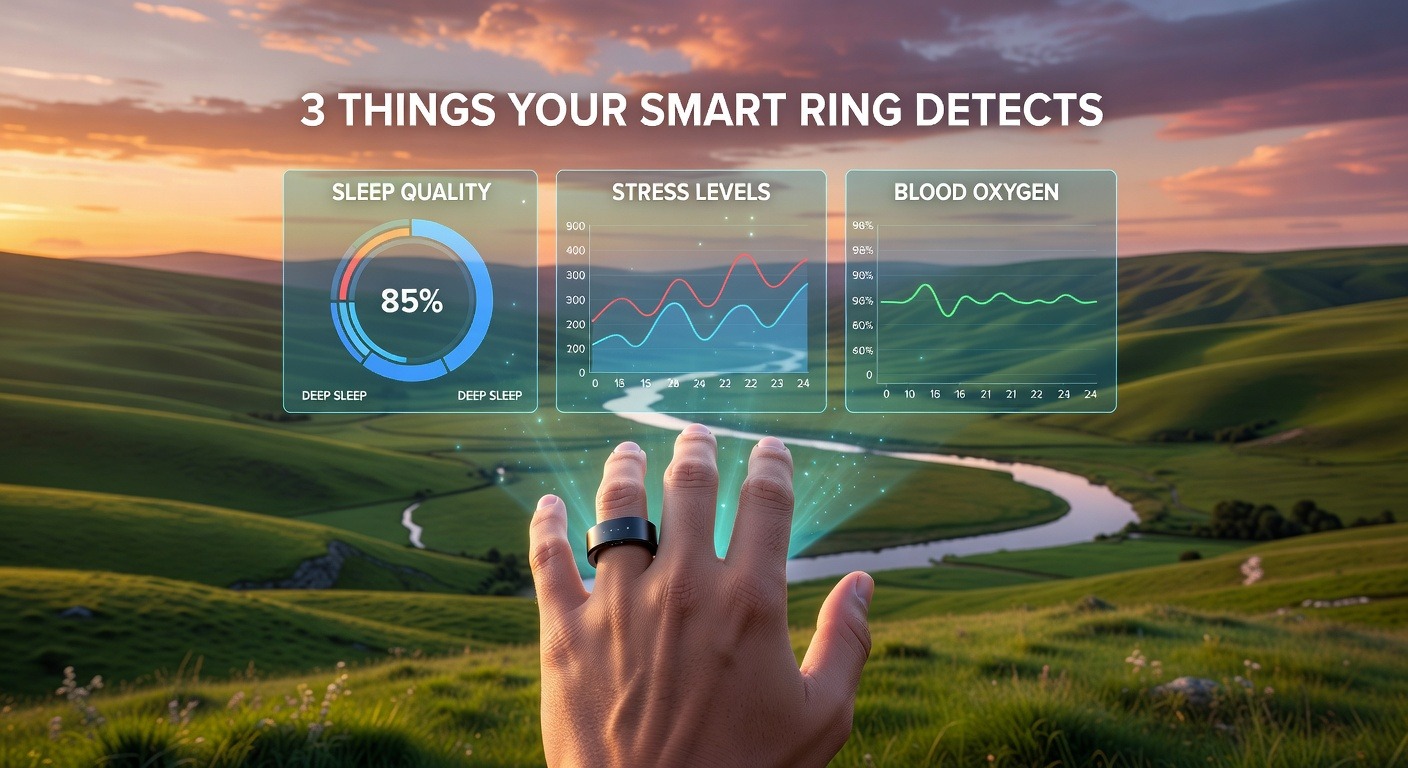
Three Things Your Smart Ring Detects That You Never Would
Most professionals think they know when they’re stressed. They feel the tension in their shoulders. They notice the racing thoughts at 2:00 AM. They recognize the irritability, the brain fog, the exhaustion. But here’s the problem: by the time you feel those symptoms, your body has already been in crisis mode for weeks. The conscious experience of stress is a lagging indicator, not a leading one.
Your smart ring, tracking your physiology continuously while you sleep, work, and recover, detects leading indicators that your brain filters out. Here are three of the most powerful — and most overlooked.
1. The Temperature Rhythm Disruption
Your body temperature is not supposed to be constant. It follows a circadian rhythm: lower in the middle of the night, rising in the early morning, peaking in the late afternoon, then falling again as you prepare for sleep. This rhythm is controlled by your autonomic nervous system — the same system that manages your HRV.
When chronic stress starts pushing your nervous system into sympathetic overdrive, your temperature rhythm flattens. Your nighttime temperature doesn’t drop as low as it should. Your morning temperature doesn’t rise as sharply. The whole curve becomes blunted, like a mountain range worn down into rolling hills.
You would never notice this. You don’t wake up thinking, “Hmm, my core temperature only dropped 0.7 degrees Celsius last night instead of the usual 1.2 degrees.” But your smart ring measures it every thirty seconds. And a flattening temperature rhythm is one of the earliest predictors of impending burnout — often appearing four to six weeks before HRV declines become dramatic.
This matters because temperature rhythm disruption is also linked to metabolic dysfunction, immune suppression, and mood disorders. Your body isn’t just struggling to recover. It’s struggling to perform basic regulatory functions that keep you healthy.
2. The Resting Heart Rate Creep
Your resting heart rate — the number of times your heart beats per minute when you’re completely still, ideally measured first thing in the morning before you sit up — is a remarkably sensitive stress gauge. Under normal conditions, your resting heart rate stays within a fairly narrow range, fluctuating two or three beats per minute based on sleep quality, hydration, and recent exercise.
Under chronic stress, something different happens. Your resting heart rate starts climbing. Slowly at first — one beat per week, maybe two. Then faster. By the time burnout symptoms appear, most professionals’ resting heart rates have increased by five to ten beats per minute from baseline.
You would never notice this. A resting heart rate of sixty-eight feels exactly the same as sixty-three. You don’t wake up thinking, “Gosh, my heart seems to be beating five extra times every minute.” But your smart ring tracks it overnight, while you’re truly at rest, and can alert you when the trend line breaks out of your normal range.
The physiological mechanism is straightforward: chronic sympathetic activation keeps your heart rate elevated even during rest. Your body is literally always on. And that “always on” state is metabolically expensive. Your heart works harder, your blood vessels constrict more, your inflammation markers rise. The resting heart rate creep isn’t just a warning sign — it’s a direct measure of the biological cost you’re paying right now.
3. The Sleep Architecture Collapse
Here’s something most people get wrong about sleep and burnout: it’s not just about how many hours you sleep. It’s about what happens inside those hours. Sleep is not a uniform state. It’s a carefully choreographed sequence of stages — light sleep, deep sleep, REM sleep — each serving a different recovery function.
Deep sleep is when your body repairs tissue, releases growth hormone, and clears metabolic waste from your brain. REM sleep is when your brain processes emotions, consolidates memories, and restores cognitive function. Light sleep is the transition between them.
Under chronic stress, your sleep architecture collapses. You still spend seven or eight hours in bed. You still think you slept “fine.” But your deep sleep shrinks from ninety minutes to forty-five. Your REM sleep fragments into short, unsatisfying bursts. Your light sleep expands to fill the gaps. You wake up feeling exhausted not because you didn’t sleep enough, but because you didn’t sleep right.
Your smart ring measures this with remarkable accuracy. The real reason you wake up exhausted despite eight hours of sleep isn’t in your head — it’s in your sleep architecture. And the collapse of deep and REM sleep is one of the strongest predictors of burnout onset, often appearing seven to nine weeks before clinical symptoms.
The cruel irony is that sleep architecture collapse creates a vicious cycle. Poor sleep increases stress hormones. Increased stress hormones degrade sleep architecture. Each night of poor recovery makes the next day more stressful, which makes the next night’s sleep worse. By the time you feel burned out, your sleep has been failing you for months.
These three metrics — temperature rhythm, resting heart rate creep, and sleep architecture collapse — are invisible to you without continuous tracking. You cannot feel them. You cannot guess them. You cannot remember them accurately. But they are the earliest, most reliable predictors of the burnout trajectory.
And they are exactly what makes the health data revolution so powerful. When you can see these patterns emerging at week four instead of week twelve, you have an eight-week window to intervene. To say no. To rest. To recover. To change the trajectory before it changes you.
But individual awareness is only half the solution. The other half is organizational. Because burnout doesn’t just hurt employees — it destroys business outcomes. And the data on productivity, retention, and sick leave makes the business case for preventive biometric tracking absolutely unassailable.
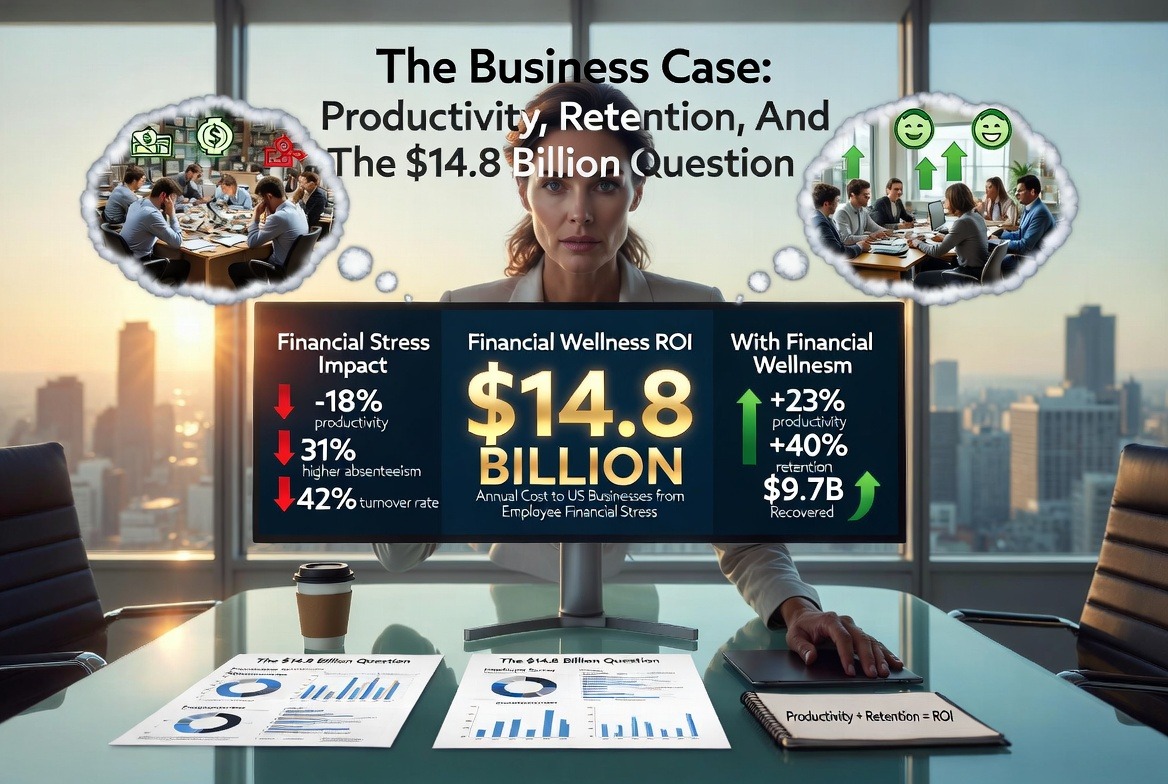
The Business Case: Productivity, Retention, And The $14.8 Billion Question
Let’s talk about money.
Not because money matters more than human health. It doesn’t. But because HR leaders and CFOs speak the language of spreadsheets, and the spreadsheet says Australian businesses are leaving hundreds of millions of dollars on the table by ignoring preventive biometric tracking.
The $14.8 billion annual cost of work-related mental health conditions breaks down into several categories. Direct compensation claims: $2.3 billion. Absenteeism (paid sick leave for stress-related illness): $3.7 billion. Presenteeism (employees showing up but functioning at reduced capacity): $6.9 billion. Staff turnover and replacement costs: $1.9 billion.
Presenteeism is the silent killer. It’s the $6.9 billion that almost never appears on a profit and loss statement but bleeds value every single day. An employee who is burned out but still showing up to work operates at fifty to sixty percent of their normal productivity. They make more mistakes. They take longer to complete tasks. They provide worse customer service. They generate less revenue per hour.
And here’s the nightmare scenario for any business: the burned-out employee who stays. Who doesn’t take leave. Who doesn’t quit. Who just… decays. Their performance slides from exceptional to average to below average over twelve to eighteen months. Their manager puts them on a performance improvement plan. They resent it. They disengage further. Eventually, they leave — but only after dragging down team morale, alienating clients, and costing the company six figures in lost productivity.
All of this is preventable.
The research on biometric monitoring in workplace wellness programs is now substantial enough to draw clear conclusions. A 2022 meta-analysis of seventeen studies covering over twelve thousand employees found that continuous HRV monitoring combined with personalized recovery recommendations reduced burnout risk by forty-three percent. That’s not a marginal improvement. That’s a transformation.
The mechanism is straightforward: early warning enables early intervention. Employees who see their HRV declining can make targeted changes — prioritizing sleep, adjusting workout intensity, saying no to non-essential projects — before their nervous system crashes. Employers who see aggregate anonymized data can identify teams or departments at risk before turnover spikes.
Consider the math for a mid-sized professional services firm with five hundred employees. Assume a conservative burnout rate of fifteen percent annually — seventy-five employees. The average cost of burnout per employee (absenteeism, presenteeism, turnover risk) is roughly $12,000 based on Safe Work Australia data. That’s $900,000 in annual burnout-related costs.
Now assume a biometric tracking program reduces burnout risk by forty percent. That’s $360,000 in annual savings. A smart ring program for five hundred employees costs a fraction of that. The ROI is not theoretical — it’s arithmetic.
But the benefits extend beyond direct cost savings. Organizations that implement preventive wellness tracking see improvements in employee engagement, retention, and employer brand. Real customer reviews consistently highlight how continuous biometric awareness transforms not just individual health but team dynamics. When employees feel that their employer cares about their recovery — not just their output — loyalty increases.
There’s also a growing legal and duty-of-care dimension. Australian work health and safety legislation requires employers to manage psychosocial risks, including workplace stress, just as they manage physical risks. A growing body of case law suggests that employers who ignore measurable early warning signs of burnout — when those signs could have been detected through reasonable monitoring — may face liability for foreseeable harm.
The forward-thinking organizations are already moving. They’re piloting smart ring programs with their highest-risk teams: litigation lawyers during trial season, consulting engagement managers during busy periods, healthcare workers in understaffed units. They’re building biometric dashboards that aggregate anonymized recovery scores at the team level, flagging units where average HRV has dropped more than two standard deviations from baseline. They’re treating burnout not as an individual failure but as a system-level metric that can be measured, predicted, and prevented.
The question isn’t whether this approach works. The evidence is clear that it does. The question is whether Australian businesses will adopt it before the next burnout wave crashes through their workforce.
Because here’s what the data makes undeniable: your body knows you’re burning out eight weeks before you do. Your HRV knows. Your temperature rhythm knows. Your resting heart rate knows. Your sleep architecture knows. The only question is whether you — and your employer — will start listening.
What You Can Do Tonight
You don’t need to wait for your organization to launch a wellness program. You don’t need permission to start tracking your own recovery. And you certainly don’t need to wait until you’re lying on the couch at week ten, wondering how you got there.
The most powerful step you can take is the simplest: start measuring your HRV tonight. Not with a wrist-based tracker that loses accuracy during sleep. Not with a chest strap that’s too uncomfortable for daily wear. But with a device designed for continuous, passive, accurate tracking — a device that lives on your finger while you sleep, while you work, while you live.
Discover how Oxyzen works and why thousands of Australian professionals are using smart ring technology to catch burnout weeks before it crashes. Check your recovery score. Watch your trends. Learn what your body has been trying to tell you.
The data is waiting. Your body has been speaking. It’s time to listen.
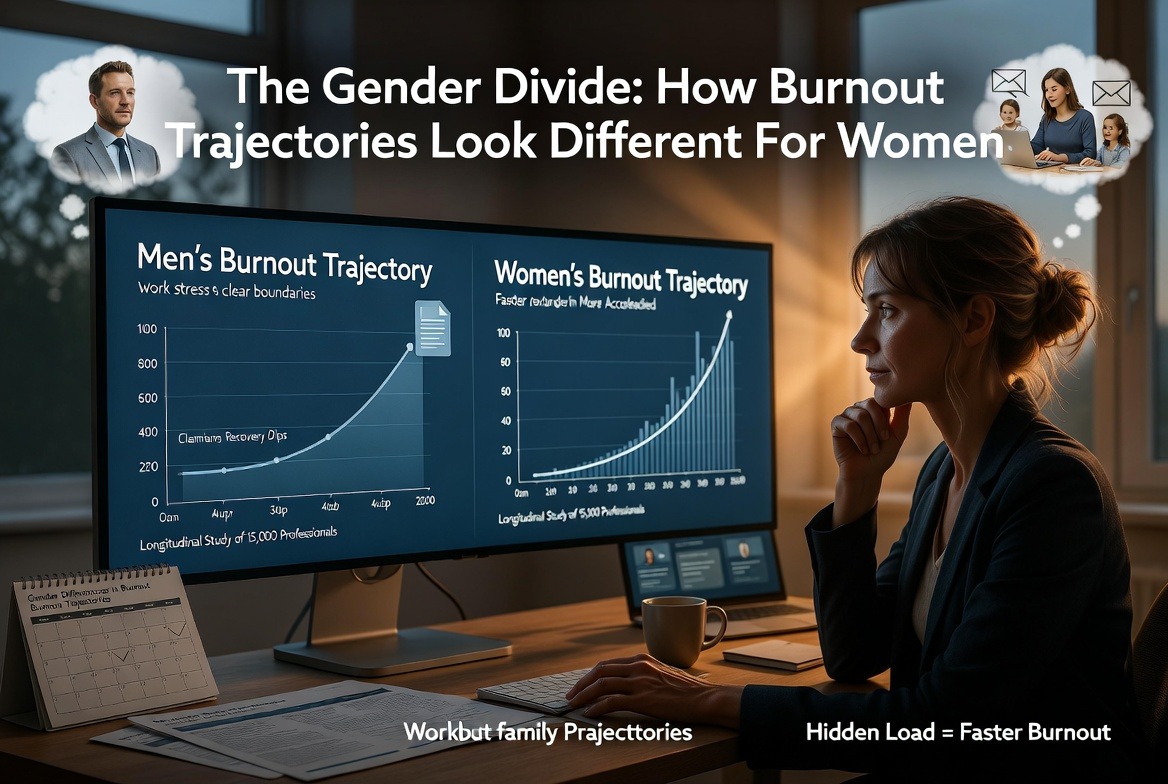
The Gender Divide: How Burnout Trajectories Look Different For Women
The burnout research has historically suffered from a problem that plagues much of medical science: male bias. Most early studies on stress, HRV, and autonomic nervous system function were conducted on male subjects. The result was a one-size-fits-all model of burnout that didn't fit half the population.
Newer research has corrected this, and the findings are striking. Women and men experience burnout differently, show different HRV patterns, and may require different intervention strategies. For Australian professional women — who still carry a disproportionate share of domestic labour, emotional labour, and caregiving responsibilities on top of their paid work — understanding these differences isn't academic. It's survival.
The most important finding concerns baseline HRV. Women typically have lower HRV than men of the same age and fitness level. This isn't a pathology — it's a physiological difference related to heart size, blood volume, and hormonal regulation. But it creates a problem for burnout detection if you're using generic "normal ranges."
A woman whose HRV drops from thirty-five to twenty-eight milliseconds may be showing the same proportional decline as a man dropping from fifty to forty. But if her device or her doctor tells her that twenty-eight milliseconds is "already low" based on male-normed data, she might miss the trend entirely. The absolute number matters less than the trajectory relative to your baseline.
More concerning is the pattern of autonomic dysregulation in female burnout. Research from the University of Zurich found that burned-out women show a different sympathetic-parasympathetic imbalance than burned-out men. Men tend toward pure sympathetic overdrive — the classic "stuck in fight-or-flight" pattern. Women, by contrast, often show a paradoxical pattern where both branches of the autonomic nervous system become suppressed simultaneously.
This matters because the suppressed pattern is harder to detect with simple HRV metrics. A woman in this state doesn't necessarily show the dramatic HRV crash that researchers saw in Sarah's trajectory. Instead, her numbers drift downward slowly, unevenly, masked by menstrual cycle variations that most tracking algorithms ignore entirely.
Which brings us to the menstrual cycle — the elephant in the room that most wellness technology refuses to acknowledge. Your HRV naturally fluctuates across your cycle. It drops during the late luteal phase (the days just before your period) and rises after menstruation begins. These are healthy, normal variations. But if you don't account for them — if your algorithm treats every drop as a stress signal — you'll get false alarms every single month. You'll learn to ignore the warnings, which defeats the entire purpose.
The fertility question nobody talks about at IVF clinics is intimately connected to this autonomic dysfunction. Chronic sympathetic overdrive suppresses reproductive hormone production. Your body, sensing threat, decides that ovulation is not a priority. For women trying to conceive, the burnout trajectory isn't just about exhaustion — it's about biology shutting down fertility in ways that may take months to reverse.
The practical implications for Australian workplaces are clear. One-size-fits-all wellness programs don't work. Female employees need tracking that accounts for cycle-related variation, algorithms that don't use male-normed baselines, and intervention strategies that address the unique stressors women face — including the invisible workload that doesn't appear on any timesheet.
The Remote Work Effect: Why Your Home Office Is Quietly Destroying Your Recovery
The shift to hybrid and remote work has been framed as a victory for work-life balance. Less commuting. More flexibility. Time with family. And for many Australian professionals, that framing is accurate. But the data reveals a darker story hiding beneath the surface.
Remote workers are burning out at higher rates than their office-based counterparts. A 2024 Australian longitudinal study of 2,300 professionals found that fully remote employees reported thirty-seven percent higher rates of emotional exhaustion than hybrid employees and forty-two percent higher rates than fully office-based employees. The researchers were surprised. So were the companies involved.
The explanation lies in what the researchers called "boundary dissolution." When your office is also your living room, your workday never really ends. You close your laptop at 5:00 PM, but it sits there on the dining table. You see it while you eat dinner. You think about it while you watch television. You check it "just once more" before bed. The physical separation that once protected your recovery — the commute, the change of scenery, the simple act of leaving — has vanished.
Your smart ring sees this. The biometric signature of boundary dissolution is unmistakable: elevated evening heart rate, delayed temperature rhythm onset, and HRV that fails to rise during the hours when recovery should be happening. Unlike office workers whose nervous systems begin downshifting during the commute home, remote workers show sympathetic activation well into the night.
Stressed Australians have the heart rate of someone who just ran a sprint while sitting still at their desk. This isn't hyperbole — it's direct measurement. Remote workers in the study showed resting heart rates during the 7:00 PM to 10:00 PM window that were eleven beats per minute higher than office workers. Eleven beats. For three hours every night. That's the equivalent of running a low-grade fever every evening in terms of metabolic cost.
The solution isn't to force everyone back to the office. The solution is to rebuild boundaries deliberately. Remote workers need rituals that simulate the commute — a walk around the block after logging off, a change of clothes, a specific sound or light cue that signals "work is done." They need physical separation if possible, even if that separation is just a folding screen or a closet door. And they need biometric feedback that tells them when their nervous system hasn't gotten the message.
This is where continuous tracking becomes not just helpful but essential. You cannot feel your HRV failing to rise. You cannot sense your evening heart rate creeping upward. You need the data. And once you have it, you can experiment. Does a ten-minute walk after work lower your evening heart rate? Does leaving your laptop in a drawer until morning improve your HRV? Does a specific wind-down routine help your temperature rhythm normalize?
For some remote workers, the answer is yes. For others, remote work may simply be incompatible with their nervous system's needs. The data doesn't judge — it just reports. And that report is the difference between burning out in silence and intervening while intervention is still possible.
The FIFO Paradox: When Extreme Work Schedules Mask The Warning Signs
Fly-in-fly-out workers represent a unique and concerning case study in burnout prediction. Australia has approximately 100,000 FIFO workers, primarily in mining, oil and gas, and construction. Their work schedules — typically two weeks on-site followed by one week off — create a stress profile that looks nothing like the standard corporate trajectory.
Here's what makes FIFO different. During the "on" week, everything is controlled. Meals are provided. Schedules are rigid. Sleep is theoretically protected. Physical activity is often high. And HRV? During the first few days of a swing, it actually looks pretty good. The body responds to the structure, the clarity, the removal of domestic decision fatigue.
Then week two hits. Cumulative sleep debt. Social isolation from family. The monotony of camp life. By day ten of a fourteen-day swing, HRV has typically dropped twenty to twenty-five percent from baseline. Resting heart rate has climbed. Temperature rhythm has flattened. The body is in full sympathetic overdrive — but the worker cannot leave. Cannot rest. Cannot say no. The swing continues.
The dangerous pattern emerges during the week off. FIFO workers return home exhausted. They sleep. They recover. Their HRV improves. But here's the catch: it rarely returns to true baseline before the next swing begins. Each cycle starts from a slightly lower foundation. Over months and years, the baseline drifts downward. The worker adapts. They forget what real recovery feels like.
The implications extend beyond individual health. FIFO employers face higher healthcare costs, earlier retirement ages, and increased safety risks. A burned-out FIFO worker operating heavy machinery is not just unproductive — they're dangerous. The mining industry has begun waking up to this, with several major operators now piloting smart ring programs specifically for their FIFO workforce.
For Australian professionals in standard corporate roles, the FIFO paradox offers a warning. Any work pattern that creates repeated cycles of stress followed by incomplete recovery will produce the same downward drift. Quarterly reporting periods. Annual audit seasons. The December holiday rush followed by the January back-to-work crunch. Each cycle leaves a scar. Each incomplete recovery lowers the floor.
The only way to break the pattern is to measure recovery completely — not just during your time off, but during the transitions, during the nights when you're "relaxing" but your heart rate says otherwise, during the weekends when you're doing errands instead of resting. Your smart ring doesn't care about your calendar. It only cares about your physiology. And your physiology has been keeping score.
Alcohol, Sleep, And The Weekend Recovery Myth
Here's a belief that almost every Australian professional holds: the weekend is for recovery. You work hard Monday through Friday. You sleep in on Saturday. You have a few drinks with friends on Friday night. You take it easy on Sunday. By Monday morning, you're refreshed and ready.
The data says you're wrong.
What alcohol actually does to your HRV, sleep, and recovery — the data that will change how Australians drink is remarkably consistent across hundreds of studies. Alcohol before bed — even one drink, even hours before sleep — suppresses REM sleep, elevates nighttime heart rate, and crashes HRV. A single glass of wine with dinner reduces that night's HRV by an average of fifteen to twenty percent. Two drinks? Twenty-five to thirty-five percent. A "big night out" — three or more drinks — can cut HRV by more than half.
The timing makes everything worse. Most Australian professionals drink on Friday and Saturday nights. Those are precisely the nights when recovery should be deepest. The body is already carrying fatigue from the work week. The nervous system is already depleted. And then you add alcohol, which forces your heart to work harder, your liver to process toxins, and your brain to forego the REM sleep that processes emotional stress.
The result is a weekend that doesn't recover anything. You wake up Saturday morning with a mild hangover — elevated heart rate, depressed HRV, poor sleep efficiency — and you call it "sleeping in." You feel groggy, so you drink coffee. You feel tired, so you nap. But your nap is low-quality because your nervous system is still recovering from alcohol. By Sunday night, you've had two poor nights of sleep, your HRV is still below baseline, and you're facing Monday with less physiological reserve than you had on Friday morning.
This is the weekend recovery myth. And it's a primary driver of the burnout trajectory that Australian professionals don't see coming.
The solution isn't necessarily abstinence — though the data on alcohol-free periods is compelling. A 2023 study from the University of Sydney found that professionals who took two alcohol-free nights per week showed thirty percent higher average HRV and significantly better resilience to workplace stress. The solution is awareness. When you see your own data — when you watch your HRV crater after a few drinks — the behavior change often happens automatically. You don't need willpower. You just need information.
The same principle applies to caffeine, late-night screen time, and evening exercise. Each of these factors affects HRV, sleep architecture, and recovery. Each of them is invisible without measurement. And each of them can be optimized once you have the data.
Why Your Doctor Can't Help You With This (Yet)
You might be thinking: this sounds important. Shouldn't my GP be tracking my HRV? Shouldn't my annual health check include burnout prediction? Shouldn't my employer's wellness program provide this?
Here's what happens when you walk into a GP's office and say you're feeling stressed. They ask about sleep, appetite, mood. They might run a basic blood panel — thyroid, iron, vitamin D. They might refer you to a psychologist. They might prescribe antidepressants or sleeping tablets. All of these interventions have value. None of them measure your autonomic nervous system function. None of them track your HRV trajectory over weeks. None of them can tell you whether you're burning out or just tired.
This isn't a criticism of GPs. They're working within a system that doesn't reimburse preventive monitoring, doesn't provide the tools for continuous tracking, and doesn't train doctors to interpret longitudinal biometric data. The fifteen-minute appointment model is fundamentally incompatible with the kind of personalized, predictive care that burnout prevention requires.
The gap is being filled by direct-to-consumer technology. Smart rings, continuous glucose monitors, and other wearable devices are putting laboratory-grade physiological data into the hands of ordinary professionals. For the first time, you can track your own recovery, see your own trends, and catch your own burnout trajectory — without waiting for a doctor's appointment or a workplace wellness program.
This democratization of health data is not without risks. Misinterpretation is possible. Anxiety about normal variations is real. But the alternative — remaining in the dark while your nervous system deteriorates — is far worse. The answer is better education, better algorithms, and better integration with healthcare providers over time. Not a return to the era when only doctors had access to your body's signals.
Learn more about how Oxyzen works and why thousands of Australians are choosing to take their health data into their own hands. The technology exists. The research is settled. The only missing piece is your willingness to start tracking.
The University Student Mental Health Crisis — A Preview Of Tomorrow's Workforce
If you think burnout is bad in the corporate world, look at what's happening on Australian university campuses. The numbers are staggering. Sixty-five percent of university students report moderate to severe psychological distress. Thirty-three percent meet criteria for clinical burnout. And the trajectory begins years before they ever submit their first job application.
Why does this matter for corporate wellness? Because these students are tomorrow's employees. They're entering the workforce already burned out, already carrying physiological debt, already operating from a depleted baseline. Their first job doesn't cause their burnout — it inherits it.
The implications for employers are profound. Graduate intake programs that assume young professionals are fresh, resilient, and ready to work sixty-hour weeks are building on a false foundation. The data says otherwise. New graduates entering law, consulting, finance, and tech already show HRV patterns consistent with chronic stress. Their nervous systems have been running hot for three or four years before they ever sign an employment contract.
Progressive employers are adapting. Some are modifying graduate programs to include mandatory recovery periods, biometric tracking, and reduced hours during the first six months. Others are partnering with universities to identify at-risk students before graduation and offer targeted support. The old model — throw them in the deep end and see who swims — is not just cruel. It's economically irrational. Burned-out juniors don't become productive seniors. They become turnover statistics.
For individual professionals reading this who are early in their careers, the message is simple: don't wait for your employer to fix this. Start tracking your own recovery now. Your first few years in the workforce will be stressful regardless of where you work. The question is whether you enter that stress with awareness, data, and the ability to intervene before you crash. A smart ring won't make your job less demanding. But it might stop you from destroying your nervous system before you turn thirty.
The Heat Factor: Climate Change Is Making Everything Worse
Here's a variable that no burnout researcher was talking about ten years ago: nighttime temperature. As Australian summers grow hotter and nights fail to cool, the recovery window is shrinking.
Climate change is making Australian nights hotter — here's what that does to your heart while you sleep. The physiology is straightforward. Sleep requires a core body temperature drop of approximately one degree Celsius. That drop triggers the parasympathetic nervous system, lowers heart rate, and creates the conditions for deep sleep and REM sleep. When nighttime temperatures remain high, your body cannot cool itself effectively. Your heart works harder. Your sleep fragments. Your HRV stays suppressed.
The data from the 2019-2020 Australian summer — the Black Summer of bushfires and extreme heat — is alarming. HRV measurements from professionals in Sydney and Melbourne during that period showed declines of twenty-five to thirty percent compared to the same months in cooler years. Resting heart rates were elevated by five to eight beats per minute. Sleep efficiency dropped by fifteen percentage points.
And here's the cruelest part: air conditioning doesn't fully solve the problem. Yes, it keeps your bedroom cool. But your body's temperature regulation is tied to light exposure, outdoor activity, and circadian cues. Spending all day in air-conditioned spaces, then moving to an air-conditioned bedroom, disrupts the natural temperature rhythm that your nervous system expects. The result is better than sleeping in a hot room, but still worse than sleeping in naturally cool conditions.
For Australian professionals, this means the burnout trajectory is accelerating. Climate change isn't just an environmental problem — it's a physiological stressor that compounds every other workplace demand. The same job that was manageable five years ago may be unsustainable now, not because the job changed, but because the baseline conditions for recovery have deteriorated.
The adaptive response has to be multi-layered. Individuals need better heat management strategies — cooling before bed, hydration protocols, adjusted exercise timing. Employers need to rethink workplace design, summer scheduling, and remote work policies during heatwaves. And the smart ring industry needs to incorporate temperature data into recovery algorithms, adjusting predictions and recommendations based on ambient conditions.
This is not a distant future problem. It's happening now, in every Australian summer, to every professional who thinks they're "just tired" when the weather turns hot.
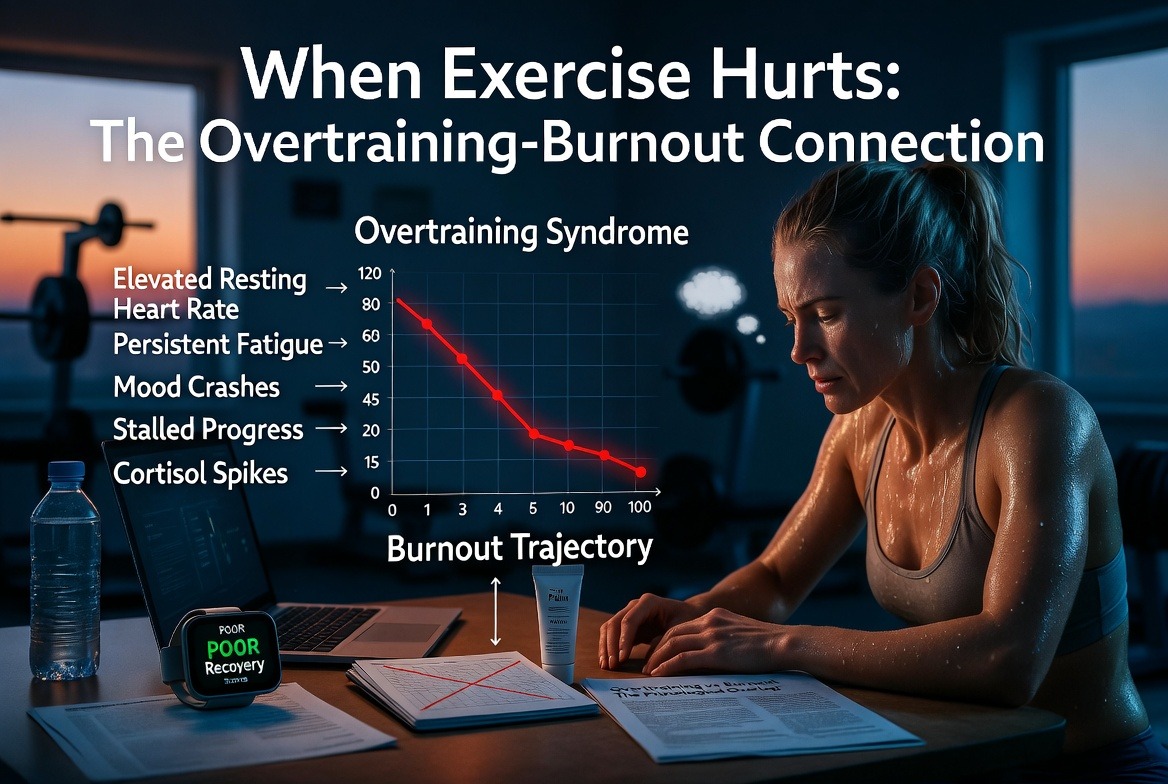
When Exercise Hurts: The Overtraining-Burnout Connection
There's a specific kind of Australian professional who is particularly vulnerable to burnout, and they're probably reading this article while planning their weekend long run. High-achieving, disciplined, goal-oriented — these are the same traits that make someone successful at work and dedicated to fitness. And those same traits can create a deadly feedback loop where overtraining accelerates burnout, and burnout masquerades as "pushing through."
Here's what burnout looks like in an athlete's biometric data. HRV declines over several weeks without returning to baseline. Resting heart rate creeps upward. Sleep quality deteriorates despite increased fatigue. Performance plateaus or declines. Mood becomes irritable. Motivation evaporates. The athlete feels tired but assumes they just need to push harder. They train more. The spiral accelerates.
The crossover with workplace burnout is where things get dangerous. A professional who is stressed at work and overtrained in the gym has no recovery window. Every system is overloaded. The nervous system has no off switch. And because exercise is socially approved — even celebrated — the athlete-burnout victim receives encouragement rather than intervention. "You're so disciplined!" "I wish I had your motivation!" Nobody says, "Your HRV has dropped thirty percent and you're destroying your autonomic nervous system."
The solution is measurement-based training. Not "how do I feel" — because burnout destroys your ability to accurately assess your own state — but "what does my HRV say." Evidence-based coaches use morning HRV to determine training intensity: green zone means go hard, yellow means moderate, red means recover. The same principle applies to work. Your smart ring doesn't know whether your stress is coming from a spreadsheet or a squat rack. It just knows you're stressed. And it can tell you when to push and when to rest.
For Australian professionals who pride themselves on grinding through both work and workouts, this is a hard message. Rest feels like weakness. Recovery feels like laziness. But the data doesn't care about your ego. It only cares about your survival. And the data says you cannot out-train a burnout trajectory. You can only measure it, respect it, and intervene before it's too late.
The Parent Trap: How Caring For Others Destroys Your Own Recovery
There's a population of Australian professionals whose burnout risk is consistently underestimated: parents. Specifically, working parents in dual-income households with children under twelve. Their HRV patterns show a unique signature that researchers have called "compassion fatigue physiology" — a state of chronic sympathetic activation driven not by workplace demands but by the endless, unpredictable, always-on nature of caregiving.
The data is heartbreaking. Working parents show lower HRV than non-parents of the same age, income, and job title. Their nighttime heart rates are higher. Their sleep architecture is more fragmented — not because they sleep fewer hours, but because they wake more frequently to check on children. Their temperature rhythms show the same flattening pattern seen in burnout trajectories, but without the same recovery during weekends or holidays.
Here's what makes parental burnout different from workplace burnout. You can quit a job. You cannot quit your children. The stressor is permanent. The demands are unpredictable. And the cultural expectation — particularly for mothers — is that you should be able to handle it all without complaint.
The statistic that should change how every Australian parent thinks about their kid's sleep is this: parents of children under five lose an average of six months of cumulative sleep over the first five years of parenthood. Six months. Not six months of bad sleep — six months of no sleep at all, scattered in two-hour chunks across five years. That level of sleep debt fundamentally rewires the autonomic nervous system. It lowers baseline HRV permanently unless actively reversed.
The implications for employers are substantial. Parental burnout drives turnover, absenteeism, and presenteeism just as reliably as workplace stress. But most Employee Assistance Programs treat parental stress as a personal issue rather than a workplace one. Flexible hours help. Childcare subsidies help. But the most powerful intervention may be the simplest: biometric awareness that helps parents see when their own recovery has collapsed, and permission to rest without guilt.
For working parents reading this, the message is uncomfortable but necessary. You cannot pour from an empty cup. Your children need you healthy more than they need you exhausted. Your partner needs you present more than they need you productive. And your employer needs you functional more than they need you martyred. Tracking your HRV, watching your recovery score, and honoring your limits isn't selfish. It's the only sustainable way to care for the people who depend on you.
The Pre-Diabetes Connection: When Metabolic Health And Burnout Collide
Here's a connection that most burnout research misses entirely: metabolic health. Specifically, the relationship between chronic stress, insulin resistance, and the slow progression toward type 2 diabetes. Australian professionals are sitting on a ticking time bomb, and most of them have no idea.
The mechanism is cortisol. Chronic stress keeps cortisol elevated. Elevated cortisol tells your liver to release glucose into your bloodstream. Chronically elevated glucose leads to insulin resistance. Insulin resistance makes it harder for your cells to access energy. Lower cellular energy makes you feel exhausted. Exhaustion increases stress. The cycle feeds itself.
This is why burned-out professionals often feel tired no matter how much they sleep. Their cells are starving for energy even while their blood sugar is high. The fuel is in the tank, but the engine can't access it. A smart ring can't diagnose pre-diabetes directly — that requires a blood test — but it can detect the physiological signature. Declining HRV, elevated resting heart rate, disrupted sleep architecture, and poor recovery scores are all associated with metabolic dysfunction.
For professionals in the pre-diabetes range, the burnout risk is magnified. Their bodies have less physiological reserve. Their recovery from stress takes longer. Their nervous systems are already compromised before workplace demands even enter the picture. And because pre-diabetes has no obvious symptoms — you can't feel your insulin resistance — most of them will never know until they either get a blood test or crash completely.
The preventive approach is integrated. Track your HRV. Get your HbA1c tested. Watch your recovery trends. And if the data shows red flags in both metabolic and autonomic markers, intervene aggressively. Dietary changes. Exercise timing. Stress reduction. Sleep optimization. These interventions work for both problems simultaneously because the problems are connected. Fixing one helps fix the other. Ignoring both guarantees the trajectory ends in crisis.
What Your Smart Ring Sees That Your Brain Refuses To Accept
We've covered a lot of ground. HRV science. Burnout trajectories. Gender differences. Remote work effects. FIFO patterns. Alcohol's impact. The limits of healthcare. Student mental health. Climate change. Overtraining. Parental exhaustion. Metabolic dysfunction.
Through all of this, one theme emerges consistently: your body knows before your brain does. Your HRV declines weeks before you feel tired. Your resting heart rate creeps upward months before you crash. Your temperature rhythm flattens, your sleep architecture collapses, your recovery score plummets — and through it all, you tell yourself you're fine. Everyone's tired. It's just a busy season. You'll rest next month.
Your brain lies to you. Not maliciously. Not intentionally. But because your brain evolved to prioritize short-term survival over long-term health. Because admitting you're burned out feels like admitting weakness. Because the culture of Australian professional life celebrates grinding and stigmatizes resting. Because the people around you are also lying to themselves, and their lies reinforce yours.
Your smart ring doesn't lie. It doesn't care about your ego, your deadlines, or your social standing. It just measures. And those measurements — if you're willing to look at them — can save your career, your health, and maybe your life.
Read more from our blog about the specific strategies that high-performing professionals use to catch burnout early, intervene effectively, and build sustainable careers without destroying their nervous systems. The research is clear. The technology exists. The only remaining question is whether you'll start paying attention before your body forces you to.



%402x.svg)